11.5.2023 [archived ~ originally published 10.10.2018]
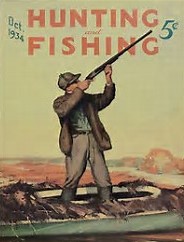
Hunting and Fishing Magazine Oct. 1934
That headline appeared on the front page of the Bigfork Times on October 24th, 1930, and was about a large flock of ducks. “While driving on the Craig Road between Kinney and Craig last Sunday evening, Ed Johnson, the local garage mechanic, had a curious experience.
A flock of from forty to fifty ducks blockaded the road, and apparently bewildered by the headlights of the car, refused to give him the right-of-way. Knowing the fishy eye that would greet him were he to relate this to his friends without corroborative evidence, Ed captured a pair of the ducks and now has them at his home here alive.
Several theories have been advanced for the strange actions of this flock. Some say that flying a long distance through snow and sleet of Sunday evening probably drove them to the ground from exhaustion. Others contend that the birds mistook the road bordered with snow, for a river and after discovering their error decided to camp there for the night.
Mansel Saunders inclines to the belief that the ducks may have stopped off at Craig and were unable to navigate further than Kinney. While Mr. Saunders knows of no instance where this has happened to ducks, he says that he has personal knowledge of several cases where other birds have acted strangely after a short stop-over in Craig.
Be that as it may, Ed has the evidence but doesn’t know whether he is allowed to keep them after the close of hunting season or not.”
A different fluke of nature, two years earlier enabled hunters to get their limit, on opening day in a very short time.
First to Get Limit ~ Itasca News 9-20-1928
“Paul O’Groskie and George H. Herreid set a brand new style for opening the hunting season when they started out last Sunday morning.
Some folks drove hundreds of miles. Scores of local hunters worried for a week over where they should go to get mallards. Resorts near the duck passes were packed with guests. Hunters crowded each other off the favorite points. Some went at midnight to get a favored position.
But Paul and George put on their hip boots, walked just outside the village limits to the latter’s farm, began blazing away at 5:22 am and came back at 6:50 am with the limit for both, just an even two dozen ducks.
We’ll put that story up against anything else that happened!
But it’s the gospel truth. The high stage of water along the Deer River has flooded the fields for a week. The ducks flocked in to pick grain from the stubble. They were easy picking.”
1903 ~ Early Duck Hunting
Even in the very early days of recreational hunting, there was a limit to the number of ducks one person could get, but it evidentially was difficult to enforce. In 1903 the season for hunting waterfowl in Minnesota was from September 1st to December 1st, with a daily limit of 25 birds. The Itasca News reported at the end of October 1903, a party getting 1700 ducks!
“The Duluthians comprising the Bowstring Club, at the head of which is Dr. W.H. Magie, are dropping the birds as they never did before. Next week the club will entertain George H. Crosby and George H. Crosby Jr., H.R. Spencer and two sons of Duluth.
The following is taken from the Duluth News Tribune:
The sportsmen who are returning from the Bowstring country give glowing accounts of the duck shooting. It is said that the Dr. W.H. Magie party killed 1,700 ducks during their trip. One of the hunters is credited with having killed 92
in an hour without moving from his place of concealment on the shore. The shooting has thus far been largely of bluegills, although there are also many of the red head variety.”
The Resorts with a History series explained that many of the first resorts in northern Itasca County were fishing and hunting lodges. George Tibbetts place is one of the first references to such a resort that I have found.
“A new hunting lodge has been opened up at the old John Lyons place on Cutfoot Lake by George Tibbetts. This is one of the best passes for duck flights in the northwest, and if anyone in these regions know the game, it is the Tibbettses. George has everything the hunter or fisherman may desire besides a stopping place, and if any sportsman cannot get his share of the game, the proprietor will see that he does not go away without trophy as that would be a poor ad for the place. Mr. Tibbetts reports millions of local ducks waiting now around his door to be shot when the season opens, Sept. 16th.” [Itasca News 9-6-1919]
1923 ~ Conservation & Cautions
By 1923, the season was shortened to Sept 16th to December 1st, the daily limit was 15, and a season limit of 135 ducks.
The following articles do not proclaim any usual records but do illustrate a few interesting aspects of hunting in the early 1920s.
Drowning ~ “On Tuesday morning while a crowd of duck hunters were out at the various passes on
Cutfoot River, a boat containing three of the party swamped, two of the occupants drowning and the
third being saved after an hour’s battle in the icy water. The drowned are Henry Drummond, of Milwaukee, who is connected with the foreign trade of the Cudahy company; and Edward Knutson of Two Harbors. David Drummond, of Duluth, brother of Henry, was the rescued man.” [Itasca News 10-28-1922]
Banding ~ “While shooting ducks on the White Oak bottoms the first of the week, H.G. Seaman shot a female mallard having a metal band on its leg. There was no date on the metal, but on one side of it was stamped, ‘230846 Notify Biol. Sury.’ And on the reverse side ‘Wash. D.C.’ Mr. Seaman sent the band in.” [Itasca News 9-22-1923]
Accidental Death ~ “At Cut-foot Sioux, Thursday morning, where Harry Warren and wife of Hibbing had been hunting ducks, Mr. Warren had cleaned his shotgun, worked the lever several times to ‘limber it up,’ put it in the case and then tossed it in the car. The shotgun discharged, and the fineshot hit Mrs. Warren in the breast about the heart as she was coming out the shanty door, killing her instantly.
Undertaker W.A. Herreid was called and laid out the body. The remains taken by car, were half way to Deer River when a hearse after the body was met from Hibbing and transfer was made, the hearse leaving Deer River on the return at about 3 o’clock.
Mr. Warren is in the garage business at Hibbing, and his family is prominent in that city. Mrs. Warren was about 29 years of age, and besides the husband, leaves four children.” [Itasca News 9-22-1923]
Injury ~ “Duck hunting lots of fun, but somehow shotguns and boys don’t seem to mix any better than ‘moonshine and gas’ as two boys are just finding out as shots are being picked out of their bodies.
While at the game on White Oak Sunday, Joe, son of C.F. Johnson, and Roy, son of Earl Cooley, had their guns loaded long before the hunting place was reached and ready to go off – and one in the boat did this while they were portaging. While Joe got an armful, both are expected to come out all right says, Doc Dumas. And anyway, ‘taint no fun staying out of school steady.’” [Itasca News 10-27-1923]
 chrismarcottewrites
The story about the ducks in the road was hoot, or should I say, quack!
LikeLike
This was most interesting. My family were all duck hunters. I received a request from a friend, Lois Jenkins, who do es a lot of work with the Beltrami History Center. She is working with a college student on POW during WWII and would either like to visit with you or have the student talk to you.She has my Cutfoot notes and a story I received from a family living in Finland about their WWII experiences with their farm.I’m in the Cities now and will phon you to check . Happy Fall!P
LikeLike
Lois’ name is familiar! I might have met her when I have done research in Bemidji. Here’s my email address chrismarcottewrites@gmail.com. You can share it with her. Also, I would love to hear the story you have about the Finnish family in WWII.
Chris
LikeLike