Hallmark Worthy Stories

12.24.2023

This article is inspired by Virginia (Custer) Wass, a long-time Bigfork reader of Reminisce. Virginia shared with me an interesting story about her friend, Nanci Zeine, and a greeting card Zeine has exchanged with friends for thirty-one years! And yes, the card just happens to be a Hallmark. I have chosen a few other heartwarming anecdotes spanning over one-hundred twenty-five years, that are perfect for the holidays.

Adoption of the Maule Children ~ 1897

In early March 1897, Minnie Maule, wife of Alex died leaving five children. The couple, both born in Michigan, had married and recently moved to Itasca County. Alex knew he could not provide adequate care for the children and asked if there were any community members who would like to adopt them.

A month later petitions were filed in the district court for the adoption of the four youngest. Alex wanted ten-year old Harvey to stay with him. The adoptions went through as follows:

~ William and Edith Goodchild, for Laura age six years

~ George and Mary Johnson, for Grace Belle, age four years

~ William and Matilda Gibbs, for Stanley Adelbert, age three years

~ James and Amelia Woodward for Andrew Buchanan, age sixteen months

Alex moved with his son, Harvey, to Port Hope, Beltrami County, where his brother’s family lived. The Johnsons, and the Gibbs resided in the Deer River area,

Grace Johnson may have been a teacher as she attended college for two years. In June 1915, when she was twenty-three, she married Harold Peck, a salesman from Shakopee, MN. They operated a dairy farm in rural Deer River where they raised two daughters, Patricia, and Virginia.

Stanley Gibbs was a businessman like his father and built up the wild rice operation started by William. He married Harriet Strom in 1915 and they raised their eight children, sons Stafford, William, Stanley, Gordon, Darrow, and Delano and two daughters, LaDonna and Ramona in Inger.

Missed the Titanic Disaster ~ 1912

RMS Titanic was a British passenger liner operated by the White Star Line. She sank in the North Atlantic Ocean on April 15, 1912, after striking an iceberg during her maiden voyage from Southampton, England, to New York City. Of the estimated 2,224 passengers and crew aboard, more than 1,500 died, making it the deadliest sinking of a single ship up to that time. It remains the deadliest peacetime sinking of an ocean liner or cruise ship. I have found two circumstances where individuals, who later settled in our community, had intended to be on the Titanic. Lucky for them, fate intervened.

But first, a bit of background information. Third class, also known as steerage, is the least expensive ticket on the Titanic. The cost per person was $35. The third class was occupied by 709 immigrants leaving Europe for America. In all there were four options for the passengers. Second class was $60, a first-class berth was $150, and the deluxe first-class suites were $4350.

It was believed that “A colony of Finlanders were coming to settle on land in the vicinity of Duluth probably perished on board the Titanic when she took her fatal plunge. The colony consisted of twenty-five families, in all 110 people. They were being brought here by a Finnish Colonization association.” [Unk Duluth paper 4-17-1912]

Miriam (Hokkanen) Payne shared this story about her father John Emil Hokkanen who at the age of twenty-five planned to immigrate to the United States in 1912. “He left Finland for Glasgow, Scotland and attempted to book passage on the Titanic but declined due to the cost. Taking another ship, he arrived at the Port of New York aboard the vessel Caledonia later in April 1912. He went to Brooklyn to the home of his sister Laina, who was his sponsor. What a surprise!  She thought he had died on the Titanic. So isn’t it a blessing he didn’t book passage, I wouldn’t be here.” [interviewed by Elmer Mattila 9.16.1996] John married Hendrika “Henny” Rutanen in 1915 in St. Louis County and by 1920 they lived at Bass Lake. The couple raised four daughters.

Twenty-two-year-old Hilma Peltola had arrived from Finland too late to board the ill-fated Titanic. Her trunk had been shipped from Finland, placed on the Titanic, and was lost. She had her spinning wheel with her and departed from Liverpool aboard Empress of Britain and arrived in St. John, New Brunswick, Canada April 27, 1912. From there, Hilma made her way to her destination—Deer River. Four months later she married August Kuusela. Hilma and August had six daughters and a son.

Treasured Diamond Ring Recovered ~ 1935

Jewel Recovered After Long Time ~ 12-4-1935 Grand Rapids Herald-Review

“Mrs. F.M. [Pauline] Williams of Cutfoot Sioux now has her diamond ring valued at several hundred dollars which she lost last May. The ring was recovered in Minneapolis through cooperation on the part of Sheriff Elmer Madsen and the police authorities in Minneapolis.

When the ring disappeared last spring, authorities were not notified as Mrs. Williams believed she would be able to recover the jewel. However, as time passed and no trace of the ring was found, the authorities were called in. Sheriff Madsen was notified of the probable theft of the ring on November 21. Certain circumstances led him to believe that the young girl suspected of purloining the ring had gone to Minneapolis and he took up the trail in that city with good results. Saturday, he returned with the ring in his possession.

The young woman who had taken the ring had attempted to sell it in Minneapolis. She had received ten dollars and was promised an additional ten dollars which she had not yet collected. The suspect in the case confessed to Mr. Madsen of her part in the affair and found the pawnshop where she had disposed of the ring. This was the Smilow Loan Office on Washington Avenue. The office had no record of the ring but the young woman in the case, identified Tom Bailey, an employee at the Smilow Loan Office as the man to whom she disposed of the ring. Detectives in Minneapolis searched his apartment and found it to be crowded with all kinds of goods, jewelry, and apparel. Among the jewelry was the diamond ring that started the investigation.

Because of her youth and because this is apparently the first time she has been in any sort of trouble, authorities are withholding the name of the young woman who took the ring and later pawned it for a small sum. She will be placed on probation.”

An Enduring Anniversary Card  

In 1993, Nanci Zeine sent a card to a good friend Kay and her husband Michael Aldridge, for their 11th anniversary, which was on December 23. The message on the front of the card read “Happy Anniversary to a Perfect Couple,” and the inside message read “And You Can Send This Back to Us If You Want.”  

Nanci and Roger’s 19th anniversary was just a few days later, on December 28, so Kay found an envelope that fit the card, added an anniversary message of her own, and sent it to the Zeines.

That was the beginning of the enduring anniversary card. “And then we just kept going!” Zeine said. “We eventually ran out of places to write a personal note, so a few years ago, I inserted blank cardstock to the center of the card.” With a laugh, she added, “The only problem is that we are always looking for an envelope to send it in.” A few years ago, the card went missing on its way from Arlington’s to Zeine’s. Much to both couples’ relief, it arrived in Bigfork in mid-February.

An hour after Zeine relayed this to me, I stopped to visit a friend, and shared her extraordinary story. Much to my surprise, another guest in their home told me he and his wife had been exchanging a similar anniversary card with another couple for forty-one years!

I reached out to Hallmark in hopes of learning more about the …and you can send this back, type of card. I wondered if they had a line of such cards, encouraging it to be exchanged again, for anniversaries, birthdays, and maybe other holidays. I also enquired as to the number of years they had offered them, and if, as with this one, they were all printed on recycled paper.

I did not get a response, but of course learned a few facts about Joyce C. Hall, founder of Hallmark Cards, Inc. “Joyce Hall was born in 1891 in a small town in Nebraska. At the age of sixteen, he and two older brothers started a postcard company and eventually went to Kansas City, Missouri.

In 1923 they formed Hall Brothers, Inc., the predecessor of today’s Hallmark. Joyce wanted to replace Hall Brothers on the back of greeting cards with the phrase, “A Hallmark Card.” When others said advertising was a waste of money, he began creating and placing ads, and established Hallmark as the most recognizable brand name in the industry. In 1966, Joyce stepped aside as chief executive officer in favor of his son, Donald J. Hall. Currently, Joyce’s grandsons Donald J. Hall, Jr., and David E. Hall lead the company’s board of directors.

[https://corporate.hallmark.com/about/hallmark-cards-company/history]

I wonder if Hallmark considered how this type of card if it was sent back and forth might affect their sales. In the case of Zeine and her friends, they would have purchased sixty-one cards between them since 1994, but instead have only bought one!

Happy 41st anniversary to Kay and Michael (Dec 23) and to

Nanci and Roger on their 49th anniversary December 28

I am taking a short hiatus from writing the Reminisce column so that I can pursue other writing projects. Look for it in the early summer 2024. As always, archived columns are published every Sunday on my blog: chrismarcottewrites – An 1897 family ax murder brought out the writer in me

Forgotten Postmarks ~ Pinetop 1901-1920

12.3.2023 [archived ~ previously published 12.14.17]

Blackduck in about 1902 ~ town where Will and Lucy Buentemeier got off the train before making their way to Pinetop

Pinetop, it was at the crossroads of two old tote roads, a couple of miles east of Moose Lake in Grattan Township, northern Itasca County.  Or was it nine miles east of Northome in southern Koochiching County?  Actually, there were two communities named Pinetop in Minnesota for some years until the former was changed to Grattan.  And this was the Pinetop that Lucy Buentemeier recalls as a newly married bride.

“We came here on our honeymoon in March of 1902. It was some honeymoon!  At that time the head of the railroad was at Blackduck.  There was no depot here.  The rails only stopped there.  We came as far as Blackduck by rail, got a team and sled to bring our stuff as far as Bridgie on an old tote road. 

From there we walked around by way of Swallow Point on the north shore of Island Lake, around the east side of Island Lake, then east to the south side of Moose Lake, then north along the east side of Moose Lake until we hit the government survey line which we followed east to our homestead.” [From Northwoods Pioneers, edited by Robert S Porter 1980. Work Projects Administration, Minnesota Papers, 1849-1942, Interviews and Biographical Sketches, Minnesota Historical Society, St. Paul, Minnesota.]

Lucy Gill and William Buentemeier married in Minneapolis, and though only seventeen, Lucy was ready for the adventures of homesteading.  William had previously filed a claim, but the homestead building was very primitive. It was a lean-to of wood logs covered with cedar bark.  The roof extended clear to the ground on the north side.  The east and west ends were then covered with smaller logs and bark, while the whole south side was left open.

That year was filled with many challenges.  Together Lucy and Will finished a small log home, and started a makeshift garden. “…we planted potatoes and peas.  Will carried the potatoes on his back from Blackduck.  They cost five dollars a bushel. We had very little open land at that time, so to save planted a hill of spuds and then a hill of peas, and we have never raised a better crop of either than we raised that first year.

Soon after we came here Mother sent me up a few chickens.  They came to Vance’s by way of Bena.  Will walked down there to get them, and brought them home on his back in a wash boiler.  There were two eggs in the boiler when he reached home.  We fed them on wild rice.”

In March of 1903, Elizabeth was born. She was followed by four brothers and two sisters.  Rosy, the youngest was a leap year baby.  As the family grew, so did the Buentemeier’s commitment to the community.  In 1904, three years after a post office was established at Pinetop, William was appointed postmaster.  Previous postmasters had been Jefferson Sherman, 11-26-1901; Charles Wirt, February 2, 1903; and Minnie Folsom, May 26, 1903.

Chances are Will and Lucy ‘shared’ the responsibility since Lucy stated she was the postmistress!  “On Jun 24, 1904 I was appointed postmaster.  The post office was in our house and known as Pinetop post office.  The first post office here used to serve the territory as far south as Frank Vance’s on the Popple River.  The name changed to Grattan post office some time during the first world war.”

Officially, Lucy was appointed postmistress on April 11, 1914 and remained so through the name change to Grattan in September 1920.  The USPO ledger documents the name change, but there is not a new entry with appointment data.  Previously, Lucy’s occupation was listed as postmistress in the census, but in 1930, no occupation is stated. The Grattan office closed in 1935, and mail went to the long-established post office in Northome.

Daughter Elizabeth Buentemeier remembers that in 1913 there were enough children for a school, three of them being from her own family.  “School was first held in a very small log cabin shack, located a short distance east of the Martin Torkelson farm home.  Miss Stella Whipple was the first teacher.  It was heated by the use of a box type cast iron stove.  We had benches made from rough boards…Another [school building] was being built on the Alfred Pierson land by neighbors, a mile west of the present site. 

About mid-winter, Miss Whipple and pupils moved to this newly constructed log school, called Pinetop.”  [Pinetop vertical file ~ Itasca County Historical Society.]    A frame school was built in 1920 and named Grattan.  The last time Pinetop appeared on an Itasca County map was probably the 1916 plat. On current maps, the location is approximately where County roads 26 and 31 meet at the corner of sections 9, 10, 15 and 16.  

According to Elizabeth other early individuals and families at Pinetop include: “Ricroft and Alex Fenton, Arthur Lacher, Willis McCrady, Alfred Pierson, Joseph Plemel, Joseph Ecenroad, George and John Sencerbox, Anton Sterle, Tim and Maurice Pendergast, John Skully, Olaf Holm, James and John Meyers, Art Bowers, Charles Cross, Sam Reed, Frank Drobnick, and EG Baily.”

In the interview done with Lucy in the 1940s, she shared some interesting facts about Indian artifacts.  “When we came here there was an Indian village just across the brook from the house.  We found a great number of stone arrowheads and other items there. 

One of my boys found a copper spearhead there a few years ago.  It was pounded from pure copper and was so hard it could not be touched up with a file.  It was 14 ¾ inches long.  The upper end had been pounded out flat, then bent around to form a socket for a handle.  This he sold to the State Historical Society for $25.  Prof. Jinks from the State University said he had never run across anything like it in this country before.  The village site was on the west bank of Moose Brook in sec 15, 150-27.

The old Hudson’s Bay Trail used to run just west of here about three-fourths of a mile. The Indians used it a great deal in the early days.  They used to go south to get to Frank Vance’s place.  I don’t know just where they left it to get there, as it went farther west from Vances.”

“Held at Anderson Prison” ~ Itasca County Civil War Vets

10.11.2023

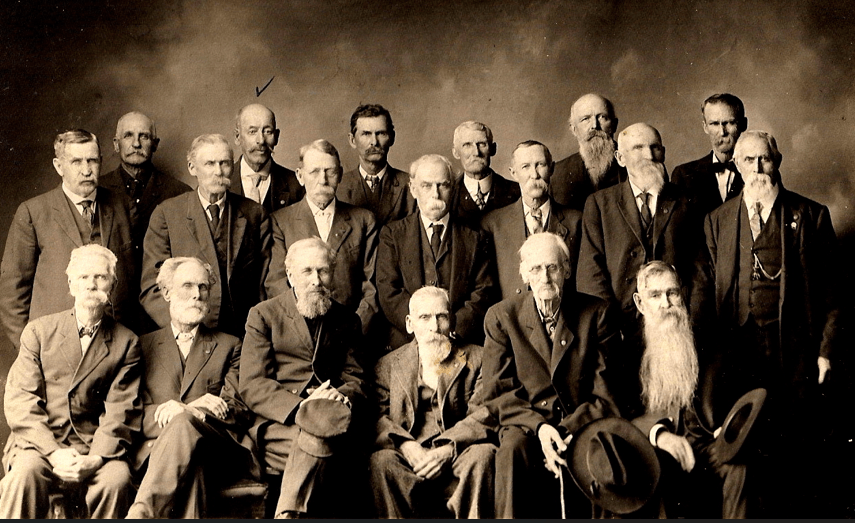
Civil War veterans residing in southern Iowa. Among them are Daniel Figgins and Josiah Mostoller. Figgins is my great grandfather. Figgins and Mostoller descendants settled in Itasca County. [Collection of Chris Marcotte]

During the time of the Civil War, Itasca County was very large. When Minnesota became a state, Itasca included the counties we now know as Cook, Lake, Saint Louis, Koochiching, eastern Lake of the Woods, eastern Beltrami, Itasca, northern Aitkin, and northern Carlton. According to the 1860 United States census, there were just over fifty white people enumerated in Itasca County. There are no records I have located on ancestry.com that indicate any men living in Itasca enlisted in the Civil War. But there were a handful of men who served and resided in the area later in life. I found the names of ten men, all of whom were identified as Union soldiers in the war between the states.

The men represented a cross-section of experiences, including enlisting at a young age, enlisting as a substitute, being wounded, being a prisoner of war, capturing a Confederate spy and participating in Sherman’s March to the Sea. The soldiers are listed as to when they came to our area.

Samuel W. Thomas ~ White Oak 1893

“Samuel Thomas was born at Bellevue, Ohio, in December 1846. He grew to manhood there, and on February 2, 1865, he enlisted for the remainder of the Civil War in Company G of the 188th Regiment Ohio Volunteer Infantry. He was mustered out with his company at Nashville, Tenn., Sept 22, 1865.

He came to Deer River about 37 years ago, as near as can be learned, and clerked in a store owned by the late F. L. Vance, one of the first ever established here. This community has since been his home.” [Deer River News 8-14-1930]

In September 1926, Thomas was issued the first small game hunting license in Deer River. “Mr. Thomas is an ardent sportsman of the proper type, and for his years retains wonderfully well his ability with a gun. His home on White Oak Point is located near some of the best shooting grounds in this section, and Mr. Thomas will no doubt bag his full quota this season.” [Itasca News]

When he was 84 years of age, Thomas moved into Deer River, living at the Miller Hotel. He died there on Sunday, August 9, from a self-inflicted bullet wound. He is buried at Olivet Cemetery.

John E. Seaman ~ Wirt 1894

“John Seaman was born in Monmouth, Ill., in April 1846. He grew to manhood in Pewaukee, Wis. When only 17 years of age, he enlisted in the Union army and fought in the Civil War. As a member of the 32nd Wisconsin Volunteer Infantry, he went with Sherman on his historic “March to the Sea,” and had the distinction of having captured the first Confederate spy found in the Sherman army.

In 1894, Mr. Seaman came to Itasca County, homesteading 2½ miles east of Wirt, where he lived at long intervals until 1912. He was prominently identified with the pioneer life of that section. He never lost his love for the region, and practically every year has spent a few weeks here enjoying its outdoor sports.” [1-3-1929 Deer River News]

The year before Seaman died, he was living in White Bear Lake and brought into that local newspaper office a map he had, which showed General Sherman’s famous “March to the Sea.”  The map had been drawn by a buddy, J.B. Tripp, also of the Wisconsin infantry. Both men were members of the band for the company when there were not active battles. John died at a hospital in St. Paul at the age of 82.

James Everton ~ Deer River 1894

James Everton is the only one of the Civil War soldiers I found living in our area who was born in Canada. By the time he was 20, Everton had immigrated to Michigan, and in 1861, he enlisted in Company A, 11th Regiment, MI volunteer as a teamster. He was wounded at Missionary Ridge when a bullet entered his arm about eight inches below the shoulder. After a lengthy hospitalization, he was pronounced fit for duty and re-joined his company. Less than a month after he mustered out in September 1864, Everton married Rosanna Steinhoff at Burr Oak, MI.

On the 1890 United States Veterans Schedule, the Everton family is living in Roscommon, Michigan. It was shortly after this that they moved to Deer River and built the Everton Hotel. He was appointed postmaster of Deer River on 8-24-1894 and served until 7-22-1897. Everton died in 1909 at the age of 69 and is buried in the Old Soldiers Cemetery in Grand Rapids.

David Charles Cochran ~ Wabana 1895

David Cochran has been referenced in a few Reminisce articles. He was born in Maine in 1845 and enlisted in the Army of the United States for one year in 1864 as a substitute for Reuben L. Pierce. Pierce paid “a sufficient consideration,” and Mr. Cochran signed the papers with his own mark. His age was stated as 18 years, and he was assigned to Co H 9th Regiment Maine Infantry. He saw three years active service in the Civil War where he was seriously wounded in battle and was mustered out May 24,1865.

Cochran married and raised a family in Maine, moving to Wisconsin in about 1875. Seventeen years later, he settled in La Prairie, Itasca County, where he lived for several years. In the late 1890s he built and managed a popular summer resort on the south end of Wabana Lake. In 1900 Cochran was listed as a farmer living near the lake with his second wife Margaret, their three children, and a son from his previous marriage. Cochran died in 1924 at the age of 79 and is buried in the Old Soldiers Cemetery in Grand Rapids. He was one of the few surviving members of the Grand Army of the Republic (GAR) and was given the traditional salute by a firing squad of local legionnaires.

John Benjamin Rahier ~ Effie 1902

John Rahier lived the longest of these soldiers. He was born in Wisconsin in 1840. On 11-26-1863 he enlisted in the US Navy and was discharged in December the following year. After the war, he moved to Wright County, Minnesota, married Mary Maurice and raised a family of fifteen children. Mary died four months after the birth of their last child in 1891. John married Celina Bastian 1896 and fathered three more children.

In1902 Rahier, his wife, and a good number of his children moved to the community of Effie where land was available to homestead. When he applied for a pension in1915, he explained his injuries. “In swinging a nine inch gun, the gun slipped and ruptured my left gland and bruised a hip at the same time which has been with me ever since – and also at Alexander Lusa, on the Red River, the Mound City went aground hitching a tug to her, the wratchet slipped and wounded nine of us, and broke my collar bone which was never set back.” [Civil War Veterans of Itasca County by Robert Anderson]

Rahier died in 1924 at the age of 86 in Bigfork and was buried in the Woodlawn Cemetery, Annandale, Wright County, Minnesota.

Nathaniel Thompson Robertson ~ Max 1903

Nathaniel Robertson was born in Greene, Tennessee on May 20, 1845. He enlisted in September 1863 at the age of 18, signing the enlistment papers with an X.

“Nathaniel was part of the Company C 4th Regiment Tennessee Infantry when he was reported missing from the Post Hospital. His telling of the story was much more interesting, however. He said he was taken captive by Confederate soldiers and that he had escaped Anderson Prison under a load of dead bodies. When he applied for a pension, he declared he had injured his leg in the war, but his family understood that he had fallen out of a wagon as a youth and broken his leg; thus, one leg was shorter than the other.”

According to the documents in the military archives of ancestry.com, his capture date was 8-6-1864 in McMinnville, Tennessee and that he was taken to Anderson Prison. “As a memento of the war, he had a .44 gun with a powder horn and bullet mold that he used to make bullets from hot lead. Nathaniel was married twice and had five boys and two girls. One of the boys died at two years old.  The youngest boy Albert had asthma, and they needed to move from Missouri to a different climate.

In 1903 Nathaniel and his sons visited Max to file for homesteads. In 1907 the entire family came to stay, bringing all their animals and furnishings by covered wagon from Missouri.” 

Robertson died on November 29, 1921, at the age of 76 and is buried at the Pine Grove Cemetery near Max. [Italicized notes from There’s No Place Like Max written by Bernard “Bud” Anderson.]

“He was a member of the G. A. R. [Grand Army of the Republic] The burial was in Mack Cemetery which is one of the spots of greatest natural beauty in the state of Minnesota. On the hill with the large green trees all about, the firing squad, and the colors on the casket, and taps sounded, the body of the veteran was laid to rest.” [Itasca News 12-10-1921]

Alanson Allison Byers ~ Jessie Lake 1914

Alanson Byers was the youngest of these men to enlist. He was born in Ohio in 1845 and joined the Co. G 44th Regiment Ohio Volunteer Infantry when he was sixteen. In January 1864, he was transferred to the Calvary Division. Byers and his first wife Mary, had six children including John, born in 1867. The Byer family moved from Ohio to Texas.

In about 1914 John Byers and his family moved to Jessie Lake. Alanson, nearly 70, and his second wife Sarah, also moved to the area. Alanson died in 1918 and is buried at Greenwood Cemetery at Jessie Lake.

~ ~ ~

Other Civil War Soldiers that I found mention of, but very little additional information about were: Burkhart Berger ~ Third River; Thomas B. Miller ~ Deer River; and Frank Van Dresser ~ Third River.

“This is Not a Fish Story”

11.5.2023 [archived ~ originally published 10.10.2018]

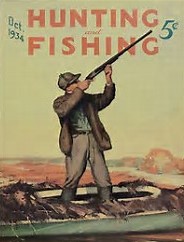
Hunting and Fishing Magazine Oct. 1934

That headline appeared on the front page of the Bigfork Times on October 24th, 1930, and was about a large flock of ducks. “While driving on the Craig Road between Kinney and Craig last Sunday evening, Ed Johnson, the local garage mechanic, had a curious experience.

A flock of from forty to fifty ducks blockaded the road, and apparently bewildered by the headlights of the car, refused to give him the right-of-way.  Knowing the fishy eye that would greet him were he to relate this to his friends without corroborative evidence, Ed captured a pair of the ducks and now has them at his home here alive.

Several theories have been advanced for the strange actions of this flock. Some say that flying a long distance through snow and sleet of Sunday evening probably drove them to the ground from exhaustion.  Others contend that the birds mistook the road bordered with snow, for a river and after discovering their error decided to camp there for the night.

Mansel Saunders inclines to the belief that the ducks may have stopped off at Craig and were unable to navigate further than Kinney.  While Mr. Saunders knows of no instance where this has happened to ducks, he says that he has personal knowledge of several cases where other birds have acted strangely after a short stop-over in Craig.

Be that as it may, Ed has the evidence but doesn’t know whether he is allowed to keep them after the close of hunting season or not.”

A different fluke of nature, two years earlier enabled hunters to get their limit, on opening day in a very short time. 

First to Get Limit ~ Itasca News 9-20-1928

“Paul O’Groskie and George H. Herreid set a brand new style for opening the hunting season when they started out last Sunday morning.

Some folks drove hundreds of miles. Scores of local hunters worried for a week over where they should go to get mallards.  Resorts near the duck passes were packed with guests. Hunters crowded each other off the favorite points.  Some went at midnight to get a favored position.  

But Paul and George put on their hip boots, walked just outside the village limits to the latter’s farm, began blazing away at 5:22 am and came back at 6:50 am with the limit for both, just an even two dozen ducks.

We’ll put that story up against anything else that happened!

But it’s the gospel truth. The high stage of water along the Deer River has flooded the fields for a week.  The ducks flocked in to pick grain from the stubble.  They were easy picking.”

1903 ~ Early Duck Hunting

Even in the very early days of recreational hunting, there was a limit to the number of ducks one person could get, but it evidentially was difficult to enforce.   In 1903 the season for hunting waterfowl in Minnesota was from September 1st to December 1st, with a daily limit of 25 birds.  The Itasca News reported at the end of October 1903, a party getting 1700 ducks!

“The Duluthians comprising the Bowstring Club, at the head of which is Dr. W.H. Magie, are dropping the birds as they never did before.  Next week the club will entertain George H. Crosby and George H. Crosby Jr., H.R. Spencer and two sons of Duluth. 

The following is taken from the Duluth News Tribune:

The sportsmen who are returning from the Bowstring country give glowing accounts of the duck shooting.  It is said that the Dr. W.H. Magie party killed 1,700 ducks during their trip.  One of the hunters is credited with having killed 92

in an hour without moving from his place of concealment on the shore.  The shooting has thus far been largely of bluegills, although there are also many of the red head variety.”

The Resorts with a History series explained that many of the first resorts in northern Itasca County were fishing and hunting lodges.  George Tibbetts place is one of the first references to such a resort that I have found.

“A new hunting lodge has been opened up at the old John Lyons place on Cutfoot Lake by George Tibbetts.   This is one of the best passes for duck flights in the northwest, and if anyone in these regions know the game, it is the Tibbettses.  George has everything the hunter or fisherman may desire besides a stopping place, and if any sportsman cannot get his share of the game, the proprietor will see that he does not go away without trophy as that would be a poor ad for the place.  Mr. Tibbetts reports millions of local ducks waiting now around his door to be shot when the season opens, Sept. 16th.” [Itasca News 9-6-1919]

1923 ~ Conservation & Cautions

By 1923, the season was shortened to Sept 16th to December 1st, the daily limit was 15, and a season limit of 135 ducks.  

The following articles do not proclaim any usual records but do illustrate a few interesting aspects of hunting in the early 1920s.

Drowning ~ “On Tuesday morning while a crowd of duck hunters were out at the various passes on

Cutfoot River, a boat containing three of the party swamped, two of the occupants drowning and the

third being saved after an hour’s battle in the icy water.  The drowned are Henry Drummond, of Milwaukee, who is connected with the foreign trade of the Cudahy company; and Edward Knutson of Two Harbors.  David Drummond, of Duluth, brother of Henry, was the rescued man.” [Itasca News 10-28-1922]

Banding ~ “While shooting ducks on the White Oak bottoms the first of the week, H.G. Seaman shot a female mallard having a metal band on its leg.  There was no date on the metal, but on one side of it was stamped, ‘230846 Notify Biol. Sury.’ And on the reverse side ‘Wash. D.C.’  Mr. Seaman sent the band in.” [Itasca News 9-22-1923]

Accidental Death ~ “At Cut-foot Sioux, Thursday morning, where Harry Warren and wife of Hibbing had been hunting ducks, Mr. Warren had cleaned his shotgun, worked the lever several times to ‘limber it up,’ put it in the case and then tossed it in the car.  The shotgun discharged, and the fineshot hit Mrs. Warren in the breast about the heart as she was coming out the shanty door, killing her instantly.

Undertaker W.A. Herreid was called and laid out the body.  The remains taken by car, were half way to Deer River when a hearse after the body was met from Hibbing and transfer was made, the hearse leaving Deer River on the return at about 3 o’clock.

Mr. Warren is in the garage business at Hibbing, and his family is prominent in that city.  Mrs. Warren was about 29 years of age, and besides the husband, leaves four children.” [Itasca News 9-22-1923]

Injury ~ “Duck hunting lots of fun, but somehow shotguns and boys don’t seem to mix any better than ‘moonshine and gas’ as two boys are just finding out as shots are being picked out of their bodies. 

While at the game on White Oak Sunday, Joe, son of C.F. Johnson, and Roy, son of Earl Cooley, had their guns loaded long before the hunting place was reached and ready to go off – and one in the boat did this while they were portaging.  While Joe got an armful, both are expected to come out all right says, Doc Dumas.  And anyway, ‘taint no fun staying out of school steady.’” [Itasca News 10-27-1923]

“Angel of Death” ~ Burials 1898-1918

10.29.2023 [archived ~ originally published 8.23.2018]

This photograph was taken at the funeral of my third-great-grandfather who was murdered in 1897 in Howard Lake, Minnesota.  The funeral was very large and held at the homeplace. They are getting ready for three-mile procession to the cemetery.

Most of us living in the northern rural communities known where a body or two is buried, marked by a large stone, or perhaps an old oak tree. Or with time, no marker at all.  These are members of the very early families who either couldn’t afford a burial in Grand Rapids or didn’t want their loved ones so far away. 

When the village of Deer River organized in 1898, there were no morticians, cemeteries, or churches.  When someone died, the family did the laying out of the body, built a casket and arranged for nearby clergy, or family, to provide a service.  Of the first three deaths recorded in the Itasca News, one does not mention a cemetery, the other two were buried in Grand Rapids.

~ “J.W. ‘Crazy Horse’ Thompson died at the Russell & Ehle hospital last Sunday, the funeral occurring the following Wednesday which was attended by a large number of sincere and sorrowing friends.  Despite his calling, Mr. Thompson was a man of sterling integrity and unblemished veracity.  His word once given could be depended upon.  The following were the pallbearers: Mike Maguire, James Kildea, Stanley Gordon, Frank Hart, William Foley, and Richard Bohlen.” 4-30-1898

~ “The Angel of Death Brings Sorrow to a Happy Home. This community was again called upon this week to mourn the loss of one of our fairest flowers.  Miss Selma Bohn aged 15, the youngest daughter of Mr. and Mrs. Peter Bohn, died Tuesday after a heroic struggle with that dread disease, consumption… The remains were taken to Grand Rapids yesterday, accompanied by her parents and many friends from Deer River.  Services were held in the Methodist church at 10 o’clock, Rev. Hartley preaching a touching sermon.  From the church, the silent procession moved to Itasca cemetery, where the last rites were performed…Deceased leaves, besides her parents, a sister, and a brother.” 5-7-1898

~ “Death’s Dread Summons Met with Resignation and Faith; QUIGG – Mattie E., wife of James A. Quigg, at 11 o’clock a.m., Thursday, April 28, 1898, aged 23 years, of pneumonia…The funeral took place today, the remains being taken on the morning train to Grand Rapids, where services were held in the Catholic church at 10 o’clock.  Father Gamache delivering an impressive discourse.  After the services, followed by hosts of friends from Deer River and Grand Rapids, the cortege proceeded to the cemetery. Deceased leaves, beside her husband, two young children in Ashland, Wis.; Mrs. C.S. Hildreth, her mother; Mrs. P.R. Brooks, her sister; M.J. Taylor and Willie Taylor, her brothers, all of Deer River.” 5-7-1898

Although the need for an undertaker and a cemetery was brought up with every death, it was nearly another decade before either was in place. First came the news of what would be called the Pine Ridge Cemetery, and shortly after that, the announcement that a newly established mercantile, would add undertaking to their business.

Cemetery & Undertaker

A Cemetery ~ Itasca News 7-6-1907

“At last, the people of Deer River and vicinity are to have a cemetery.  After may endeavors on the part of many of the leading citizens and of the News to

interest others in the project, the town board has a last taken the matter up and have already secured a site.  The board, in view of the amount of gravel which will be needed in road work this year and in years to come looked about for a suitable location from which to procure it and as a result finally purchased a forty at the turn of the county road.  One part of this makes an admirable site for a cemetery and will be set aside for that purpose and will be divided into lots and one corner will be set aside for a potter’s field.  This is a good location, being on the main road in this part of the county and only four miles from town, and the new state road which is to be built to Big Fork will pass along this side of the plat.”

Put in Undertaking ~ Itasca News 9-14-1907

“An establishment long wanted in Deer River, undertaking is about to be installed by H.O. Herried [sic] & Co. This week A.H. Smith, representing the North St. Paul Casket Co., was here and sold a complete line of undertaking goods to this firm.  They will soon be able to sell coffins, caskets, and funeral supplies to this part of the country.  This fall the firm expects to have a licensed undertaker in charge of the department.” 

Herreid & Co. did have caskets available by early October 1907, but it was still the responsibility of the family to prepare the body until Henry Herreid, one of the sons of Hellick, obtained his undertakers’ license in 1908.  It also took some time to get the cemetery ready, so burials didn’t begin until spring of 1908.  According to the Cemetery Book at the Itasca County Historical Society, the first recorded burials were: “Baby Holdridge, April 6, 1908, child of John/Mary Holdridge; Lars J Sjolund, 1869-1908; Donald Day Brown, Sept 5, 1904-July 3, 1908; and Harold Olson, 1907-1908.”

Apparently, the standard sized caskets supplied by the casket company did not always meet the needs of the undertakers since in 1909 a “special coffin had to be ordered” for the remains of Ida Butler.  She “conducted a resort in the west end of town, died suddenly Monday night from fatty degeneration of the heart.  The woman retired in apparent good state of health.  She weighed about 300 pounds.” [Itasca News 4-24-1909].  It is my understanding that the word ‘resort’ referred to a house of ill-repute at this time in history,

Hearse & Coroner

Deer River Gets its First Hearse ~ Itasca News 2-16-1915

“Herreid Brothers, undertakers, last week purchased a hearse for use here, and it is expected to arrive next week.  Will Herreid, who was away last week, purchased the vehicle, says it is a fine rig.

and one that anyone ought to be ‘be proud to ride in.’  The firm has very substantial equipment in every respect for taking care of their work in the undertaking line, and they say they would have long ago had a hearse but were waiting for better roads to use it on, and now that the roads are fair, they waited no longer to procure the wagon of death.”

Lois Tomblin recalls seeing that hearse in about 1917. “I remember the early horse-drawn hearse, gray color, and as a small child, I thought very ornate.  I was five years old when I attended my first funeral. A neighbor Van Brandon had died.” [Lois (Tomblin) Noble – My 55 years in Minnesota, 1997]

By WWI the Herreid brothers, Henry, George, and William had established several businesses in Deer River.  Though all were capable of embalming, it was William who handled the undertaking business.  He was elected Itasca County Coroner in 1918, a position he held for many years. Because of the size of the county, he appointed as deputies William Libby of Grand Rapids and A.P. Peterson of Coleraine.

George Herreid recalled transporting bodies in the early years, “In those days there simply were not any roads.  The only thoroughfares were the rivers and other water routes – or foot trails for foot travel.  In winter, teams and sleighs traveled over frozen and snow-covered roads with comparative comfort.  But unfortunately, folks did not always pick wintertime in which to die.  In summer the trails that were open for winter traffic were muddy, rutted, tree roots reached out across the trails, and it was virtually impossible for a wagon to negotiate the trails.  Many a body was taken out on stone boats over such trails, Mr. Herreid says.” [Editor A.L. LaFreniere’s Nosin’ Around column, Deer River News 5-12-1949]

Sportsman’s Cafe ~ 50 cent coffee for 40 years (and counting!)

10.22.2023 [archived ~ originally published 11.22.2018]

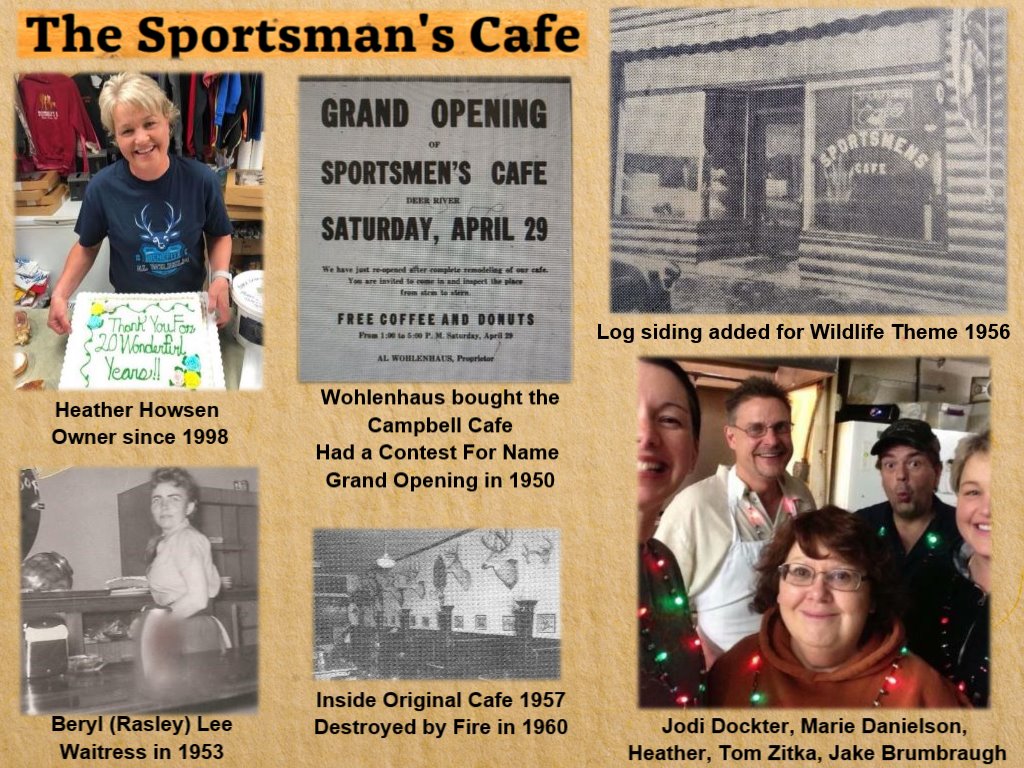
To tell the history of the Sportsman’s Cafe means starting a little further back in history, but first, an explanation as to the spelling of the name. The original spelling, decided in 1949 was Sportsmen’s, but over time and apparently with nothing deliberate on any one individuals’ part, it there has been changes. Newspaper articles through the 1960s spelled it Sportsmen’s and so did the local phone book. During the 1960s the phone book spelling was Sportsman or Sportsmans.  It appears that by the mid-1970s the phone book and newspaper advertising was Sportsman’s Cafe, as it is today.

Three other Deer River restaurants of the past are intertwined, to create what we all know as the only place in town to get a homemade caramel roll and a bottomless cup of coffee for under a $1.50!  They are Harmond’s, Campbells, and Arrowhead cafes.

Deer River Restaurants Through the 1930s

There have been many restaurants in the village of Deer River through the years.  Some of the oldest listed in order of advertisements beginning in 1897 are: Little Harry’s, Willis Block Cafe, Globe Cafe, Itasca Hotel Cafe, Ideal Restaurant, Lou’s Place, Liberty Hotel Cafe, Pete’s Corner, Miller Hotel Restaurant, Finley’s Hot Lunch, Itasca Cafe, Brownie’s Snak Shack and St. Peter Delicatessen Lunch Room.

It doesn’t appear that there were ever more than three or four operating at once and I suspect new owners changed the name at least some of the time.  For instance, I do know that the Itasca Hotel Cafe was bought by Thomas Finley and became Finley’s Hot Lunch.  In 1931 Finley sold to Howard and Ellen Harmond, who renamed the business Harmond Cafe. 

Changes in 1935

Prohibition had ended, and the village of Deer River decided to establish a municipal liquor store.  The location they had in mind required a few businesses to shuffle around.  Campbell Lunch, which was started by Malcolm and Phoebe Campbell in the early 1930s was pivotal to these changes.

In mid-January, a jewelry store moved – “As soon as Mr. Scharfenberg had vacated his former store, M. Campbell began the work of remodeling it for occupancy by his restaurant and beer parlor.  As soon as the building can be made ready, Mr. Campbell will move out of his present quarters which have been leased by the village for the municipal liquor store.” [Itasca News 1-24]

A couple of days later the second move was made “The new Harmond Cafe opens in the former Henry Herreid Clothing store building.” [Itasca News 1-24]

And finally, the following week – “What is probably the last of the shifts to accommodate changes in the business section of the village was made Tuesday night, when the Campbell lunch was moved into the building formerly occupied by the Harmond Cafe but purchase by Mr. Campbell last month. This shift paves the way for opening the municipal liquor here, which will be conducted in the building just vacated by the Campbell Lunch.  The work of preparation was started yesterday, and it is expected the store will be open for business next Monday…” [Itasca News 2-7]

In 1940, Howard Harmond died unexpectedly, and I am not sure how much longer the Harmond Cafe was open, but I assume it became the Arrowhead Cafe because they also occupied the Henry Herreid Clothing building.  The Campbell Cafe changed hands at some point and by the late 1940s was owned by Bill Brewster.

Sportsmen’s Cafe 1949-1998

Albert “Al” Wohlenhaus bought the Campbell Cafe from Brewster in November 1949. The cafe was the 1st or 2nd building to the east of the Neville corner (what is now Cinderella’s Closet). Wohlenhaus wanted to do a complete remodel and name change for the restaurant.  The remodeling began in December and was completed in April, with very little time lost serving meals.

In December, he also advertised a contest for a new name for the cafe and the winner was Mrs. Gerald Swanson. Her suggestion was Sportsmen’s Cafe.  And as the winner, she was presented with a $5 meal ticket equal to over $50 today.  Chances are a cup of coffee was not much over a nickel.

Wohlenhaus had acquired quite a collection of animal mounts and proudly displayed them on the east and west walls of the cafe above the high wooden booths. He had the front of the building redone in log siding in 1953 to enhance the theme, and an advertisement in the 1956 Deer River phone book proclaimed the cafe had “Northwest’s Largest Collection of Wildlife.”

Beryl (Rasley) Lee, 99 years of age, was a waitress at this time. “Those animals,” she said, “we girls had to dust them.  One time this other waitress was with me, and it was a slow time of the day.  She was polishing the eye on the moose.  I was standing behind her and said moo and boy did she ever jump.” Beryl chuckled and with a twinkle in her eye added, “You had to have fun once in a while!”

Sadly, this collection of wildlife mounts was destroyed in a late-night fire in January 1960 which burned the cafe and the adjacent bakery to the ground. No one was hurt in the fire, and the affected businesses had insurance. Wohlenhaus was undeterred and immediately started over in the vacant building in the same block, which had housed both the Harmond and Arrowhead Cafes. 

He and his wife Jeanette were well known for their friendly and courteous service and excellent food.  They were civic-minded, and he was the mayor of Deer River for a number of years.  The restaurant prospered even without all the animal mounts.  Wohlenhaus died in 1969, and the Sportsmen’s continued under the watchful management of Jeanette, though the price of coffee steadily increased, as it did everywhere.

Charlene (Stangland) Benson began working at the Sportsmen’s after in 1985, and she recalls that a cup of coffee was fifty cents.  In late 1992 when Jeanette was ready to retire (at age 76), Charlene bought the restaurant from her.  She changed a few things, got a new sign for out front, but she didn’t increase the price of the coffee! 

Sportsman’s Cafe 1998-2018

Heather Howsen had been working in local restaurants since she was fourteen years old, so when she heard there was an opportunity to own one, she made it happen. In May 1998, Heather became the owner of the Sportsman’s Cafe.  Her son was only two years old, and there were many long days and short nights, but over the last 30 years, the hours have become not manageable, Heather says “But I can take a vacation.” 

She built up the business and put what she could back into it. Little by little most everything mechanical has been upgraded, and the dining area reconfigured for better seating (remember the old orange booths?) Basically, the only thing that hasn’t changed is the location of the bathroom.  Or so Heather thought.

Part of my research for this article led me to Peg Huotari. She was a waitress at the Arrowhead Cafe in 1956 when it was in the same place that Sportsman’s now occupies.  Peg explained that the counter and stools are the same as they were when she worked there.  Heather has no reason to disagree, “They were here, she said. “But I have painted and recovered them.”

Since it has been determined that a restaurant has occupied the location since Harmond’s moved into the building in 1935, there is a possibility that the stools could be over eighty years old! 

Heather proudly admits that one of the most notable successes of the Sportsman’s is the dedicated staff.  There is about half a dozen that that been working with her for 10-15 years.  That kind of longevity is a goal in any business, but in restaurants, it means not just repeat customers, but those that come in a couple times a week.  Customers who know the names of the staff and who are greeted by name. Customers who know that the item they order from the menu with taste pretty much the same as the last time they had it, no matter who is cooking.

The Sportsman’s has become a community center.  It is where the meals for seniors are served, where you can get a cup of coffee before the lights are turned on or where you can learn the latest news of an ill neighbor.  Heather and the staff help give back the people of Deer River with communitywide and single person fund-raisers. It seems there is always something on the end of the counter encouraging a lending hand. 

Heather is pleased with all she has done with Sportsman’s.  She and her dedicated staff look forward to many more years of being a gathering place in Deer River.  Heather assured me her mother’s caramel roll recipe will not change, and neither will the price of coffee! 

Waitressing In the 1950s

During the 1950s and early 1960s, Beryl (Rasley) Lee worked at several of the Deer River restaurants. “We wore uniforms, green at Campbells and white at Sportsmen’s.  I can’t remember what color at Arrowhead, but always an apron or a smock over it.”

Beryl remembers a school teacher who came into Sportsmen’s for breakfast every day and requested a sandwich that wasn’t on the menu.  “She always had toasted peanut butter, bacon and banana sandwich.”  This sounded familiar to me, so I asked Beryl if the was the sandwich Elvis Presley was famous for. She thought it might have been.

Peg (Cronkhite) Huotari began waitressing at Arrowhead Cafe in May 1956 at the age of fifteen. “I started at 11:00 p.m.,” she said. “The night before the opening of fishing. I wasn’t familiar with Deer River as we lived in Cohasset.  My mom just dropped me off out front, and right behind us was a carload of guys that were stopping at the restaurant.  Katie, the owner, told me to put my apron on and start with the booth where the young men had sat down.  They’ll just order coffee.” It was a busy night, but Peg made it through and was later trained in by Beryl. Though Peg’s waitressing was only for the summer between her junior and senior year, she really enjoyed it. “The tips were good,” she said, and that’s where I met my husband!”  Peg told me about a prune pie that is a favorite in the family.  “You take the pits out of the prunes and put a walnut in its place. Then cover the crust with the prunes, and then cover with a thickened sauce made from the juice.” Her mother was a neighbor, and good friends with the Arrowhead cook, the recipe was passed on and became favorite at the cafe as well.

For the Love of Ella ~ Law & Order in Itasca County 1911

10.8.2023

Stillwater prison photo of Vincent Wood ~ 1911

On April 19, 1911, Vincent Murphy was shot and killed by Vincent Wood in Wirt, Minnesota. Wood was sentenced for life, but eventually married the woman he believed he had defended.

The Characters

Vincent Murphy – 37.  He was a camp foreman for the Namakan Lumber Company. His permanent address was in Minneapolis. Lillian, his bride of ten months, had spent the early spring with Vincent in the north woods where he had overseen a log drive. She returned to Minneapolis on Sunday April 16, and Vincent was expected to join her by the end of April.

Ella Wood – 40. She was the wife of James Wood and mother of their five children: Lowell, Altie, Goldie, Olga, and James. Based on the birth places of the children, the family had moved from Iowa to Nebraska and then to Wisconsin between 1894 and1905. The 1905 Wisconsin State Census has the Woods living in Gay Mills, WI. James was listed as a farmer. His younger half-brother, Vincent, was living with them.

No record of the Wood family is found on a 1910 census, but in April 1911, Ella appears to be separated from James. She and the children were living with Vincent Wood in Wirt. The pair was managing the kitchen of a boarding house and had resided there for at least six months.

Vincent Wood – 25. He is the half-brother of James. He is known to have resided with James and Ella Wood in1905. According to the Grand Rapids Herald-Review dated 4-26-1911, he and his sister-in-law Ella Wood were living “as husband and wife.”

The Crime

Murder at Wirt ~ Itasca News 4-22-1911

“Another murder affair at Wirt has brought attention to that spot on the map forty miles north of Deer River, at the terminus of the northwest branch of the Minneapolis & Rainy River Railroad.

The victim is Vincent Murphy, an old woods and river foreman who of late years has been employed by the Namakan Lumber Company and was in charge of that company’s log drive at Wirt when he met his death.

The report is that while Murphy had his crew and wanigan [boat used to cook and feed loggers while on the river] in the town he was about the hamlet considerably.  On Wednesday evening he had been missing for several hours and a search for him was instituted.  At about 9 o’clock of that evening [timeline incorrect] his body was found by Ole Nelson and another river driver, lying on a brush pile, and partly concealed by brush on the edge of the right of way of the branch railroad running to Dora Lake, at a point about a hundred rods from the station.

The news of the tragedy was phoned by D.M. Price, superintendent for the Namakan Company, to the M&RR office, here, and a special train with undertaker Herreid aboard was dispatched to the scene and brought the remains down yesterday.  The body is at the morgue and the marks are plain that the bullet that caused his death entered his chest just below the throat from over the left shoulder and passed out right about two inches to the right of the right breast, lodging against the suspender buckle.  The bullet still clung to the shirt in a clot of blood where it stopped.

This morning by special train, Sheriff Riley, Coroner Russell, Marshal Fraelick and others went to Wirt and made an investigation.  It was found that Murphy had his mackinaw on though the day was warm; that he had no business to take him up that road; he was sober, and had been associating with one Vincent Wood and a woman living with him, Ella Wood, people of unsavory reputation living at Wirt; two shots were heard in the direction of the spot where the body was found, Wednesday afternoon. [timeline incorrect]

The sheriff and party returned by the special train this afternoon bringing under arrest as suspects Vincent Wood and Ella Wood, and as witnesses, Jack Ebe, Charles Goreing and Zade Cochran.”

Suspicion pointed to Vincent Wood as the murderer. Ella Wood was questioned but not arrested.

The Investigation and the Trial

The primary focus of the investigation was observations of several other Namakan employees, including Horace Carnahan and Zade Cochran.

Horace Carnahan who oversaw another camp in the town of Wirt for the Namakan Lumber Company, said that he was also in Wirt waiting for supplies. He said he saw Murphy there two or three times and on Wednesday evening when the crime was supposed to have taken place, heard two shots about 9 o’clock from the direction of the river. 

Carnahan thought nothing of it at the time and an hour later he went up to the room he shared with Zade Cochran. When he entered, he found Cochran awake and concerned about a conversation he had heard from his room about Vincent Murphy. Cochran believed he heard Ella Wood and Vincent Wood discussing what Vincent Wood might have hit when he had fired his gun earlier in the evening. The next morning, Carnahan and Cochran looked around town for Murphy, but couldn’t find him. It was then that a search was organized, and Murphy’s body was found the following day. In October 1911, the grand jury at Grand Rapids indicted Vincent Wood for the murder of Vincent Murphy.

The trial of Vincent Wood started on November 9, 1911, in district court before Judge McClenahan at Grand Rapids.  Nearly two dozen witnesses were subpoenaed in this case, and two special venires were needed to select the jury. The men selected as jurors were Charles A. Aldrich, A.E. Durham, E.R. Elliot, F.W. Estabrook, A. Haglee, William Hanson, John C. McKusick, L.F. Roman, Henry Simpson, John Van Cotter, Henry Washburn, and William Willis.

Opening statements began on Tuesday the 14th.  According to several local papers, even though there was only circumstantial evidence, there was definitive sentiment against Wood. 

The testimony of “Cochran was the strongest against Wood.  Others testified to hearing the shots and comparison of Wood’s guns made a strong chain of evidence against the accused.

He said he heard a murmur of voices in the bedroom below; that he could distinguish the voices of the defendant, Mrs. Wood and the chatter of her little children; that he could catch a word now and then when Mrs. Wood and the defendant talked. The floor of the room he occupied was also the ceiling of the barroom, the witness stated, and that he became interested when these words were mentioned and placed his ear to one of the cracks.

After that, the first thing he heard was Mrs. Wood saying ‘Vince, you never shot at him at all.  You shot up in the air.’

Wood then replied: ‘I didn’t.  I shot at him, and I shot to kill the—’

Mrs. Wood then asked, ‘Which side of the track was he on?’

Wood: ‘I know which side of the track he was on.’

Mrs. Wood: ‘I’m going to have some fun with Murphy in the morning when he comes back.’

The witness said the balance of the conversation was unintelligible, it being just a confusing murmur…” [GRHR 11-22-1911]

The Verdict

The jury began deliberations Friday evening November 17th and on Saturday at 9:00 o’clock, returned a verdict of guilty of murder in the first degree. Less than two hours later, Judge McClenahan sentenced Vincent Wood to serve the balance of his natural life in the state prison at Stillwater at hard labor. 

“It is presumed he [Vincent Wood] became jealous of Murphy believing he was paying too much attention to her.  The arguments were attended by a large crowd and much interest in the case had been taken through the trial. Wood took his sentence very calmly. [Itasca News 11-18-1911]

In October 1916, Wood’s attorney presented information to the Pardon Board in hopes of an appeal for a pardon or sentence commutation of his client’s lifelong sentence. The attorney claimed that Wood had attempted to play a practical joke on his friend Jacob Ebe and had accidentally shot a bullet that hit Vincent Murphy. No action was taken by the Pardon Board.

Fifteen years later, another hearing on Wood’s application for a pardon was held, and the board denied his application for parole.

The Continued Relationship

Twenty-seven years after Vincent Wood killed a man he allegedly thought was romantically interested in Ella Wood, the woman he loved, they were together again.  It is likely that he was paroled in October 1936, and after James Wood died in Canada in 1937, Ella and Vincent were free to marry.  The ceremony took place on April 6, 1938 in Polk County, Minnesota.

We can only speculate as to how and when they stayed in touch during the intervening years. After the trial and imprisonment of Vincent, Ella returned to her husband James, and they made their home in Canada, at least for a while.  The 1921Canada Census indicates the Wood family was together in Winnipeg.  In 1928, Ella returned to northwestern Minnesota. 

By 1940 Vincent and Ella were farming in the community of Warren. No children were living with them. Vincent died July 28,1950 at the age of sixty-five. Ella was eighty-years old when she died two years later. They are buried at the Greenwood Cemetery in Warren, Minnesota.

All in the Family ~ Jurvelin Hardware Part II

10.1.2023 [archived ~ previously published 4.26.2018]

Olga and Henry Jurvelin ~ circa 1960

The history of Jurvelin Hardware store started when 26-year-old Henry Jurvelin began working for the Herreid Bros. in the late 1920s. Last week’s column took us from that time up until July 1964, when a fire in the adjacent Red Owl threatened to destroy the hardware store as well.

In early 1967, Henry was diagnosed with cancer and died in September of that year.  He had walked the floors of the hardware store for over 40 years. Before Henry’s death, his only son agreed to take over the store.  Dick was thirty-three years of age and his mother Olga sixty-six. The pair successfully continued to manage the store, with a little help from Fritz, the family dog.  Dick states “My mother and I walked to the store each morning.  Our dog came along too and then stood guard behind the counter.  She’d lay there on the floor, didn’t bother anybody, but if they [a customer] stepped behind the counter where they weren’t supposed to be, Fritz would give a warning growl.”

By then, Dick had had his eye on a petite young nurse, Fern Raboin, for some time.  Fern was from Cass Lake and began working at the Deer River Hospital in 1963.  She lived with her aunt and uncle, and later with other hospital staff. Dick was always delighted to wait on her when she came into the store, and in fact, the family lore of how they met, explained by Steve is as follows. “The story I heard of how you met, was that she came in the store to buy a cracker barrel. We had that cracker barrel at home for years until it finally broke.”

Fern pretty much confirms this, “Yes, I did go into the store to buy the cracker barrel, though I’m not sure it was the first time I had met Dick.  There was a group of us that did things together.  The cracker barrel eventually broke, and I found one just like it at a sale Reenie Reuters had, so I still have one.” 

After a few years at the hospital, Fern went back to school to become certified as a nurse anesthetist.  She worked away for a bit, returning to the Deer River Hospital in 1966.  Dick and Fern were married in June 1968 at St. Charles Church in Cass Lake. 

Steve, the oldest of Dick and Fern’s three children, is the only one who seems to have the hardware gene.  “I started coming down here at Christmas time when I was in first grade,” Steve said. “We’d be open two weeks before Christmas until 9:00 p.m.  That was my first job.  I would come here at 5:30 with supper for my Dad and my Grandma and then I stay until the store closed.” 

In 1979 Dick bought the old Herreid mortuary building on the east side of the hardware store.  If you remember it at all, it was probably as the Northwoods Gift Shop.  The Herreid Bros. closed their business shortly after Carroll Funeral Home opened.  In 1959 it was remodeled into a souvenir shop for Mrs. Chubb, then sold to Faddens in 1964.  Dick was glad to get the addition, not only for storage but because the chimney that the hardware store utilized was actually in the mortuary building!  When it was originally built by the Herreid’s in the early 1900’s, the heating system of the two buildings was connected in the basement.

By the time Steve was in 6th grade, he was working at the store summers, after-school and Saturdays.  “In the evenings,” he said, “we’d pile in the truck to deliver 100-pound propane cylinders to area resorts and cabins. Grandpa did a lot of installs [appliances] and so did dad into the 1970s and 80s.  Washers, dryers, and Perfection oil stoves.”  Steve was involved in these activities and considered them to be part of the family business.  “I was like a farmer; I just thought that’s just what you did.”

Steve enjoyed working with his grandma Olga and was impressed that she was able to help customers who spoke Swedish.  Fern too was impressed with her mother-in-law’s dedication.  “She worked in the store virtually until the day she died. She worked on Saturday and died on Sunday.” From the time Henry took over the store, until 1983, over twenty-five years, Olga did the accounting which she entered by hand. 

Steve graduated in 1987 and continued working at the store while attending Itasca Community College and Bemidji State University.  “I wasn’t planning on staying at the store.  I went to school for business, but I wanted to fly. I would have loved to have been an airline pilot, but the store was an anchor, and it also provided income.”

By 1998, Steve had certainly decided to stay.  He was co-owner, and the store had more than doubled in size with the addition of 2500 square feet. Fern retired from the hospital after Olga was gone and stepped in as bookkeeper until Steve implemented a computerized system.  Although still family owned, the hardware store has had three or four other staff assisting with the day to day operations for the past 62 years. 

Dick hasn’t officially retired, and explains, “Steve is the owner and boss.  Sometimes he’s gone on fire calls, and at least I can close up and lock the door if I have to in the evening.”  Dick is at the store most of the time, and he doesn’t sit around with a coffee cup in his hand. He is always on the move.

Steve and Krystine married in March 2008.  Their son, Henrik Steven was born in December 2012. Now five-years-old, Henry has very definite ideas about his future.  “I am going to work here someday,” he told me as he confidently hung a bike horn back onto the store display, “and I might even be the boss.” By the time Henry is running the cash register, there will have been a Jurvelin in the building for 100 years and four generations.

Although Dick didn’t work much in the store until he came back from the service, he has walked the floors for about 60 years.  Steve isn’t too far behind, and then of course, there’s Henry.

All in the Family: Jurvelin Hardware ~ Part 1

8.6.2023 [archived ~ originally published 4.19.2018]

Herreid Bros. Hardware May 20, 1932 ~ Henry Jurvelin on the right

There has been at least one Jurvelin walking the floor of the hardware store for over ninety years.  As I mentioned in last week’s column, Dick Jurvelin is one of them.  While he was in the service, his parents, Henry and Olga, bought the hardware business.  When Dick returned home, he went back to his former employer, but before long was lured away by his parents.  “Did they pay better,” I asked. Dick couldn’t remember, “but I guess it was where I was meant to be,” he replied with a chuckle. 

Manager of Herreid Hardware 1926-1956

Dick’s father, Andrew Henry Wilho Jurvelin was the third child born to Finnish immigrant parents Jacob and Sophia on August 28, 1899.  Jacob came to America as a young man and worked hard on the coal docks in Superior, Wisconsin, so he could buy a farm and move his growing family.  When Henry was three years of age, the Jurvelins settled in the small community of Floodwood.  Other Finnish families in the same neighborhood included the Wuottilas, Kivisaaris, and Hannulas. 

If those names sound familiar, it is because some of the Wuottila, Kivisaari, and Hannula families came to Deer River in 1916, establishing a grocery and dry goods store.  As was often the case, it didn’t long for friends and relatives to follow. Sometime after 1920, Henry Jurvelin moved to Deer River and was employed at their store.  The first mention of Henry in the Itasca News was the announcement in the summer of 1926, that he had resigned from KW & Hannula and started working in the hardware department of the Herreid Bros. store.

It is evident that the Herreid’s (several entrepreneur brothers, who collectively owned over a half-dozen businesses in the village of Deer River) saw Henry as a trustworthy worker. In 1928 he “went to Duluth to attend a four-day institute in effective salesmanship sponsored by the state hardware dealer’ association,” and every couple of months attended a regional meeting of some sort (hardware, Winchester, Majestic radio).  Henry was the manager for hardware department of the Herreid Bros. store, and Paul O’Groskie was the manager for the grocery department. 

Henry boarded in town and began courting Miss Olga Sjolund.  Olga’s father had homesteaded four miles away, and as a young woman, she had moved into town to attend high school.  She boarded with the St Peter family, working in their Confectionery and several other stores for many years.   Henry and Olga’s names appeared together in the paper’s local news section during the late 1920s until their secret marriage.

Spring Surprise on Friends Here ~ Deer River News 6-5-1930

“When it comes to putting over a real good one, we must hand the palm to Mr. and Mrs. Henry Jurvelin, Deer River’s most newly discovered newlyweds. Mr. Jurvelin and Miss Olga Sjolund were married at the Community church manse in Grand Rapids on Sunday, April 27th.  Rev. S.W. Arends was the officiating clergyman, and the ceremony was witnessed by Mr. and Mrs. Arthur Eide.

The happy couple returned here with every avenue of information locked tight.  For five weeks they kept their secret, chuckling at their success.  Last Sunday they quietly began housekeeping in the King cottage near the Pure Oil filling station.  Curious eyes watched, and curious minds wondered.  The secret is out.

The bride is one of the Deer River’s most popular young ladies.  For years she has been associated with local business firms and is now employed in the M.J. Baker Co. grocery department.  The groom holds a similar position in the hardware department at Herreid Bros.  A host of friends are extending congratulations and wishing them a long life of success and happiness.”

Dick fondly recalled a story about his mother’s father, “my grandpa came to town, bought a sewing machine, and then he walked all the way through the woods to bring it home.” I had read about this and found it in my files. 

Paul O’Groskie provided a few more details in this example of the hardiness of the early settlers.  “The packsack was standard equipment for the early settlers, and most of his supplies had to carry on his back to his homestead until roads were available for wheel or sleigh travel.  Many a settler carried his tar paper, nails, window, and cook stoves for miles to fix up the first log home that later became a beautiful home.  J. Sjolund, who lived four miles northwest of Deer River, had ordered a sewing machine and upon its arrival had it strapped to his back and putting a 50-pound sack of flour on top of that, walked home.”  [Deer River – 100 Years]

Henry continued working at Herreid’s, and Olga took up housekeeping and caring for Dick, their young son. Dick started working for the local tailor at Itasca Clothing Store while in high school.  He graduated in 1951 with classmates Rodney Davidson, Jerry Dederick, Barbara Geving, Darrow Gibbs, Henry Gregerson, Caroline Howe, Alice Isaacs, Robert Northberg, Gerry Ott, Janis Schedin, Maxine Seater, Jeanne Sprague, Joanne Tibbetts, and Marica Wolfe.

After graduation, Dick enlisted in the Navy and attended the prestigious Naval Hospital Corps School at Great Lakes, Illinois. He spent nearly two years in California. “In San Francisco, I was stationed at an ultra-modern experimental facility. One of my patients, a high-ranking officer, was excited one day because Admiral ‘Nimi’ was coming to visit him, they had been classmates.”

Admiral Chester Nimitz was indeed someone to be excited about; he was an American submarine commander in the United States Navy during World War II and the Korean War, and businessman. He was awarded the Silver Star three times for valor in battle.

His tour of duty completed, Dick returned to Deer River and his position altering clothing at the Itasca store.

Jurvelin Ownership 1956-1967

George Herreid, one of the two brothers who owned the Herreid store where Henry worked, died in 1952.  By 1956, his wife Agnes, and the rest of the family decided to sell the hardware portion of the business.  Henry and Olga were proud to become the new owners.  Henry was a very hard worker and dedicated to his profession.  The 1940 census documents that he worked 52 weeks in 1939 and the week before the census had logged 57 hours.

Olga joined in the day-to-day operation of the store, assisting wherever needed.  Henry spoke Finnish and was reasonably fluent in Ojibway.  Olga had picked up some Ojibway and also spoke Swedish. Dick didn’t think the change in ownership affected sales at all.   “There were lots of Finnish people living north of Deer River who spoke only Fin. They depended on my dad, not just for hardware. If they had a problem, they came in to get guidance from him on anything.  We had a lot of business from them.”  Dick was an integral part of the business as well – at that time there were no other employees.  He was also a volunteer fireman and assisted John Carroll on the ambulance. 

Two noteworthy events occurred during the early 1960s.  In 1963, the changeover to all-number telephone dialing began in Deer River, and Jurvelin Hardware was assigned the number 246-8628.  Which is the same number they have today!  

In July 1964, there was a fire in the adjoining grocery store, Miller’s Red Owl (formerly Herreid Grocery).  The fire reported at 11:45 p.m. was fought by multiple fire departments until the building was leveled six hours later.  Dick remembers the night like it was yesterday.  “Then there was the fire. I was on the fire department at that time. I spent the night, and so did Bob Lundeen. The two of us just laid in there [west wall in Jurvelin store] all night with a hose – we didn’t know what was going on outside, but we kept enough water on the wall so that we salvaged it. We were able to save our part of the building, but the rest was a total loss.” 

The Western Itasca Review published extensive coverage and photographs in the two issues following the fire. “Henry Jurvelin, owner-operator of the neighboring hardware store, said most of his stock was ruined by water and smoke, and gave thanks to the fire-fighting units for saving his building.  ‘How they did it, I’ll never know,’ he commented.  Jurvelin Hardware, Northwoods Gift Shop, Heneman Insurance and Vienna’s Eat Shop are all a part of the former Herreid building, which comprises about one full city block.

Flames leaped more than 100 feet into the early morning skies while night-clad spectators lined the streets and US Highway 2 as the fire fighters battled to control the blaze from spreading to the adjoining buildings. At one time, about 3 a.m., Deer River’s firefighting equipment lost its water pressure, and it was then that the Grand Rapids auxiliary unit was pressed into service.” 7-16-1964

The Jurvelin family history won’t quite cover a six-part series like the Kennedys, but there is still more to come.  Next week we’ll look at several significant events in the late 1960s, the emergence of the Hardware Hank mascot, and the expansion of the home-grown family-owned business.        

Tibbetts Holds Winning Ticket

7.23.2023 [archived ~ originally published 6.16.2016]

In the first quarter of the twentieth century, it was rare to see weekly ads for groceries or consumable goods in the newspapers. There might be a national advertisement for a specific product or a placard for the local merchants.  The placards were small and generally had the name, location and items offered. Some even had a logo or slogan, but the information didn’t vary from week to week.  The exceptions seem to be the holidays, the beginning of school, and when a business was closing.  Then sale prices were listed. 

Most people still used a team and wagon to go to town, and went to the closest one for whatever they couldn’t get from their land.  But by the mid-1920s when more than a few folks had automobiles, competition between merchants in nearby towns began.  Bigger places, such as Grand Rapids, had more stores, more selection and attracted more people. 

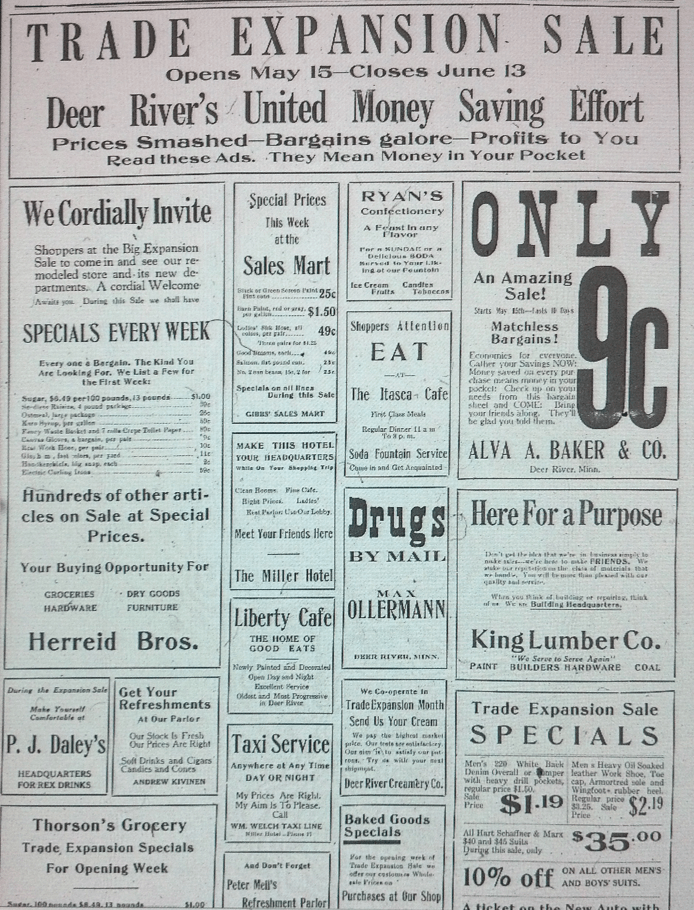
Perhaps the Deer River merchants felt a pinch over the Christmas holidays in 1924, or maybe at a state convention of some sort one of them learned what other smaller communities were doing to keep up with the competition.  At any rate, in March 1925, the merchants of Deer River developed a plan they hoped would “…extend trade confidence in local business firms.  Their proposal met with favor, business and professional men with two exceptions becoming parties to the plan.  United effort on the part of forty-one firms brings results. The chief motive was to enlarge the trade territory and convince the public of the reasonableness of prices maintained here.” [Deer River News 6-18-1925]

It was decided the event would be called a Trade Expansion Sale and the dates of May 15th to June 13th were set.  Some items would be on sale during the entire time and others, for instance as part of Dollar Days would be for a select time only.  But the biggest savings would be to the person who won the Ford Touring Car to be given away on June 13th, the final day of the sale.

All participating merchants gave customers one ticket for every 50 cent cash purchase on payment or account.  There was no limit to the number of tickets an individual could get, hence the incentive to shop often and stock up.

The Deer River News began writing articles about the Trade Expansion Sale in early May, and full-page advertising soon followed.  One of the big events halfway through was the Dollar Day sale on June 1st.  

Trade Sale will Feature $1 Days ~ Deer River News 5-28-1925

Dollar Days will furnish the special feature of Trade Expansion Sale during the coming week.  This issue contains an entire page of Dollar Bargains, special attractions to be put on beginning next Monday.

As a feature of the opening Dollar Day, the Deer River band will give a concert at 2 p.m.  Director Casson will supplement the band here with some of his Bemidji players.  Come for the band concert Monday and get first choice at the Dollar Day Bargains.

Read the Dollar Day ads.  They contain some of the greatest buying opportunities ever offered in Itasca County.  Some of them are good on next Monday only.  Others will be on sale throughout the entire week.  If you want to save money, these Dollar Bargains give you a fine opportunity to do so.

Here is a selection of the items that could be purchased for one dollar during the sale:

Herreid Bros. ~ Ladies house dress, 13 lbs. of sugar, or 10 pairs of men’s work sox

Alva Baker & Co. ~ 1 brass washboard, good clothes line and 2 dozen clothes pins

Itasca Clothing Co. ~ 1 pair men’s tennis shoes, brown

Thorson’s Grocery ~ 25 bars of Light House soap, or 10 lbs. of macaroni

Kivisaari, Wuotila & Co. ~ 1 lb. coffee, 1 lb. tea and cup and saucer free

M.J. Baker ~ 22 ½ lb. sack of rolled oats

Miller Garage ~ 30” x 3½” Goodyear Tire

City Drug ~ any toilet water up to $1.50 in value

At the beginning of the Trade Expansion Sale, the expectation was that the person whose ticket was drawn for the car had to be present at the time of the drawing to win.  In order to appease disappointed folks from out of town, the rules were changed. 

“One hundred numbers will be drawn.  Every tenth number will be eligible to the prizes as follows: the tenth number drawn will be the winning ticket.  The holder of this number will be given until Tuesday noon, June 16, to claim the car.  If not presented by that time, this ticket loses all claim to the prize and the twentieth number drawn takes its place.  No. 20 has until Wednesday noon, June 17, to claim the car, or forfeit its claim and give way to No. 30, which is good until Thursday noon, June 18.  In this same manner, each succeeding multiple of ten will be eligible in turn, each limit expiring 24 hours later than its predecessor.

Should none of the numbers drawn next Saturday eligible to win be presented in proper time, there will be a second special drawing on Saturday, June 27. However, it is considered highly probable that someone is going to be on the ground and drive the prize home next Saturday night.” [Deer River News 6-11-1925]

There was a huge crowd in Deer River on Saturday, June 13th and at the time of the drawing an estimated two thousand people.   The tenth ticket was drawn, number 124095 but no one seems to have it, so more tickets were pulled, the twentieth belonging to Peter Vickjord.  If the winning ticket holder didn’t claim his prize by Tuesday noon, Mr. Vickjord would drive the car home.

Shortly after the crowd dispersed, sixty-six-year-old Willian Tibbetts, Sr. of Ball Club showed that he had number 124095, the winning ticket. “Scores of friends extended congratulations on his good fortune.  A great-grandson, less than a year old was here on Saturday to help celebrate.  No boy was ever more tickled over a new pair of boots.  ‘Well, the old car was just about worn out,’ said Mr. Tibbetts. ‘This one will come in handy,’ and he climbed in and drove away in great glee.” [Deer River News 6-18-1925]

Incidentally, the Tibbett family has won a number of prizes over the years, some through skill and others, like William Sr. through luck.  I would love to write a story on all of the winning Tibbetts someday, so if you have any information or pictures, please send get in touch with me ~ chrismarcottewrites@gmail.com.