7.16.2023 [archived ~ originally published 7.28.2019]
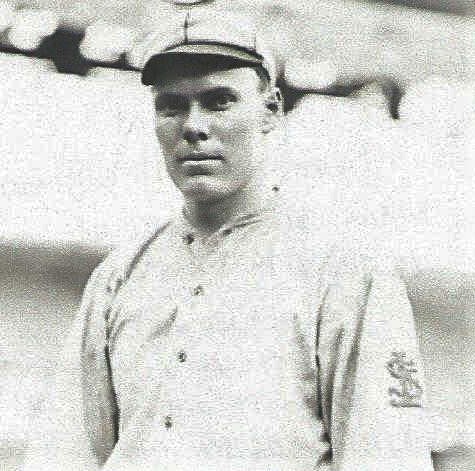
Rees “Steamboat” Williams was a pitcher for the St. Paul Saints in the years between 1915 and 1922. He spent his first twenty-five years in Montana and his last fifty-four years on Sand Lake in Northern Itasca County.
The Montana Boy
Rees Gephart Williams was born on January 31, 1892, to Anna and William Williams in Cascade, Montana. His name is representative of both parents. Rees is a traditional Welsh name, which was his father’s heritage, and Gephart was his mother’s maiden name. Both Anna and William were immigrants. It is believed their paths crossed in Montana when Anna was cooking for General Nelson Miles at Fort Benton, Chouteau and William was in the army. They married in about 1886.
Rees was the youngest of three. His brother Elmer is five years older than him, and he had a sister who died as a very young child. Before Rees was two years old, Anna and William were divorced. William moved to Pennsylvania where he later died in a coal mining accident. Anna married Frank Woodworth, a rancher, in June 1897. “He married my mother when I was about four years old and they worked on a cattle ranch owned by a man named Johnson. I think they had about two thousand head of cattle and my stepfather was foreman, and my mother did the cooking. I’m not sure but I think they went from there to the ranch in Cascade. [RWilliams ~ 1970]
According to the 1910 United States census, the Woodworth-Williams family lived in Soldier Creek, Cascade where Frank’s occupation was listed as a farmer, and Rees as farm labor. But there was always time for a baseball game.
“I pitched for a team we used to round up from the different ranches and always seemed to be able to beat Cascade most of the time. Then I pitched some games for Cascade. I had to ride a horse the sixteen miles into town in the morning and then ride home after the game. My pay was thirty-five cents for dinner, but I had to pay for my horse’s feed myself. It was a pretty long day but lots of fun.” [RWilliams ~ 1970]
The Nickname
Jeremy Watterson, a member of the Society for American Baseball Research, wrote an article on Rees Williams which is posted on the Society’s website. Watterson states “The first appearance of Williams’s signature nickname shows up in an Ogden newspaper in early April quoting a letter from manager Hester in the Great Falls Tribune. “‘Steamboat’ Williams [is] in the pink of condition and [is] working great.”
The Missoulian, however, would claim he was more of a mud-scow than a steamboat. At one point the author theorized that the origin of the moniker may have been the result of the young hurler showing up to play ball in Great Falls after hitching a ride on one of the many vessels travelling the downstream stretch of the Missouri River from Cascade. If true, the stunt surely would have resulted in some ribbing from his teammates.
According to Joan Isaacs, historian and former writer for the Deer River Western Itasca Review, there is another story. Roger McDonald, who lived near Rees at Sand Lake, stated that Rees told him “the nickname ‘Steamboat’ came not from baseball but from his ability to put away a steaming boat of potatoes at the dinner table.”
The Minor and Major League
Rees played for major and minor leagues from 1912 to 1925, with the exception of a hiatus during World War I. Williams’s major league record of 6-8 is dwarfed by his minor league achievements. He appeared in 305 minor league games, earning at least 116 victories over eight seasons.
In February 1912, the Great Falls Daily Tribune reported that Rees signed a contract with the Great Falls Electrics, a minor league team in the Union Association. “Williams has been sort of a ‘phenom’ in the country in which he lives when it comes to baseball games. He has been the star on the local team for the last few years and Cascade fans will watch with a keener interest than ever the fortunes of the Electrics while Williams is being given the chance to show whether he belongs in the ranks of professional baseball players. The local club owners believe Williams shows all the characteristics of a comer in the ranks of pitchers and they will give him every opportunity to make good in the team.” 2-29-1912
Watterson states that the day after Williams pitched a game in Missoula on July 3, 1913, he “was sold to the St. Louis Cardinals for $2,500.” He reported to the Cardinals on September 14, 1913.
It wasn’t until a year later that he “made his first big league start in the second game of a doubleheader on the second-to-last day of the season against the Cubs. Working with catcher Paddy O’Connor, he pitched five innings, giving up three runs on six hits including a homer to Tommy Leach. Williams struck out in his only at bat of the season, as Hippo Vaughan won his 21st game for the Cubs. The following day, Williams was on the mound for the Cardinals as the 1914 campaign came to a close. Working the final frame, he recorded his only scoreless outing in five attempts.” [JWatterson]
Watterson did a considerable amount of research on his article, including interviews with several people in Deer River in the early 1990s. I have extracted the following highlights of Rees’ professional baseball career from Watterson’s article.
1915 ~ lent by the Cardinals to the St. Paul Saints, he appeared in 27 games, finishing 15-6. He posted a career best 2.18 ERA, which was good for third in the American Association.
1916 ~ appeared in 36 games with the Cardinals and makes the record books leading the National League in games finished with 21.
1917 ~ back in St. Paul. Best season of his career at age 25. He appeared in 51 games, leading the Saints in wins (22, with at least two shutouts) and innings pitched (265) while posting a 2.82 ERA. St. Paul again finished in second place, this time to Indianapolis.
1918 ~ World War I cut the American Association season short, he was 4-10.
At the end of July, Rees went to Duluth to work in one of the factories manufacturing steel for the war effort. He also joined the Duluth team in the Twin Ports league.
1920 ~ signed back with St. Paul in March, after wintering at his cabin in Thunder Lake, Cass County
1921 ~ fifth season with the Saints
1922 ~ After appearing in four games for the Saints, he “jumped to the outlaw ranks” with Eveleth of the Mesaba Range league on May 13.
Until 1925 ~ was an arm-for-hire in the competitive semi-pro leagues so popular in Minnesota.
The Resorts
In September 1925, with a couple tents and camping equipment, Rees and his wife Peg, leased a plot of land from the Forest Service on the shore of Sand Lake. They worked quickly to erect the tents and a cabin. They had duck hunters renting them that season. They constructed the rest of Pine Grove Lodge the following year and owned it until 1945.
At that time, they moved about a mile away, on a point of land Rees had purchased from the former mayor of St. Paul, Arthur Nelson. There was sixty-eight acres, perfect for duck and deer hunting as well as summer vacations. The Williams began building a lodge and cabins in 1947, and opened Sand Lake Lodge in May 1951. Rees and Peg owned that resort for over twenty years.
Peg died in 1972 and Rees in 1975. They are buried at the Olivet Cemetery in Deer River. The funeral card for Rees lists the following well known and respected men as pall bearers: Bruce Leino, Dick Jurvelin, Eugene Sword, Ludwig Haataja, William Schultz III and Paul Shaw.







 chrismarcottewrites