Pick a Peck

5.7.2023 [archived ~ originally published 5.24.2018]

The surname of Peck is familiar to the Deer River community and has been for nearly 130 years!  In fact, the 1900 United States census verifies that there were almost 5, 000 head of household Pecks in the nation, and less than 200 Marcottes.  And unlike many families that settled in the Deer River area at the turn of the century, the Peck surname goes back to at least 1693, where I found a gravestone in Cohasset, Massachusetts. Incidentally, that is less than 50 miles from Plymouth Rock where the Mayflower landed in 1620.

In the Deer River area, I discovered six different Peck families.  Two are brothers, but if they or any others are related, it is many generations back.  The brothers settled in Cass, later moving to Itasca.  Two others that homesteaded, in northern Itasca County did not stay in the area. Many Pecks were born in Itasca. According to the 1905-1995 Minnesota Birth Index, there were fifty babies registered, some of which still reside in the area.

I am introducing them in the order in which they came to the area.

Warren Welcome Peck 1889

In late fall 1889, Warren Peck filed on an eighty-acre homestead in northern Itasca County.  Born in Illinois in 1858, his parents, Hiram and Alminta were initially from Vermont.  Warren was working in Stillwater, Minnesota in 1880, and after filing on the homestead, he married Sophia Olstad.  Their first two children were born in the state, possibly on the property.

After living on the homestead for the minimal requirement of fourteen months, Warren took the cash option and paid $100 for the land. By 1895 he had moved his family to the North Dakota.  Warren’s great-grandfather Welcome Peck (for whom he was named), fought in the Revolutionary War.

Eugene R. Peck 1891

According to the 1905 Minnesota State census, Eugene “Gene” Peck came to northern Minnesota from Wisconsin in about 1891 at the age of 23.  His father Arthur H. had been born in Wisconsin, and his mother, Mary was from Scotland.  In 1900 Gene was living in Cass County, employed as a day laborer. Probably in the fall of 1903, Gene filed on a 40-acre homestead in Cass County, not far from Mud Lak, and married. His wife Alice had a daughter, Mary, the following year. 

In 1918 Gene and family moved from Mud Lake and leased property from Joe Krasky in Ball Club. Shortly after that, they moved to Grand Rapids where Gene was employed by Blandin paper mill, according to the 1920 and 1930 US census.  Eugene’s father, Arthur served in the Civil War in the 1st Regiment, WI Infantry Co D, and was mustered out when he was wounded.  The 1940 census finds Gene living at the home of the sheriff.  He is a widower and identified as a prisoner.  I verified with the Itasca County Historical Society that the address he was residing at was the home designated as the sheriff’s residence, and it was used as a jail. 

Arthur H. Peck 1902

Arthur H. Peck is the younger (by nine years) brother of Eugene. In 1896 he moved to Minnesota and was living in Duluth by 1900.  In April of that year, at the age of 24, he married Gertrude Day, and they filed on a 20-acre homestead in Cass County not far from his brother.  After proving up on that homestead in 1909, Art filed on 120 acres in Township 146-26, sec 34, west of Oteneagen, and relocated his growing family. They had three sons and six daughters who lived to adulthood: Gertrude, Arthur, Mary, Ethel, Hazel, Robert, Richard, Fern, and Eva.

The grandparents of Gene and Art were from out east.  Rufus was born in New Hampshire and Alameda, New York. Rufus and Alameda married in NY and had two children, before moving west to Wisconsin at the end of the 1830s.

Anna M. Peck 1907

Anna M. Gorenflo had filed on a homestead in the Big Fork Valley on July 5, 1907.  It appears that she and her brother, Frank came to Itasca from the Brainerd area.  When Anna was ready to prove up on her property the following year, she is listed in the ‘Notice for Publication’ as “Anna M. Peck, formerly Anna M Gorenflo of Bigfork. She named as witnesses: Orwin Van Dolah, Frank Gorenflo, James Pratt and William Kennedy, all of Bigfork.”

I could not locate any additional information on Anna Peck.  I have no idea who she married and where she was by the 1910 US census.  The property in her name was still listed on the 1916 plat map.

Harold Jay Peck 1911

Harold Jay Peck was born in Scott County in 1879.  His father, Horace was from Vermont.  Horace attended school in the east, became a lawyer and after his marriage moved to Shakopee.  In later years he was county attorney. Harold was the middle child and only son.

Harold came to Itasca County in the early 1910s and filed a homestead on 77-acres near Ball Club.  According to family, he also purchased land and started the first herd of registered Guernsey cows in the area.  An advertisement in the Itasca News in March 1918 states, “Whose grandam has a record of 720 lbs. of butter in 1 years and whose dam with first calf has made 50 lbs. butter first month in milk.  Will sell for a bargain price in order to keep him in the county.  Pure white Leghorn Hatching Eggs for sale.  H.J. Peck, Deer River, Minn.”

In about 1915, Harold married Grace Johnston, and they had two daughters, Patricia and Virginia.  On the 1920 US census the Harold Pecks are enumerated as family number 42 in Township 145, and the Arthur Pecks, who had moved again, are family number 43!  The two are also neighbors on the 1940 census, as well as Arthur Jr. and Richard, the grown sons of Art and Gertrude. 

Harold was elected State Senator in 1930 and was instrumental in getting many projects critical to Deer River underway.  The first was a paved road from Grand Rapids to Deer River instead of from Rapids to the east. He was the postmaster from Deer River from 1935 through WWII.

Neil Ira Peck 1936

The following article sums up how Neil Peck, born in 1910 near Fergus Falls, settled in Deer River.

Poultry Hatchery to be Opened Here

Deer River News 9-24-1936

“Neil I. Peck of Herman, Minnesota, a graduate of the North Dakota Agricultural College in Fargo, is planning to open a hatchery in Deer River next spring, with a new 35,000 egg capacity to start.  He has leased the old creamery building for his plant.

Mr. Peck has spent some time here looking over the field and finally decided to locate.  Express and post office reports show that many thousand chicks are shipped into Deer River every season.  This can be avoided, and the money kept in the community, through the installation of a hatchery.

He is an experienced poultry grower and breeder as well as a hatchery operator.  Peck’s birds have taken many first place prizes at county fairs and winter shows, as well as at the ND and Minnesota state fairs last year and this year.  He is also a licensed poultry culler and asks owners who wish their flocks culled, to list names and numbers with The News.

In addition to operating his hatchery, Mr. Peck will handle some standard brands of poultry feed and will have the agency for Dr. Saulsbury’s celebrated poultry remedies.  He has taken the prescribed courses in poultry disease at Dr. Saulsbury’s school.

Mr. Peck’s business venture will be a valuable asset to this community and has great possibilities of development.  Further information will be published from time to time in this paper.  Meanwhile, information for Mr. Peck can be left at this office.”

Neil did open the hatchery in the following spring, and it was a very successful family business.  He returned to Herman briefly to marry Florence and the pair easily settled into the Deer River community.  They had three children: James, Joan, and Jane. 

As with all of the other Pecks, except the mysterious husband of Anna, Neil’s ancestors, great grandparents Charles and Lovica were from the east – New York.  So, according to the information I compiled, the five families with the paternal surname of Peck, were from Vermont, New Hampshire, New York.  I will let the Peck family historians determine at what point they are related!
The Girl on the Train 1915

4.30.2023 [archived ~ originally published 4.6.2017]

One hundred years before the best-selling novel The Girl on the Train was published, there was a different girl on the train that made a debut the Lyceum Theatre in Deer River.  The theater had opened early in the year, setting up chairs and concessions in the original Brooks store. 

Silent films were a favorite diversion and acceptable form of entertainment for men, women, and most of the time children.  In late November, patrons were excited to see the first serialized film or at least twelve minutes of it!

The Girl and the Game ~ Itasca News 12-2-1916

“For the first time in Deer River, a ‘serial’ story film is being shown in the movies, and judging by the first section, the step is a success.  With a desire to please their patrons, Managers Evenson and Sandgren of the Lyceum have been giving them the largest and biggest creations made in the film industry, the same, in fact, that the big cities are using as their best, and the enormous response by the people is evidence that the best is what Deer River wants, regardless of price.  And the best is what the house will continue to serve.

Beginning with last Monday night the Lyceum began its run of the serial, ‘The Girl and The Game,’ and the first installment was witnessed by a full house.  The picture portrays a thrilling railroad story with which is linked a love affair, and as well as exciting, it is very interesting.  One chapter of the story is to be run every Monday night and there are fifteen chapters.  Besides a serial, two other reels are run on each of these nights and the price is fifteen cents. 

As a matter of interest to readers of The News, we have arranged in conjunction with the Lyceum management to run the story in the paper, and the first two chapters are on another page of this issue.  One chapter will be in the paper every Saturday right along with the movie until the happy ending of the drama.”

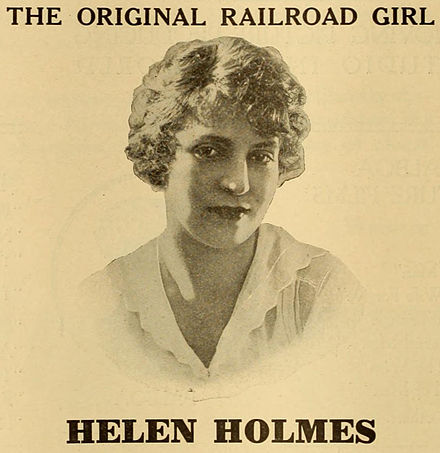
‘The Girl and the Game’ starred Helen Holmes as Helen, and the man who would later be her first husband, J.P. McGowan as Spike. The first two chapters, mentioned above, were titled Helen’s Race with Death and The Winning Jump.  Helen was quite athletic and performed almost all her stunts.  She was in more than100 short films, often playing an independent, quick-thinking and inventive heroine.

“…as part of her dangerous exploits Helen did such things as leap onto runaway trains or treacherously chase after bad guy train robbers. While occasionally the plot called for Helen to be rescued by a handsome male hero, in most episodes it was the dauntless Helen herself who found an ingenious way out of her dire predicament and single-handedly collared the bad guys, bringing them to justice.” [wikipedia]

‘The Hazards of Helen’ was not Miss Holmes’ first film shot on a train or even her most famous role.  That distinction goes to ‘The Hazards of Helen,’ which was released several years earlier. 

Backstory

In March 1914 the adventure film serial titled ‘The Perils of Pauline’ starring Pearl White as a bold and daring heroine, became an enormous box-office success. As a result, the Kalem Company, where Helen was working, decided to make a similar serial. In November 1914, they released an adventure series called ‘The Hazards of Helen.’

The original version of ‘The Perils of Pauline’ had 20 episodes, totally 490 minutes. The first 3 were 30 minutes and the rest 20 minutes.   In their attempt to outdo the Pathe Freres film company, Kalem’s serial of 119 twelve-minute episodes released over a span of slightly more than two years, the last in February 1917.  At 23.8 hours, it is one of the longest non-feature-length motion picture series ever filmed and is believed to be the longest of the film serial format.

Building on Success

The Kalem Company, like the Pathe Freres Company, broke away from the cliffhanger style that serials were up until that time.  Cliffhanger meaning something terrible was happening to a pivotal character and no help was in sight.  Of course, the beginning of the next segment was another key character saving them.  Instead, each film was actually a melodrama.  The reviews were that the public favored the melodrama over the cliffhanger, even if the film was short.

Because of the rave reviews of the ‘The Hazards of Helen’ serials, in which railroads played a great part. Helen was either jumping onto, off, running across the tops of, or escaping from railroad cars, locomotives, train stations, etc., the producers created ‘The Girl and the Game.’  It was not based on a book as ‘The Hazards of Helen’ was.  Instead, Kalem hired famed western author Frank Spearman to write the serial articles after the films’ production.  This was an interesting technique as it was free advertising, like many papers, the Itasca News being one, printed it. 

Spearman’s other chapter titles provide a fairly comprehensive outline of the film’s plot:

3. A Life in Peril

4. Helen’s Perilous Escape

5. The Fight at Signal Station

6 Helen’s Wild Ride

7. Spike’s Awakening

8. A Race for the Right-of-Way

9. A Close Call

10. A Dash Through Flames

11. The Salting of the Superstition Mine

12. Buried Alive

13. A Fight for a Fortune

14. Helen’s Race Against Time

15. Driving the Last Spike.

In my search for more information, I found a postcard, with a lovely photograph of Helen Holmes and the title of this film.  On the back was a handwritten note (or it was made to look handwritten) saying “Dear Friend, I saw Helen Holmes the fearless film star in ‘The Girl and the Game,’ the great railroad film novel, she’s Great! You simply must see her.” A promotional gimmick to be sure, but one I had not seen before.

After her marriage to co-star and director J.P McGowan, the two soon formed their own production company, Signal Film Productions. Between late 1915 and early 1917, they made a dozen films together that met with reasonable success but financial, and distribution problems ended the production partnership.

Helen later married film stuntman Lloyd A. Saunders, and as a result of the popularity of the Rin Tin Tin dog films, the two began training animals for use in the movies.

A final note on the Lyceum Theatre – in 1920 the fire marshal condemned the Brooks building.  At that time, it was reported to have been the oldest building still in use in Deer River.  It had been built in 1898 and had moved twice.  The building was razed, and films were shown in the coliseum until a new brick building was constructed.

Law & Order ~ For the Love of Ella

4.23.2023 [archived ~ originally published 1.4.2018]

In the spring of 1911, the actions of one man, for the love of a woman, affected the lives of many.  The murder, by gunshot, occurred on April 19th in the village of Stanley, better known today as Wirt, in northern Itasca County.

The Characters

James Wood – 47; Husband of Ella; The Wood family moved to Wirt to run a boarding house in fall 1910.  He left relationship (and area) approximately three months prior.

Ella Wood – 40; Wife of James and mother of their four children; Helping to manage a boarding house; living with her husband’s brother, Vincent for several months.  “Ella was a sister of Allen Whitt who was shot and killed by David Cochran, a Deer River attorney, about five years ago and was acquitted of the deed.  Her sister-in-law, Whitt’s wife, was a somewhat notorious character and was known under the name of Mary Whitt and Mary Rosin.” [GRHR 4-26-1911]

Vincent Wood – 25; Half-brother of James Wood; Accompanied his brother and sister-in-law to Wirt; single but living with Ella “as husband and wife.” [GRHR 4-26-1911]

Vincent Murphy – 37; Camp foreman for the Namakan Lumber Company; permanent address Minneapolis where his bride of ten months, Lillian resides.

Zade Cochran – Clerk for the Namakan Lumber Company who was residing at the Wood’s Boarding House, waiting for supplies, etc. for the spring run.

The Crime

Murder at Wirt ~ Itasca News 4-22-1911

“Another murder affair at Wirt has brought attention to that spot on the map forty miles north of Deer River, at the terminus of the northwest branch of the Minneapolis & Rainy River railroad.

The victim is Vincent Murphy an old woods and river foreman who of late years has been employed by the Namakon Lumber company and was in charge of that company’s log drive at Wirt when he met his death.

The report is that while Murphy had his crew and wangon [wannigan] in the town he was about the hamlet considerably.  On Wednesday evening he had been missing for several hours, and a search for him was instituted.  At about 9 o’clock of that evening, his body was found by Ole Nelson and another river driver, lying on a brush pile and partly concealed by brush on the edge of the right of way of the branch road running to Dora Lake, at a point about a hundred rods from the station.

The news of the tragedy was phoned by D.M. Price, superintendent for the Namakon company, to the M&R office, here, and a special train with Undertaker Herreid aboard was dispatched to the scene and brought the remains down yesterday.  The body is at the morgue, and the marks are plain that the bullet that caused his death entered his chest just below the throat from over the left shoulder and passed out right about two inches to the right of the right breast, lodging against the suspender buckle.  The bullet still clung to the shirt in a clot of blood where it stopped.

This morning by special train Sheriff Riley, Coroner Russell, Marshal Fraelick and others went to Wirt and made an investigation.  It was found that Murphy had his mackinaw on even though the day was warm; that he had no business to take him up that road; he was sober, and had been associating with one Vincent Woods and a woman living with him, Ellen Woods, people of unsavory reputation living at Wirt; two shots were heard in the direction of the spot where the body was found, Wednesday afternoon.

The sheriff and party returned by the special train this afternoon bringing under arrest as suspects Vincent Woods and Ellen Woods, and as witnesses, Jack Ebe, Charles Goreing and Zade Cochran.”

The Court Verdict                                                         

The trial of Vincent Wood started on November 9, 1911, in district court before Judge McClenahan at Grand Rapids.  Nearly two dozen witnesses were subpoenaed in this case, and two special venires needed to select the jury.  Opening statements began on Tuesday the 14th.  According to several local papers, even though there is only circumstantial evidence, there is definitive sentiment against Wood. 

The testimony of “Cochran was the strongest against Wood.  Others testified to hearing the shots and comparison of Woods’ guns made a strong chain of evidence against the accused.

He said he heard a murmur of voices in the bedroom below; that he could distinguish the voices of the defendant, Mrs. Woods and the chatter of her little children; that he could catch a word now and then when Mrs. Woods and the defendant talked. The floor of the room he occupied was also the ceiling of the barroom, the witness stated and that he became interested in when these words were mentioned and placed his ear to one of the cracks.

After that, the first thing he heard was Mrs. Wood saying ‘Vince, you never shot at him at all.  You shot up in the air.’

Woods then replied: ‘I didn’t.  I shot at him, and I shot to kill the—’

Mrs. Wood then asked, ‘Which side of the track was he on?’

Wood: ‘I know which side of the track he was on.’

Mrs. Wood: ‘I’m going to have some fun with Murphy in the morning when he comes back.’

The witness said the balance of the conversation was unintelligible, it being just a confusing murmur…” [GRHR 11-22-1911]

The jury began deliberations Friday evening November 17th and on Saturday at 9:00 o’clock, returned a verdict of guilty of murder in the first degree. Less than two hours later, Judge Clenahan sentenced the convicted and to serve the balance of his natural life in the state prison at Stillwater at hard labor. 

“It is presumed he [Vincent Wood] became jealous of Murphy believing he was paying too much attention to her.  The arguments were attended by a large crowd and much interest in the case had been taken through the trial. Wood took his sentence very calmly. [Itasca News 11-18-1911]

Vincent Wood was convicted of 1st degree murder and sentenced to life at the Stillwater Prison in 1911. He applied for parole on at least two occasions and was granted release sometime between October 1931 and June 1940.

The Continued Relationship

I followed this story from an article I found in the October 22, 1931, issue of the Deer River News.

“Sessions of the state board of parole at the Capitol last week in St. Paul caused considerable interest in this country because of the fact that this country because of the fact one of the applicants was Vincent Wood, convicted of first-degree murder at Grand Rapids twenty years ago next month.

The hearing on Wood’s application was held Wednesday of last week.  Associated Press reports named Stafford King as one of those who appeared.  On Saturday the board denied Wood’s application for parole.”

My research of Ancestry records surprised me.  Nearly thirty years after Vincent Wood killed a man, he thought was romantically interested in the woman he loved, they were together again. 

Evidently, Vincent Wood applied for parole again, because the 1940 United States census documents Vincent and Ella, married and living in Warren, Minnesota.  They are farming, and at the ages of 54 and 69, respectively, they had no children.

We can only speculate as to whether they stayed in touch during the intervening years. After the trial and imprisonment of Vincent, Ella returned to her husband James, and they made their home in Canada, at least for a while.  The 1921Canada Census indicates the family was together in Winnipeg.  In 1928, Ella returned to Minnesota.  James died in Canada in 1937. 

Squirrel Tails: Taking it Up a Notch

4.16.2023 [archived ~ originally published 3.31.2016]

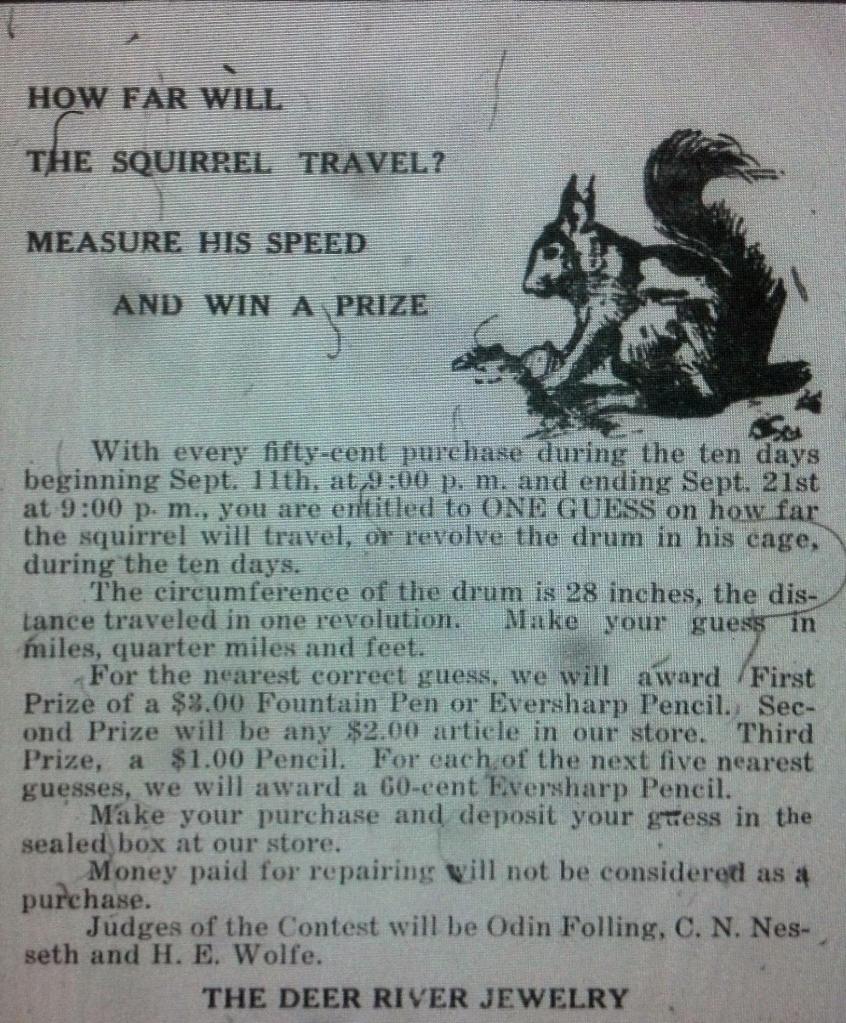
Advertising gimmicks have been around for as long as there have been things to sell, and Deer River businessmen and women were as creative as anyone.  In the spring of 1925, the Deer River merchants gave away chances to win a new car during the Trade Expansion Event. For every 50 cents that was spent at participating stores, a ticket was given to the spender. Each ticket had a number, and one ticket was the winner of a Ford car.

Hans Anderson, the owner of the jewelry store in town was impressed by the excitement that was generated by the Trade Expansion and decided to use the same technique, with a twist at his store several months later.  Hans had a pet squirrel that occupied a corner of the store and spent a good deal of time running on a wheel inside his cage.  Hans decided it was time his squirrel earned his keep.

As had been done earlier, Hans gave away a ticket for every 50 cents spent, but instead of a drawing, the ticket holder had the chance to guess how far the squirrel would travel on the wheel during a designated period of time.  Prizes of course were awarded to the top guesses.

How Far Will the Pet Squirrel Travel? ~ Itasca News­ 9-10-1925

“H.P. Anderson has invented something else.  His pet squirrel has initiated more inventive genius than any other thing that ever came to the town.  Marveling at the energy and speed of his pet, Mr. Anderson has attached a speedometer that will accurately measure the revolutions of the drum in which the squirrel travels.  Each revolution makes a distance of two feet four inches.

Beginning bright and early next Saturday morning, Mr. Squirrel will set out for a world’s record.  For ten days the speedometer will be kept sealed.  On Monday night, Sept. 21, the total will be taken.

During the ten days, with every 50-cent purchase, Mr. Anderson will offer an opportunity to guess on the total distance the squirrel will travel.  Liberal prizes will be offered for the best guesses.  In all there will be eight prizes.  Read his ad on another page of this issue.”

Hans and his wife Elsie were both born in Demark and immigrated in the early1890s.  It appears they met and married in Chicago before venturing into the Dakotas.  Two of their children were born in South Dakota and by the time they moved to Deer River they were the parents of seven children. 

Their sons thirteen-year-old Harold and eleven-year-old Ingvar probably had hundreds of guesses, but of course were not in the contest.  It is easy to picture the boys and maybe their friends, closely watching the squirrel, the wheel and the clock to make their own predictions.  No doubt the boys also had more athletic names for the furry critter other than Mr. Squirrel which appears to be his father’s choice.

Squirrel Sets Record in Total Ten-Day Run ~ Itasca News­ 9-24-1925

“H.P. Anderson’s pet squirrel completed his ten-day indoor track contest last Monday night, finishing with a burst of speed that indicated he is no quitter.

Some time ago, announced in these columns, Mr. Anderson rigged up a speedometer and attached it to the wheel in the squirrel’s cage, which accurately measured the distance traveled.  Each revolution of the wheel marked a distance of two feet four inches.  Ninety-four revolutions of the wheel made one turn of the first disc, which in turn moved the third disc one notch.

At the end of ten days it was found that the squirrel had traveled within the wheel a total distance of 163 miles, 107 rods, six inches.  In addition to this, he probably traveled many more outside of the wheel.

The greatest distance for any one day was 10 miles, 498 feet on Sept. 14, the third day of the contest.  The highest total for one day was last Sunday, when Mr. Squirrel whirled the cage for a total of 23 miles, 150 rods, 8 feet.  Evidently Sunday isn’t a day of rest in squirrelology.

The judges awarded first prize to H.G. Wick and second prize to P.K. Vickjord.

Mr. Anderson’s measurements of the squirrel’s travel will be of great interest to students of wild life, and will probably be heralded throughout the nation.” 

As far as I could determine, Mr. Squirrel’s long-distance endeavor did not make the news in any other papers, but he did impress a few individuals and perhaps by word of mouth attracted the attention of the Graflex Photography Company. Whether a salesman was just passing through or stopped in Deer River specifically to see Mr. Squirrel is unknown, so we’ll stick with the story printed in the paper.

That Squirrel Again, Two of Them Now ~ Itasca News­ 11-12-1925

The thing in Deer River that has achieved the greatest notoriety in proportion to its size of anything here, is H. P. Anderson’s pet squirrel.

A representative of the Graflex photo service from Minneapolis, recently came here for a feature story induced by stories published in the News.  Mr. Squirrel had his picture taken, duly dubbed the “Greatest Long-Distance Squirrel in the World” and with the record of his long distance run as published in this paper is being heralded throughout the nation.

Mr. Anderson has concluded that two squirrels are better than one and has secured a mate.  A properly equipped department has been built in the north windows of his jewelry department, with a homemade tree, shelves, private bedrooms and a lot of other things.  Call it a miniature menagerie, squirrel farm, or whatever you wish.  The squirrels don’t care.

And now Mr. Anderson will study squirrel nature.  He proposes to learn which squirrel sleeps longest in the morning, which takes afternoon naps, and which stays out late nights.  He may yet prove that man has descended from the squirrel.   They have a lot of things in common, especially their toleration of ‘nuts’.”

There was one more article pertaining to Mr. Anderson squirrels which appeared on Christmas Eve.  It seems that a teacher, Mr. J.M. Martin had been sent a small alligator from Florida by U.S. mail and it was presumed the alligator would replace Mr. Squirrel in the limelight.

No more was said about the alligator though, so I am assuming it might not have survived a Minnesota winter.

And regarding the winner of the new car…you’ll have to wait for the article on the Deer River Trade Expansion scheduled for this June to find out who the lucky winner was.

“Thar’s Gold in Them Thar Hills”

4.9.2023

As I mentioned previously, many of the articles for 2023 are based on stories I found intriguing from the six-part Diamond Jubilee issues of the Grand Rapids Herald-Review (June 16-July18, 1966).

In February 1925, deputy sheriff John Dickie recovered $1600 in gold that had been stolen by three Grand Rapids boys between the ages of 12-17. The gold was taken from a private residence, the owner was not at home at the time. Because the boys were minors, there were no further details provided in subsequent issues of the paper, but this did prompt me to investigate the rumor I had heard about gold in northern Minnesota. And no, I’m not referring to Chief Busticogan’s gold—that’s another story!

Boy Robbers Caught with Gold ~ 2-25-1925 Grand Rapids Herald-Review

“When Deputy Sheriff John Dickie stopped some boys who were target shooting in the village limits last Sunday, he uncovered a daring robbery, or series of thefts, and led to investigations which cleared up several mysteries.  He also found and recovered for the owner about $1,600 in hoarded gold, the biggest surprise of the year.

The boys that were doing the shooting a short distance from the Dickie residence were Leslie Greene and Roland Anderson, aged 12 and 17 years, respectively.  When Greene was searched, Mr. Dickie found a purse of gold coin amounting to several hundred dollars. He decided to hold both boys for investigation, and they soon implicated a third, Leland Bradley, age 16.

After they had been questioned by the officers, the three boys confessed that they had stolen a large sum of gold from the home owned by Tony Zines, who lived in the west part of town, and who was supposed to be so poor that he could not pay his hospital and physician’s bills. The money had been equally divided among the three boys and the amount recovered was about $1,600, while a portion of the sum taken is believed to have been spent. Mr. Zines [Zeine] had not been at home for several weeks, being out at work on the Root ranch several miles east of Bigfork.

When the gold had been unearthed, the officers obtained search warrants and looked for more property. They found a large amount of stolen property including three rifles taken from Legion Hall, army service guns. These with the belts had been missing but no one knew where they had gone. A fair-sized truck was packed with stuff stolen from Forest Lake School. This plunder included books, pencils, shears, paper and almost anything that could be removed easily. Various other articles that had been stolen in homes or in places of business were found concealed in various places and revealed through confessions by one or another of the trio.

As the boys are all under eighteen years of age, they come within the jurisdiction of the juvenile court. Their cases are to be disposed of by Judge McCullough today.”

Lake Vermillion Gold Rush

In the fall of 1865, geologist Henry Ames found gold in quartz along the shore of Lake Vermillion in St. Louis County. He brought a sample to St Paul, and it was sent to the Philadelphia Mint for analysis. Based on the information received from there, it was believed there might be enough gold to make someone very rich. “The St. Paul Pioneer newspaper 9-20-1865 speculated that the existence of the gold bearing quartz would ‘immediately turn the tide of California emigration to Minnesota.’ Ossian Euclid Dodge, a well-known singer and song writer (and sometimes journalist) was hired by the paper to report on the story.

Dodge chose to write under the pen name of ‘Oro Fino’ and submitted a series of nine ‘Gold Letters,’ between September 30 and the end of October 1865 to the newspaper.  To get to the gold fields, Dodge described vividly the route he took [after the train to Superior] and his sometimes perilous means of travel—the journey from Superior by canoe through waters often swift and full of rapids and over portages frequently narrow and steep.

He wrote of seeing, or hearing rumors of, gold veins ‘from three inches to ten feet in width, and some of them extend for many miles in length.’” [extracted and summarized from Lake Vermillion Gold Rush by David A. Walker, Minnesota History magazine, Summer 1974]

Dodge’s choice of a pen name was appropriate. “Oro Fino” translates to “fine gold” in Spanish. It was also the name of a gold mining camp established near Pierce, Idaho (then Washington Territory) in 1861.

By the end of December, the full force of gold fever hit the city of St. Paul.  Businessmen organized several mining companies and offered their stock to the public. Within two years, more than a dozen groups had incorporated to develop the Lake Vermillion gold fields. There were over a dozen gold mining companies which organized, established claims, and sought gold-bearing quartz.  The three most notable being Mutual Protection Gold Mining, Minnesota Gold Mining, and Vermillion Falls Gold Mining. The peak of gold fever was from spring 1866 to fall 1869. None of the companies yielded sizable profits, but many men who caught gold fever, including George Stuntz and Lewis J. Merritt, subsequently played major roles in the initial exploration of both the Vermilion and Mesabi Iron Ranges.

In 1934 a gold crusher, one of the first pieces of mining equipment brought to the area in the 1860s, was found under water near Lake Vermillion. The crusher is mounted on a historic marker in the city of Tower, MN.

Gold in Deer River

Using the search function on my computer I looked for other articles about gold in my Itasca County Research file (contains over 15,000 files), I found an article about gold in Deer River!

Gold found in Village ~ Itasca News 10-18-1902

“The neat job of gold leaf lettering on the window of the News shop was done by artist Holdridge, who cannot be beat in that line of business. This is the first and only gold leaf sign in town.”  John Holdridge was from Pennsylvania. He moved from Wisconsin to Deer River about 1900 and was a house and sign painter.  The building (former Western Itasca Review) still stands, but the window with the gold leaf lettering was removed and replaced with brick many years ago.

Gold in Bigfork

The Minnesota Department of Natural Resources (MDNR) has reported that Bigfork is one of six major areas in the state which has gold deposits. The five others are Cook, International Falls, Linden Grove, Vermilion, and Virginia Horn. Overall, there are almost 62 areas in Minnesota where gold can be expected.

The scattered amounts of gold in Minnesota, as well as other midwestern states was brought down from receding glaciers from the last ice age.  Glacial deposits do not generally accumulate gold in enough quantity to be valuable by commercial endeavors, but smaller scale gold prospecting is a present and growing hobby within the state.

According to goldrushnuggets.com, in addition to the glacial gold, “past discoveries of low-grade lode deposits in the northern part of the state caused a few short-lived gold rushes but were eventually abandoned due to low yield. Lode discoveries in the past decade have caused a huge interest in recent years by commercial mining companies. For recreational gold prospectors, Minnesota has plenty of opportunities and several active clubs to help you get started pursuing gold.

Near the border with Canada, a short-lived gold rush occurred at Rainy Lake near present day International Falls. Several mines popped up in the summer of 1894 but, like other discoveries in Minnesota, profitability was an issue. The gold was locked up in ore, and the gold recovered did not cover the cost of production.”
[from https://www.goldrushnuggets.com/goinmi.html] At the time of this discovery, the northern border of Itasca County went all the way to Canada.

If you are interested in finding gold in “them thar hills,” check out the Minnesota Gold Facebook page. https://www.facebook.com/groups/MNGold.

The May column is about Fish Stories & Trophies in Itasca County.


Whoozis Detective Agency ~ Bigfork 1929

4.2.2023 [archived ~ previously published 4.2.2015]

It was late February 1929 when a new business, Whoozis Detective Agency, hung its shingle here in Bigfork.  Of course, our community and some north of us had our share of small-town crime, disorderly conduct, vandalism and a few threats of bodily harm when the moonshine was flowing, but certainly nothing that the local sheriff deputy couldn’t handle.  Detective agencies were few and far between, in part because they were willing to delve into the less than savory aspects of human behavior and also because someone had to be willing to pay the high fees.  It was a bit of a mystery as to why Mr. Jabo Grabb had settled here.  Folks were definitely curious when they saw two notices in the February 22nd issue of the Bigfork Times

One was notification of a missing person – a man working north of Effie.   It read:  Lost – My only husband age 43 at present.  He has one brown eye, the other is out. When a child he fell on his head and got a permanent scar on his left lung.  Dark hair, yellow mustache, purple polka dot tie and grey teeth. If found warn his poor wife who is distracted to know exactly when he may return. Last seen near Craigville loading a car of railworks.  NOTIFY—THE WHOOZIS DETECTIVE AGENCY 

The other notification was written as an advertisement: 

When in need of real live police enforcement, Call on:  JABO GRABB T.C.

Our detective agency caters to all clients. Disguises and make up in all forms

Phone Your Wants

Signed THE WHOOZIS DETECTIVE AGENCY 

No one was sure what the initials T.C. behind Mr. Grabb’s name stood for, but he was a friendly fellow and soon found his way into the social circle of the Bigfork community.  He was professional and didn’t breathe a word of any client’s personal business, though more than a few folks tried to see who he might be conferring with at the back corner of the restaurant.

It was quite a surprise several weeks later, to learn that Mr. Grabb’s name was on the front page of the paper again.  It had nothing to do with his business dealings but listed him in the cast of a dramatic production that was to be performed by the Community Players.  Reading the article more closely, we see that he is not acting in the production but is actually one of the characters being portrayed.  A coincidence?  We think not. 

The first paragraph of the article explains “The Community Players announce their annual Benefit Play to be given in the middle of March.  The farce comedy The Dutch Detective, promises to fill a program that will be a laughing roar from beginning to end.

So the WHOOZIS DETECTIVE AGENCY was a ruse, a farce of its own to get us interested in the unusual occupation of a detective.  Well, it worked!  I for one was taken in by the missing man employed at Craigsville.  I felt genuine sympathy for his wife and thought of the children he might have left at home. 

As we later learn, there are ten characters in the play.  [Note: it took a detective’s skill to identify the females by their given names and not just as an accessory to their husband.]

Otto Schlmutz                         Mr. Dan Burman                                  

Jabo Grabb                              Mr. Wendell Freed

Major Hannibal Howler          Mr. Sydney Swanson

August Coo                             Mr. Joe Dugan

Gladys Howler-Coo                Mrs. Mansel Saunders [Ingaborg]

Plunk Jarleck                          Mr. Richard Rosen

Hortensey Smatters                 Mrs. John Pinette [Abbie]

Ambrosia McCarty                 Mrs. Oscar Pearson [Agnes]

Miss Arminta Sourdrops        Mrs. Arthur Leeman [Lois]

Katrina Kraut                          Mrs. Dan Burman [Mildred]

The synopsis of the story is that Major Howler hires the Dutch Detective Agency to find his daughter Gladys, who has eloped with the scoundrel August Coos.  Mr. Schlmutz and Mr. Grabb opened the agency after taking a correspondence course and have not yet used the newly acquired skills.  In their determination to meet the needs of a paying client, they mistakenly identify Plunk Jarleck and Hortensey Smatters as the newlyweds.  Jaleck and Smatters are actually on the lamb, having escaped from an insane asylum. Both couples are at the depot awaiting the train.  As can be imagined, all sorts of interesting situations occur because of this mix up, and no doubt it is very entertaining.

The Community Players performed for the students at the start of the Easter holiday, and again the following evening as a fundraiser for stage curtains.  The Bigfork High School, including the impressive auditorium had been dedicated six months earlier and was the pride of the community.  As had been done for generations, local entertainment was a source of income when needed for school items outside of the everyday budget.  Chances are if they didn’t raise enough with this performance, the Community Players may have gone on the road.

The playwright, Walter Benjamin Hare wrote over 200 plays, mostly during his spare time while working as a meteorologist between 1905 and his death in 1950.  His plays were very popular with amateur theaters around the country, though none of them made it to Broadway.  His most well-known play, Aaron Slick from Punkin Crick was made into a movie starring Alan Young and Dinah Shore in1952.

Hare wrote under three names and explains why: “I use the pen name Lt. Beal Carmack for the plays that I am ashamed of, the name Mary Modena Burns for the religious plays, and the other stuff I wrote under my own name.”  It is interesting to note that Aaron Slick from Punkin Crick was written under the alias Lt. Beal Carmack.  [Source:IMDb; Internet Movie Database]

Road Trips ~ Montana or Bust

3.26.2023 [archived ~ originally published 5.31.18]

By 1922, the overall economic prospects improved for many, including families in our area.  More people bought automobiles and ventured further from home, creating a new pastime – auto touring.  Tourists could plan where, when and how fast to travel, as they were no longer limited to train or bus schedules. Auto touring literature at the time described automobile transportation as a revival of the stagecoach and carriage travel. 

In fact, Frank Brimmer, author of Autocamping stated: “autocamping is by far the most popular and fastest growing outdoor sport.” [Autocamping by Frank Brimmer 1923.]  According to the United States Touring Bureau, a 1922 survey disclosed there were 1200 cities and towns in the country offering camping grounds and facilities to auto tourists, many without charge. Most provided conveniences such as police protection, electric lights, toilets, cooking facilities and permanent shelters.

So, it should not surprise you that more than a handful of Deer Riverites traveled west to the highly publicized Yellowstone and Glacier National Parks. Not all of their adventures made the news, but here is a handful that did get press between 1925-1927.

To Yellowstone Park 1925

“Laurence Olson, Darrell Smith, and Nels Olson, who sign themselves as “Ole, Easy and Swede,” left Sunday morning by auto for Yellowstone Park.  They will camp enroute and sleep in the car.  Their first day took them as far as Fargo.  Monday noon they were at Jamestown, N.D. They expected to reach the park Wednesday.  They are taking two weeks for the trip.” [Itasca News 8-13-1925]

Darrell and Joe Write 1926

Darrell must have had an excellent experience at Yellowstone, as he planned another trip, this time with Joe Rydrych, the following June. Before the pair left Deer River for Glacier National Park, they, or perhaps well-intentioned friends, decorated their automobile with the words Montana or Bust.  Darrell and Joe sent a postcard to the Deer River News.

“The editor received a card this morning from Darrell Smith and Joe Rydrych, who “went west” last week in an elaborately decorated Phord.  The card was mailed at Benchland, Mont., on June 15th.  It says:

‘We arrived at Windham Saturday night at seven, and it has rained ever since.  We are now in the Little Belt mountains.  Everything is honky tonk.  Plenty of wild “cow girls,” two for us. (That’s just as Darrell wrote it, make your own guess.) “No can Catch,” (evidently the boys have been trying.)  Will be leaving for Great Falls in about a week.  Will write from there.” [Deer River News 6-17-1926]

When I interviewed Dick and Fern Jurvelin earlier this spring, I was thrilled to see photographs in their collection of the Darrell and Joe!  The railroad might have been feeling a bit of a pinch from the autocampers as they began placing substantial advertisements in the local papers.

Great Northern Railway Northwest Special “Make a complete trip through the Northwest Special Round Trip Summer Fares to the Pacific Northwest include stop off privileges at Glacier National Park, which is still unspoiled and primitive. Fine hotels and comfortable chalets await your visit.  Come out and live in Adventure Land.  The food is excellent and plentiful.

Your opportunity to travel on transportation’s thoroughbred, the deluxe ENTIRELY NEW Oriental Limited.  The Great Northern is the scenic, low-altitude, river course route across the continent.  Inquire today from your local Great Northern Agent.

At least one person living in Deer River decided this was a worthwhile adventure.

Hilda Steffens Goes West 1926

“Miss Hilda Steffens, cashier at the Great Northern station, left Saturday for an extended vacation in the west.  After visiting at her home in Bemidji, she leaves this week for Glacier and Yellowstone Parks and Salt Lake City, Denver, and Colorado Springs.  She may possibly go on to the coast.  She will be absent about two months.  Louis Gimpil of Kelly Lake will serve as cashier in her absence.” [Deer River News 6-24-1926]

A two-month train trip!  Oh, how I would love to the gift of such travel.  Years ago, Amtrak had a writer-in-residency opportunity, but from what I can tell, it didn’t last long and is now defunct.  I am saving my hard-earned paychecks from Reminisce and will take a train trip to write within five years.  Now that I have shared this with you hold me to it!

Harlow Herreid Working in Yellowstone 1927

In the early spring Harlow Herreid, the sixteen-year-old son of businessman Henry and wife Bessie, applied to work at Yellowstone National Park for the Yellowstone Park Company.  The Park Company was incorporated in Minnesota in the 1880s as a subsidiary of the Northern Pacific Railroad, which explains how Minnesota young people were hired.  “Harlow Herreid received a contract for employment the coming summer with the Yellowstone Park Hotel Co.  He expects to leave June 13th.”  [Deer River News 5-12-1927]

And three weeks later, school was over, and he was ready to go. “Harlow leaves next Sunday for St. Paul, where he will join a caravan of employees going to Yellowstone Park, where he will spend the summer.” [Deer River News 6-9-1927]

I do not know what Harlow was hired to do, but the Yellowstone Park Company operated the very elegant Lake Yellowstone Hotel.  Also, in 1927, according to the National Park timeline, Charles A. Lindbergh barnstormed over Yellowstone Park in September, only months after his historic transatlantic flight.  Harlow regretfully missed this historic event, as he returned to Deer River on September 3rd.  

Harlow did have a chance to make a long-distance telephone call to his parents, as this was the first year telephone exchanges were installed in the Park. “The H.H. Herreid family had a pleasant surprise Sunday evening, when Harlow, who is employed in Yellowstone Park, called over the long-distance telephone.  In spite of the great distance, the conversation was very plainly heard.” [Deer River News 8-18-1927]

The last story I found in the Deer River News was about the trip of brother and sister Nels (23) and Mary (21) Olson, and friends Mildred and Carl. I thought this was interesting because it was both males and females traveling together.  According to ancestry.com, there were no marriages to transpire among them.

Return from Yellowstone 1927

“Nels Olson, Carl Norberg and Misses Mildred Sweum and Mary Olson returned last Saturday night from a two-week motor trip that took them through Yellowstone Park. They went west through Grand Forks, Fargo, Bismark, N.D., and returned through Cody, Wyo., Pierre, S.D., and east to Ivanhoe, Canby, Granite Falls and St. Cloud, Minn.  The route out took them through the Badlands of North Dakota and the return trip through the Black Hills of South Dakota.  All report a most interesting trip.” [Deer River News 8-18-1927]

More road trips were made west before the Great Depression, but I’ll save them for another column.  Until then, safe travels in whatever direction you go.

Law & Order ~ The Hanging of William Chounard

3.19.2023 [archived ~ originally published 3.3.2016]

Cass County Jail 1904

On Tuesday January 26th, 1904, William Chounard returned to his home in Cass Lake under the influence of alcohol and shot his wife three times. The first bullet struck Dora in the abdomen and when she ran from him, he fired and hit her twice more. Badly injured, Dora was taken the following day by train to the hospital in Duluth. On Thursday she died. Seven months later William was hung for the murder of his wife, leaving their young daughter Beatrice an orphan.


Although neither the murder nor trial occurred in Itasca County, when the sentence was decided, residents of the area were just as interested in the news as everyone else in northern Minnesota. This was the first death sentence in this part of the state. Our county papers didn’t even carry the news story of the trial. Here are the lengthy headlines from the Bemidji Daily Pioneer on April 30, 1904:

Death Penalty Imposed


Wm. Chounard Must Hang for the Murder of His Wife at Cass Lake
Judge Spooner Passes Death Sentence Last Night
Court Room Crowded to the Capacity During Impressive Scene


William Chounard was born in 1877. His parents died before he was ten and his grandmother raised him and a sister. He attended high school in Little Falls, and then started at St John’s College Before William finished the first year he headed north and was living in Bemidji between 1898 and 1900. He was a professional piano player, playing mostly in the saloons and houses of ‘ill-fame’.


It was in Bemidji that William met Dora and they eventually moved to Cass Lake. They had a child together and were considered married by common law standards. He continued to furnish music for the saloons, and Dora worked when she could. The Chounard’s eventually purchased an establishment and ran it until the time of the murder. Dora was a beautiful woman and William a jealous man. He had no recollection of the night of the shooting, but many witnesses during the trial told of the arguments the couple had the months preceding the incident.

William’s sister Marie and an aunt, Mrs. Young were diligent about getting a petition with over three thousand signatures submitted to the clemency board in hopes of commuting the sentence to life imprisonment. The petition included signatures of eight of the ten jurymen whose findings resulted in the death penalty. The state board of pardons denied the request. The date of the execution set by Governor Van Sant would remain – Tuesday August 30th, 1904.


Chounard’s attorney submitted an appeal with the Minnesota Supreme Court and their decision was filed at 3 o’clock p.m. on August 29th. The Supreme Court ruled in favor of the lower court. There would be no stay of execution. William would die within twelve hours. Marie was at the State Capitol with her brother’s attorney when the decision was announced. She was devastated. By William’s request, she had not seen him for months and would not see him before the execution. He had written her that he preferred she not add her own sorrow and grief, and possibly unnerve him, by a visit.

Meets Death Like A Man ~ Bemidji Daily Pioneer 8-30-1904

“At 1:07 o’clock this morning Wm. Chounard was executed at Walker for the murder of his wife at Cass Lake last January. He walked to the gallows unassisted, repeated the Lord’s Prayer, allowed the noose to be fastened around his neck and was swung to eternity, the law fully satisfied. The murderer was a little pale but held up throughout the affair without the slightest emotion being manifested.


He did not flinch, had nothing to say before death, but died without so much as a word on his behalf.
Twenty deputies were in his cell when the prisoner was led out at 1:05. Father Murphy told him to be brave, and Chounard promised that he would. Sheriff Hardy led the procession to the steps of the scaffold; two priests came next, the prisoner and two deputies following them. They walked up the steps to the platform, no hand of assistance being tendered to Chounard.


When they reached the scaffold Father Murphy knelt and repeated the Lord’s Prayer, Chounard repeated it with him. Father Murphy spoke for the condemned man and said that he had nothing to say. The hood was put over the body and the arms and legs of the condemned man were tightly strapped to his side. The noose was then put around his neck by a deputy, Chounard looking around at him as he fastened the rope.


The hood was then pulled over his head, and as soon as it was fastened the trap fell, being exactly seven minutes past one o’clock, and two minutes after the condemned man was led from the cell.
The body hung there until 1:13 when Dr. Wilcox made an examination to see whether or not life was extinct. After a short examination, he said, ‘There is no pulse, gentlemen.’ He found that the neck was broken instantly.”


As far as I know, this was the only death sentence that ever occurred in northern Minnesota. From soon after statehood in 1858 until 1906, Minnesota law authorized the death penalty for murder. In that time twenty-seven convicts were hanged by order of state courts.


The very last person to be hung in Minnesota was William Williams in 1906. When his hanging went awry, newspapers broke state law to report the graphic story. The botched Williams execution caused renewed fervor against the death penalty. Williams was the last person legally executed by the state, and capital punishment was formally repealed in 1911.


I could not find out what happened to Beatrice Chounard, the daughter of Dora and William. She was said to be living with her aunt, Marie Hitts in Brainerd at the time of the trial but Marie’s husband had died by 1905 and she had a young son to care for. Marie was the only sibling I found documentation of, so perhaps the young girl was adopted by someone with the financial means to support her. Beatrice was not listed as residing with Marie on the 1905 state census. The 1910 United States census shows Marie and her son Elmer living in St. Paul where she is working as a dress maker.

Moonshine Long After Prohibition

3.12.2023

Sheriff Marvin Mitchell and deputy Darwin Holsman, right, inspect the home-made still which Holsman uncovered in the Bigfork area. The blowtorch was used to provide additional heat for the mash in the copper boiler.

As I mentioned previously, many of the articles for 2023 are based on stories I found intriguing from the six-part Diamond Jubilee issues of the Grand Rapids Herald-Review (June 16-July18, 1966).

In August 1954, Bigfork deputy Darwin Holsman found a moonshine operation in full swing at the cabin of Abel Kinnunan. Prohibition had been repealed in 1933 meaning that alcohol could be sold and consumed, but it was still illegal to manufacture it.  I recalled another incident of post-prohibition moonshine, so there is enough for a column.

I wrote an eight-part series Itasca County During Prohibition in 2020. The articles contain many interesting tactics used by moonshiners of all ages, male and female. There are quite a few names of those arrested and convicted which make for interesting reading. The columns are archived and can be found on my blog https://chrismarcottewrites.com.

Here is a quick review of the fourteen-year National Prohibition.

January 1920 ~ The Eighteenth Amendment of the Constitution, which established the prohibition of alcohol, went into effect.  It is also referred to as the Volstead Act, because the amendment was drafted by Minnesota Congressman Andrew Volstead from Granite Falls. In essence, it was illegal to manufacture, transport, sell or have possession of illicit liquor.

March 1933 ~ Congress passed the Cullen-Harrison Act which legalized 3.2 beer and wines of similarly low alcohol content.

December 1933 ~ The Twenty-First Amendment to the Constitution is ratified. The legal sale of alcoholic beverages, except in those states that have voted to remain dry, is no longer prohibited.

It may have been illegal to make alcohol, but there were plenty of homemade stills of various sizes throughout Itasca County. Moonshine was the most common name for the illicitly distilled liquor. Other names for moonshine include Moon, White Lightning, Hooch, Dew, or Homebrew.  

This is the article featured in the July 18, 1966, Diamond Jubilee edition of the Grand Rapids Herald Review.

Bigfork Deputy Finds Moonshine Still ~ 8-19-1954

“Deputy sheriff Darwin Holsman of Bigfork, making a routine trip to serve papers, uncovered an old-fashioned moonshine still in operation in the Bigfork area Wednesday. Holsman stopped at the cabin of Abel Kinnunan of Hibbing to ask directions to another man’s home.  He noticed an old copper boiler heating on a two-burner kerosene stove and spotted a blow torch nearby. But Holsman drove away before he realized that he walked in on a moonshiner.

Deputy Holsman said that the man heated the mash with the kerosene stove and used the blow torch for extra heat against the side of the boiler. As the mash evaporated it went into a copper pipe and a series of coils in a barrel of water.  The steam became liquid and ran out a hose at the bottom of the coils into a jug.

Sheriff Marvin Mitchell notified the federal alcohol tax unit of the case.  The unit is expected to bring action against Kinnunan.”

I could not find anything more in the newspaper.

Another post-prohibition story happened during the time that the Civilian Conservation Corp (CCC) had a camp on Deer Lake near Scenic State Park. In 1934, Rayner and Sally Broberg moved their family from Chicago to northern Itasca County.  The Brobergs built and operated a small resort called Green Wing, southeast of Bigfork. John G. Broberg (1929-1993) was five years old when they left Chicago. In 1991, he put together a booklet of stories he had written about life at the resort. It includes everything from harvesting ice, dealing with wolves, porcupines, bears, moose, and the Feds. This story comes from his collection.

CCC Raid

“We had at least two moonshiners in our general area who evidently enjoyed their trade and continued to produce white lightning after the prohibition law ended. Neither of the moonshiners could have made or sold a lot of whiskey. One of them would never have been caught except for a bizarre set of circumstances, since he was a low-profile individual.

The CCC camps were built in the 1930s in the area of Green Wing.  One camp was on a lake four miles south of us and the other was situated on a lake five miles north of Green Wing.  I would estimate there were several hundred young, single males from about eighteen to perhaps thirty years of age in these two camps. They were supplied uniforms and given their food, lodging, limited medical care, and thirty dollars a month.

The camps appeared to be run by Army personnel.  The CCCs job was to build parks and roads.  They were also used as forest fire fighters when the need arose. They helped build Scenic State Park, which is located seven miles north of Green Wing.

These young men could quit and walk away from the CCCs if they chose to do so, and some did. It was undoubtedly a very confining atmosphere for restless men. The isolation, lack of female companionship, general boredom, and shortage of other things to do other than eat, sleep, and work made them mischievous.

The camps did not have liquor and the men couldn’t readily get it without going thirty miles to Bovey or Coleraine.  None of them owned cars, so it was likely their alcoholic consumption was limited.  The CCC boys knew at least one of the local moonshiners.  They undoubtedly had walked to his house and made small purchases prior to the night of their big caper.

Frenchy (not his real name), the moonshiner, lived on a lake back in the woods.  His house was surrounded by dense trees and brush.  The clearing around his house extended only about fifty feet in any direction.  One night the CCC boys hatched a scheme to steal Frenchy’s entire supply of white lightning.

A group of them headed for Frenchy’s place.  They scattered themselves all over the woods and hid. One young man knocked on Frenchy’s door and asked if he could buy a pint. Frenchy told him to sit down and wait since he never kept the liquor in or close to his house. Frenchy disappeared into the woods.  He returned about fifteen minutes later with a pint. The young man paid for his bottle and departed.

The CCC boys located Frenchy’s barrel of booze that night by watching his movements. They carried the barrel back to their camp. As one might expect, the entire camp got drunk, sick, and hung over.

Unfortunately for Frenchy, the county sheriff heard about the mess and had to take action. Frenchy was arrested and incarcerated.” [The Green Wing Story by John G. Broberg 1991 ~ Itasca County Historical Society archives]

If you happen to have an idea about who “Frenchy” is, I would love to know! chrismarcottewrites@gmail.com.

The April column is about gold fever in Itasca County.

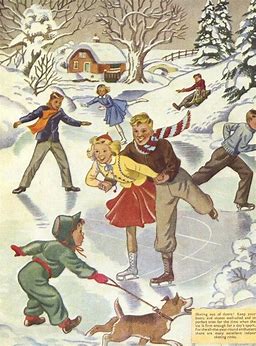
On Thin Ice

3.5.2023 [archived ~ originally published 3.1.2018]

Through Ice in Sand Lake was the headline in the 12-12-1914 issue of the Itasca News. Sadly, a century ago, a local headline such as this appeared far too often, followed by a story detailing the incident.

“At Bowstring on Friday evening of last week Nick Aebli, a settler, fell into Sand Lake through a rift in the ice while coming home in the dark and perished before help could reach him.  The accident happened only about forty rods from Aebli’s home and his cries for help were heard by his family and a number of them went to his rescue, but he sank before they could reach him and as it was dark, they could not locate him.  The body was found on Wednesday and Undertaker Will Herreid was called to take care of the body.  Interment was made at Bowstring yesterday. Mr. Aebli had been married twice and he leaves a widow and thirteen children.  He was fifty-two years old and a native of Switzerland.  He settled at Bowstring a little over a year ago and had one of the best improved farms of that section.”

As we all know, winter in northern Minnesota varies from year to year regarding the amount of snow, the below zero temperatures and the length of time the season lasts.  We also know the importance of carrying a winter survival kit in vehicles, wearing appropriate clothing for outside activities and being aware of winter storm warnings and alerts.

One of the biggest differences between now and one hundred years ago, is technology.  Weather predictions are only a google or app away.  Lightweight, but exceedingly warm outwear is available from head to toe. And cell phones provide immediate response when help is needed. 

These incidents occurred during a time when warm clothing meant cumbersome layers of wool and animal furs. Thick wool or cotton long underwear was sold for men or women and though harder for women to walk in the snow in long dresses, the extra material did provide added warmth when traveling by sleigh. Boys wore extra socks and girls ‘those ugly brown tights.’

Oscar Pearson’s story was similar to Aebli, but he made it home safely. “Oscar Pearson returned from Duluth last Thursday where he had been employed during the summer and is now with his family (cats and dog) at his residence on the shores of Rice Lake.  While making a trip to town Saturday after provision Oscar ventured to cross the lake on the ice and thus shorten his journey but as the ice was rather weak, he came near taking a longer journey than he cared to. When about halfway across the lake the ice broke and he had a hard struggle to save himself from a watery grave.” Bigfork Settler 11-26-1909

Curious children are drawn to ice for stomping, sliding and skating. Parental warnings mean very little until a tragedy occurs close to home.  How very sad the community of Ball Club must have been in the early winter of 1916.

Three Children Perish Through Ice at Ballclub ~ Itasca News 11-18-1916

“From the schoolhouse at Ballclub it is but a few rods to the shore of Ball Club Lake, and though, it is said, the children had been forbidden to go on the ice, half a dozen of them ventured out sliding during recess Wednesday morning, and suddenly two of the leaders broke through, and the third in trying to rescue them perished with them.  Children on shore seeing the accident at once ran to the school and the village with the alarm, and in a few minutes men with boards and poles reached the break and all three of the bodies were at once recovered.

Within one hour after the accident doctors from Deer River were at the side of the little dead bodied, but no attempt at resuscitation was made has it was claimed by the doctors that the coldness of the water caused the death of the little ones almost instantly.

Then water was ten feet deep where the accident happened and owing to springy nature of the shore there the ice is never safe until late in the season.

The dead are Mark, aged 8 years and William, aged 10, the sons of Mr. and Mrs. George Wilson; and Ben Tibbits, aged 10 years, son of Mr. and Mrs. Ben Tibbits. Funeral for all three was held at Ballclub Thursday and internment was made there.” 

Another November incident occurred in 1929. Algot Johnson, who lived on the south side on Bowstring Lake, broke through the ice near a muskrat house.  By the time he reached home, “both feet were quite badly frozen.  He was brought to the Miller [Hotel], where he has been improving steadily, though it is reported the amputation of one toe may be necessary.” Deer River News 11-28-1929

And then of course, there are stories of the lumberjacks. Some were found in time to thaw out, as described in 1905 – “A lumberjack, reported frozen to death was found at Churchill’s Spur and brought to town.  He was housed, fed and “watered” by officer Bond and came out all right.”  Others, like Edward Walters were not so lucky.

Froze to Death ~ Itasca News 3-22-1902

“Edwards Walters, about forty years of age, clerk in one of D. Dumas’ cedar camps on Leech River, froze to death about three miles south of town last Sunday.  He was returning from town and was grossly intoxicated.  Different men overtook him and offered assistance and advice, but he only answered surly and abused those who were trying to befriend him, so he was left wandering around on the open stretch of Mississippi meadow in a foot or two of cold water with his rack of whisky on his back. 

The next morning, he was found near the road in a wet slough just across the Mississippi about a quarter of a mile from Mickleby & Chandler’s camp.  His stiff lifeless body was frozen into about a foot of water and bottles of whisky and crackers and cheese were scattered on the ice around him.  The Coroner of Cass County was notified, and he arrived Wednesday and had the body chopped out of the ice and buried near the camp where he worked.  The News has been unable to procure information as to the man’s home or relatives.”