For Better or Worse ~ 3 Betrothals: 2 Weddings and 1 Success

10.16.2022 [archived ~ originally published 10.16.2016]

Miss Alice Pauline, Miss Ella Kiernan and Miss Emma Bjorklund may not have known each other, but they did have a few things in common.  First, their birth names began with a vowel; second, they were young women at the turn of the 20th century; and third, they all desired to marry men in the communities of Deer River or Bigfork during the new decade.

In fact, each did accept a marriage proposal with interesting circumstances.  Emma read of Axel’s predicament in the local paper, Ella corresponded with a widower, and Alice believed her beau was as smitten as she was.  Alice, Ella and Emma or their betrothed was considered newsworthy and an article about each was published in the local papers.   I will also provide you with the “rest of the story” deduced from the facts I uncovered.

A Betrayed Girl ~ Itasca News 5-3-1902

“The following article in this morning’s Duluth News Tribune has caused speculation in Deer River today as to who the white-aproned ‘gent’ referred to:

‘Miss Alice Pauline, aged 23, called at the office of the county poor board yesterday with a sad tale of duplicity on the part of the man who she said, had promised to wed her, but who had deceived her.  The man, she said, was a barkeeper at Deer River and he had sent her to Duluth several weeks ago with the promise that he would follow soon and take care of her.  The girl was in a delicate condition and without friends in Duluth and went to the poor board for assistance.

‘After hearing her story Mr. Cook told her that she did not belong to St. Louis County and that he could do nothing for her.  He advised the girl to proceed to Grand Rapids, the county seat of Itasca County, in which Deer River is situated, and apply for aid at the auditor’s office.  Mr. Cook also wrote a letter to the auditor setting forth the girl’s story as she told it to him.

‘Mr. Cook said that this was but one of many such cases that come to the office of the poor board.  The girl said her parents reside in Manitoba and that she went to Deer River to work in the North End hotel.  She soon made the acquaintance of the man who promised to marry her but who failed to do so.  It is expected that the Itasca County authorities will take up the girl’s case against her betrayer.  She will leave for Grand Rapids in the morning.’”

The Rest of the Story:

There was no follow up on this article and I could not find enough information on the censuses to determine if Alice Pauline stayed in the area.  Perhaps when she got to Grand Rapids, she decided to look for employment there, rather than return to her acquaintances in Deer River.  And as far as the unreliable groom, folks probably had a guess in 1902, but since at that time Deer River had about a dozen employing at least two bartenders, your guess is as good as mine as to who the betrayer of Miss Alice Pauline might have been.

Cooling Oe’r Big Fork Way ~ Itasca News 1-10-1903

“The bride was from Missouri but was shown her lord-to-be for the first time Sunday in Deer River and was married Monday.  Kenneth McLean, a bachelor homesteader of the Big Fork valley is the happy man.  A lady of about thirty-five, wearing glasses and somewhat nervous inquired at the Northern hotel if Kenneth McLean was around.  He was, and had been for two days, evidently waiting for something to happen.  The twain were introduced and it happened just as the matrimonial paper had designed it should.  No justice of the peace or minister happened to be in town that day so the newly met but acquainted lovers went to Grand Rapids the next day and Rev. E.L. Jaquish united them with the tie that binds.  The bride was Miss Ella Kiernan of Ward, Mo.  The happy couple departed Tuesday over the Itasca Road for the Big Fork.”

The Rest of the Story:

Ella Kiernan apparently responded to an advertisement Kenneth had placed in one of the many matrimonial papers of the time.  He was twice married, the father of six children and a widower. He and his children had moved from near St. Cloud to the area shortly after 1900.  Ella was the daughter of a prominent doctor, received a good education and was a teacher.  Based on the 1905 Minnesota census and the 1910 Federal census we can surmise that the marriage was not consummated. In 1905 there is no Mrs. Ella Mclean listed with the McLean family, and in 1910 Kenneth McLean is enumerated with his two youngest children and identified as a widower. 

Ella Kiernan is enumerated in Huntsville, Missouri as a single woman, teaching in the public school and residing with her sister.  Maybe Ella changed her mind on the rugged train ride to Bigfork, or when she saw the small log structure that was her new home.  Or perhaps, Kenneth had not given her a truthful picture of the place he lived, and she balked at the primitive log structure and rudimentary kitchen.  It couldn’t have been because the only child he had mentioned was three-year-old Basil and had neglected to say she was to cook and clean for four other nearly grown sons, could it?

Bachelors Ready to Settle Down ~ Bigfork Settler 7-4-1907

“If there are any ladies in or about Bigfork who are single and are looking for a chance to change their name and occupation they might do well to write to or call on Axel Damgren or Sam Torgensen as both these gentlemen are tired of living alone and have made known their desire of having seine one of the gentler sex take pity on them and make their homes brighter.  Both of these men are well-to-do and honest farmers who are tired of living on baking powder biscuits and hoe cakes; and they will undoubtedly make kind and loving husbands.  Now girls ‘do not let your chances like the sunbeams pass you by.’”

The Rest of the Story:

Axel was considered an eligible bachelor at the age of 25, but 46-year -old Sam may have been thought of to be too old for most of the young women who had settled in the remote community of Bigfork.  Emma Bjorklund was one of these women.  She had been born and raised in Wright County, but when so many others her age moved north to the Big Fork Valley, she did too.  Emma may have had her eye on Axel before the newspaper article appeared, or he may have asked her to a dance or two.  After all, it was the editor who took it upon himself to mention the bachelors.  At any rate, Axel and Emma married shortly thereafter and had a son in June 1908!  A daughter was born to them several years later.  The couple remained married, residing near Bigfork until Axel’s untimely death in 1923.

Bones ~ “Unsolved Mysteries of the North Woods”

10.9.2022 

With Halloween just around the corner, I decided to share some of the articles from nearly one hundred years ago that are about finding human remains, sometimes only bones, in Itasca County. There is one incident that warrants its own article (maybe in November), and it’s certainly possible that there are other stories that I haven’t found, or that never made it to the newspaper.

In each example, the person’s identity is not known, and none indicated foul play was evident. The Itasca Cemetery referred to in the articles, was later renamed the Itasca Calvary Cemetery.

 Skull is Found ~ Grand Rapids Herald-Review 11-22-1922

“A skull, evidently that of a girl 14 or 15 years old, was found last Saturday on the Jarvis Farm, four miles east of Grand Rapids, by Arthur Anderson while hunting. W. W. Libbey, deputy coroner, was notified and went out and got it. The skull has probably been there for 12 or 15 years according to Dr. Russell, who examined it after it was brought to Grand Rapids.  He believed it to be that of a girl 14 or 15 years of age.  How the skull came to be where it was found is somewhat of a mystery.”

 No One Able to Identify Body ~ Grand Rapids Herald-Review 12-10-1924

“Although the remains of the man who was found dead on the ice of Gunn Lake, last week were inspected by a large number of people, no one was able to identify the body and simple funeral exercises were conducted last Saturday, and the remains interred in the potter’s field in Itasca Cemetery.

The body was found by Ray Barcus and Fay Casper, who were looking up a location for a trap line. They were skirting the south shore of the north arm of Gunn Lake when they glimpsed a dark object on the ice, some hundred feet from shore.  They walked out and found the body of a man frozen into the upper surface of the ice. They at once went to Bert Pearson’s place on Sand Lake, some eleven miles away, and the nearest place where there was a telephone, and notified the office of the sheriff.

Coroner W.W. Libbey, and Mark Delaney went after the body, and found they could not drive their car closer than about four miles from the scene. A long low sled was taken in the car from Pearson’s and when the body was chopped loose from the ice it was strapped to the sled and hauled out by six men.  The body was lying face downward in the ice, with the hands under the face.  The clothes were such as a woodsman or trapper might wear, and the pockets contained nothing by which the man might be identified.  The trip back to the automobile proved to be a hard one, and the party did not return to Grand Rapids until the following day.

Careful examination of the remains by physicians did not disclose any wounds or injuries of any character.  It is thought that the man must have fallen on the ice from a sudden heart attack or stroke which caused his death.  He was a man of medium height, about five feet nine inches tall, weighs about 160 pounds, and apparently not far from sixty years of age.

So far as anyone can ascertain, there were no resident trappers in that part of the county.  No one lives within several miles of the place where the body was found and no reports of anyone missing that answers the description of the dead man have been made. The case will doubtless go as one of the unsolved mysteries of the north woods.”

 Ancient Grave is Found in Street ~ Grand Rapids Herald-Review 3-2-1932

“An interesting if somewhat gruesome discovery was made here Monday by men employed in excavation work for the water main extensions.  While digging in the middle of the block immediately east of the county hospital, the crew, which was under the supervision of Fred Birch, discovered pieces of an old pine box in the hole which was being excavated. 

Digging deeper, the men came upon the skeleton and other remains of a man, the only parts of the body left being the skull, red hair about sixteen inches in length, a set of teeth, and bones of the body.  The teeth were in good condition and were almost perfect in construction, indicating that the man was probably in the prime of life, about 35 years old, when he was buried.  The framework of the body suggested a medium sized individual weighing in the neighborhood of 150 pounds. The only remnants of clothing still remaining were a portion of a blue striped shirt and part of a suspender.  The shirt was of a style prevalent about 40 years ago. 

The remnants of the rough box and the bones were found four feet below the surface, the general position of the remains indicating that the man had been placed in the box on his side.  W.W. Libbey, county coroner, was notified of the discovery, and the remains were taken to the potter’s field for burial.

Residents of Grand Rapids recall that a number of years ago a cemetery was located at approximately the place of this discovery, the bodies later having been removed to the Itasca Cemetery.  The supposition is that in this cemetery this man, evidently an early lumberjack, was buried at the foot of a pine tree where it was discovered, and in the later removal of other bodies in the cemetery, was overlooked.” 

Road Workers Find Skeleton Near Bank of Big Fork River ~ Grand Rapids Herald-Review 6-8-1932

“Mysteries are continually coming to the attention of the people in northern Minnesota as the country is developed.  Occasionally, the buried remains of some early pioneer come to light and sometimes there is no clue as to the identity of the persons who lay in an unmarked grave.

Last Friday workmen engaged in hauling gravel, under the direction of Harry Lamson of Bustitown, were astonished to see portions of a human skeleton rattling down as the gravel bank caved in.  The work was being done on the north Bustitown road not far from the Big Fork River and at the foot of Muldoon Rapids, where there is a bridge over the Big Fork. Mr. Lamson at once notified the office of Sheriff Madsen and Deputy Crisp, accompanied by Coroner Libbey, went to the scene.

Investigation showed that the bones found were that of a tall man who had apparently been buried just below the surface at the top of the hill overlooking the river.  The condition of the bones indicated that burial had taken place many years ago, probably 40 to 50 years.  No fragments of cloth or evidence the body had been enclosed in a box or casket were found and there was no mark to indicate a grave.  The remains were very near the surface as the bones were covered by not more than a foot of top soil.

No indication as to the identity of the man buried there a half century ago were found.  The shape of the skull indicates that the remains are that of a white man. 

Old Timers recall that logs were driven down the Big Fork River at least 48 years ago, and perhaps even before that time.  Muldoon Rapids is a dangerous place for river drivers.  It is considered quite possible that some log driver met his death in the rapids at an early date and that his companions buried the body on the hill overlooking the river where his skeleton was found last Friday.  If no claim is made or any identity established after a reasonable interval the skeleton will be given interment on county property in the Itasca Cemetery. The skeleton is now in the possession of Mr. Libbey.”


Moose Tails in Itasca County

10.2.2022 [archived ~ previously published 11.3.2016]

The rumors you have heard are true, there are moose thriving in Northern Itasca County.  Over the past several years, periodic sightings have been reported, and in late September 2016, a photograph posted online shows three gangly moose dancing their way across Hwy 6 north of Deer River.

It has been said by the people that settled here in the last quarter of the 19th century that there were more moose than deer at that time.  The MN DNR website explains the decline “…mature forests could support only a limited number of moose. During the early 1900s most of the moose range was logged and much of it was burned from fires that often started in the leftover slash from logging.  The change in habitat – removing the overhead canopy of large trees allowed shorter and smaller shrubs and trees to grow – helped the white-tail deer population to increase dramatically but created poor habitat for moose and their numbers declined.”

There were no designated regions for hunting, but the new game laws in 1901 included the following for large game: “Deer, Nov. 10 to Nov. 30; male moose or male caribou, Nov. 15 to Nov. 20. Each hunter is allowed to kill three deer, one moose and one caribou. The sale or shipment by common or private carrier is made unlawful.” [Itasca News 4-20-1901]

Following the first season of the limit regulations, a lumber company in the county was believed to be well over the legal limit

Moose Meat Seized ~ Itasca News 1-22-1902

“Executive Agent Fullerton of the state game and fish commission believes that the killing of game out of season by actual settlers and for food is not a violation of the spirit of the Minnesota laws.  He is determined, however, that the large lumber companies operating in the northern part of the state shall not try to furnish fresh meat for their camps by the wholesale slaughter of game.  A telegram was received recently from Deputy Warden J.F. McCormack of Grand Rapids telling of the seizure of nineteen quarters of moose at the camp of the Al Powers Lumber company and the arrest of the foreman.  Another telegram was received later telling of the seizure of five moose carcasses at the same camp and the arrest of four men.  The case will be prosecuted vigorously.  The law provides a penalty of from $100 to $300 for each animal killed or held untagged out of season.”

The homesteaders in the mature forests of the Big Fork Valley were always pleased when they got a moose, especially so if they didn’t have to spend a long day in the woods.  “John Larson shot a moose from his door step last Thursday afternoon and as John is doing some logging this winter fresh meat homes in rather handy.” [Bigfork Settler 11-23-1905] * I checked the 1905 calendar and verified that this moose was shot on November 16th…during the identified season!

It seems that most everyone is amazed by the large animals. “Monday morning a big moose visited our town and after taking a few observations he leisurely walked down to the river right in the busiest part of town and swam across while a number of our citizens stood on the bank and watched him, but the monarch of the forest, though not in any hurry to leave, seemed to think his place was to the woods, so her finally walked off.  The animal appeared so contented that not a soul in town expressed any desire to harm him.” [Bigfork Settler 8-15-1907]

Although moose were seldom seen in Minnesota after logging and forest fires, the hunting season continued until 1922 when hunters harvested 219 moose. The moose season was suspended in 1923, when the population was estimated at 3,000 animals.  I have seen moose up in Isle Royale and they are magnificent creatures.  It is easy to understand why after the decline seeing a moose was newsworthy, like these stories.

Saw Bull Moose ~ Itasca News 6-20-1929

“While driving across the bog on Highway No. 61 last Friday morning about 7:45, at a point 13 miles north of Deer River, H.F. Betsinger, Rev. J.W. Schenck and the News editor saw a big bull moose grazing near the highway.  At the approach of the car Mr. Moose lumbered into and across the ditch and disappeared, but not until the travelers had had a fine view of him.”

New Moose Stories, Now You Tell One! ~ Itasca News 6-27-1929

“Last week we gave our readers a story of personally seeing a large bull moose on Highway No. 61 about 12 miles north of here.  Our story was vouched for by a Methodist clergyman and another.

It was almost a fatal step.  Our reputation for veracity suffered a serious blow.  We may have to begin going to Sunday School again to restore it.  We are very certain it was a moose, but our friends appear to think it was mostly the other.

Now we have been eclipsed entirely.  TWO moose stories developed yesterday that makes ours go way back and sit down.  Here they are:

About 1:30 yesterday afternoon Lowell Ruby was driving across the bog and a short distance beyond the Divide sign came upon a cow moose on the highway.  Lowell avers he had a hard time avoiding striking the animal and brought his car to a stop within seven feet and four inches of her.  So loath was the animal to leave the highway that they had to get out and throw rocks at her.  Four other cars had pulled up before she disappeared.

But as Al Jolson would say, “You aint heard nothin’ yet!”

Last night Ted Matheson and Verl Kinder drove out to Bowstring Lodge to go swimming.  And just north of the same Divide sign, right on the highway, about 7:30 o’clock, were a cow moose AND TWO CALVES!

Really, it’s time to call a halt!  If this thing keeps up folks will cease to believe us!  That bull moose story has started something, but if it gathers any more momentum, we’ll have to join the wets at International Falls and yell “For God’s sake, help us!”

We believe these stories, have no occasion to doubt them.  But anything in the future will have to be supported by an actual photograph or go into our editorial waste basket.  And we hereby offer a fancy price for that picture.

All these facts go to show how much more valuable the moose or deer is alive than dead.  Put up your gun and permit them to increase.   They are the sight of a lifetime to the tourists who come up from the south of us.”

Isn’t that the truth!  I hope to see a moose in my travels soon.

**Moose Madness Family Festival, Oct. 21 & 22, 2022

The Moose is Loose in Grand Marais during the annual Moose Madness Family Festival! This event is the ultimate family-focused celebration of all things moose. Enjoy the outdoors and learn a few facts about our celebrated mascot along the way with activities, scavenger hunts, quizzes, dance challenges and more. [https://www.visitcookcounty.com/]

Forgotten Postmarks ~ Mack

9.25.2022 [archived ~ originally published 5.21.2017]

Mack 1923

When I began my research on the western and northern communities of Itasca County, I started a list of places that I did not know.  The first time I found mention of Mack, I assumed it an error and should have been Max, but eventually, I discovered I was wrong.  There had been a post office, and an unincorporated community called Mack from May 1st, 1912, when John K. Samuelson was appointed the first postmaster, until sometime in the early 1930s.

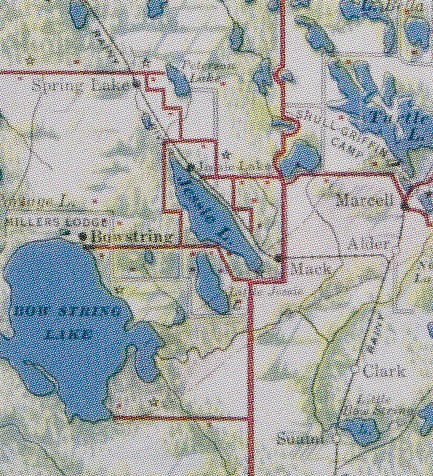
Mack was located along the boundary line between Bowstring Township and Marcell Township, at about the junction of where Hwy 6 interests with Mac Road, which is actually the old railroad grade between Alder and Spring Lake.

Samuelson had a general store, and that is where the post office was.  He was the postmaster until the end of 1923 when John and Ida (Suominen) Puhakka took over the store, and Ida was appointed postmistress.  There is no record in the documents I had access to that indicated when the Mack post office closed.

Elmer Mattila Interviews

One of the places I found Mack referenced was in some of the oral history interviews Elmer Mattila and others did with the older population in the area in 1996 and 1997. 

Elmer used a very in-depth set of questions with everyone he interviewed, then the tapes were transcribed and are filed by the last name at the Itasca County Historical Society (ICHS).  I located four who walked to Mack three days a week when delivered by the train that came from Deer River to Wirt.  The other days the train went from Deer River to Bigfork. 

Robert McDonald (dob 1925) ~ “It was called Mack or Coal Docks.  It was a coal station for the railroad.  They had big piles of coal there.”

Saimi (Mantila) Poliachik (dob1913) ~ “When I got old enough to go, I had to walk there a couple times a week.  It was four miles to Mack.  That’s where the mail was.”

Cliff Niemela (dob 1926) ~ “Mack would have been the nearest store.  By the Alder Road.  It used to be a depot there and a Post Office, and then Puhakkas store.  That was the closest until Noso put up a store on Higgins when Higgins was in jail.  But that didn’t last long.  Maynard Tumsa robbed that store.  Ever hear about that?  Maynard come over Noso wasn’t there and he went into the store.  Then he bought a candy bar.  He started down the road.  Noso said he was walking kind of funny.  So he ran after him.  He stuck the money in his shoe and he couldn’t walk.”

Mary (Byer) Schultz (dob1903) ~ “There was a depot there.  See the train went through there up to Spring Lake then.  Then there was a depot and Samuelson had a great big store there.  Post Office.  And then there was a lady that started a restaurant there.” Elmer: “So in Mack, there was a restaurant, the post office, store and the depot? Mary: “Yup, that was Mack.”

Kuusela Family

There is a file on Mack at the ICHS.  It is thin but contained an interesting document.  A copy of the Petition for Naturalization for August Kuusela, who resided in Mack with his wife Hilda and several children at the time he made application in 1916.  Here is the portion of the paperwork I found most interesting:

Petition for Naturalization

In the District Court of Itasca County, Minnesota the petition of August Kuusela hereby respectfully states:

First, my place of residence is Mack, Itasca County, Minnesota. Second, my occupation is Homesteader.  Third, 

I was born on the 3rd day of November anno Domini 1883 at Kuopio, Finland. Fourth, I immigrated to the United States from Liverpool, England, on or about the 1st day of May, anno Domini 1910, and arrived in the United States, at the port of New York, New York, on the 13th day of May, anno Domini 1910, on the vessel Lusitania.  Fifth, I declared my intention to become a citizen of the United States on the 31st day of May, anno Domini 1912, at Grand Rapids, Minnesota in the District Court of Itasca County.  Sixth, I am married.  My wife’s name is Hilma Kuusela.  She was born in Finland and now resides at Mack, Minnesota.  I have three children, and the name, date, and place of birth and place of residence of each said children is as follows:

Aili Tyyne – born Aug. 4, 1913 in Deer River; Svea Esther – born Sept. 2, 1914 in Mack; Salli Senia – born May 6, 1916 in Mack.  Residence – Mack, Minnesota­.

The petition covers a few other items, and includes affidavits and signatures of petitioner and witnesses.  The witnesses were Joseph P. Peterson of Alvwood and Wirt Heikine of Mack.  It is dated and filed with the court on October 18, 1916.  Heikine had homesteaded on a parcel of land adjacent to Kuusela’s 80 acres in section 27 of township 147-25 (Bowstring).

Searching ancestry.com brought up another very intriguing piece of information.  Hilma (Peltola) was supposed to have been on the Titanic.  In fact, her trunk was on the ship, and of course, it was not recovered.  Peltola arrived from Finland to Liverpool too late to board the Titanic, and sailed on a different ship! [Hibbing Daily Tribune, Hibbing, Minn. May 22, 1985.]

Benson Family

William O. Benson and his son Everett came up from Missouri in the spring of 1917 and settled about four miles from Mack.  They started working the land as soon as they could, and in a letter William sent home in December 1918 he stated: “We think Minn the garden spot of the earth.  Of course we can’t raise everything here and neither can you any place else that I have ever heard of.  But we can raise all the potatoes and other roots.  We had 175 bu potatoes, 30 bu rutabagas & turnips, 15 bu parsnips, 10 bu carrots, 5 bu onions, some beets and 100 head of cabbage.  We canned 75 qt green beans, about 20 qt peas, 60 qt raspberries, about 15 qt strawberries.  I expect I saw a carload of raspberries go to waste, they are everywhere that is in open ground.” [Jessie Lake the First Fifty Years]

Law & Order ~ The Poisoned Cake

9.18.2022 [archived ~ 10.19.2017]

Poison has been used as a murder weapon throughout history, and most originally came from plants. 

Strychnine, the poison used in this alleged crime, is found in a genus of 196 various trees and climbing shrubs in the warm regions of Asia, Africa, and America. The seeds and bark contain strychnine.  Specifically, a shrub grown in the Philippines with a fruit known as Saint Ignatius bean contains two dozen seeds in each pod.  Strychnine was first imported and marketed as a poison to kill rodents.  It was easy to buy at either general or drug stores.

Gus Voigt Held for Poisoning Stepmother ~ Itasca News 5-28-1915

“Grand Rapids, May 26. – Gus Voigt is under arrest here on a charge of attempting to poison his stepmother by sending a cake containing strychnine to her home.  Mrs. Voigt, after eating some of the poisoned food, became violently ill and a physician was summoned and with difficulty saved the woman’s life.

Family troubles over the estate of Voigt’s father, who died two months ago, is alleged by the police to have prompted the attempt.  Voigt was cut off without an inheritance by the terms of his father’s will.

The family is well known in Deer River, having lived for the past twenty years at Deer Lake.  Friends say there was no feeling over the will of the deceased father, as it was annulled by the wife, who wished an equal distribution of the property.”

Brief Voigt Family History

1884 ~ Gus Voigt was one of nine children born to Frank Sr. and Anna Voigt. 

1900 ~ Voigt Family moved from Wisconsin to Itasca County.

1903 ~ Frank Voigt, Sr. built summer resort of east side of Deer Lake.

1910 ~ Gus had a family of his own and lived near his parents in Bass Lake township.

1912 ~ Gus’ mother, Anna died just before Christmas from tuberculosis of the knee joints.

1914 ~ Gus’ father, Frank Sr. married Emma C. (last name unknown).

1915 ~ Gus’ father, Frank Sr. died February 21st.

Probate following Frank Sr.’s Death

“Frank Voigt, Sr., her husband to whom she had not been married a great while, died intestate – without leaving a will.  She inherited one-third of the estate by law.  There are nine other heirs to the estate, which was not valued at more than five or six thousand dollars.

The day after the funeral Mrs. Voigt entered into a contract with the nine other children, to accept one-tenth of the estate, dividing it equally between the children.  This seemed to be understood and mutually satisfactory at the time. Mrs. Voigt, from apparently laudable motives, gave up one-third to accept one-tenth of the property – she to have the custody of the two little minor daughters, Lillian and Alice, her step-children.  In her testimony, she said she freely understood the terms of the contract read and prepared by Hon. C.C. McCarthy.

Later Mrs. Voigt began an action in the office of the probate judge to annul this contract.” [this action occurred before the May Day cake – trial testimony]

Trial

The trial began on October 1, 1915 and lasted eleven days. 

“The question of whether Gus Voigt of Deer Lake, placed strychnine in cake that his children carried in May baskets to the home of his stepmother, Mrs. Emma C. Voigt, on last May 4, with the intention of poisoning her, has occupied the time and attention of the district court here for the past week, and has proven of absorbing interest in the village and throughout the county.  There has been a very large attendance all the time, including many ladies.” GRHR 10-20-1915

Mrs. Emma Voigt, the alleged victim, was on the stand for two days.  “The story told by Mrs. Voigt, and substantially confirmed by stepdaughters, Alice and Lillian, and others, is that she and the girls planned to send May baskets to the children of the Gus Voigt on Sunday, May 2 and that this was done.  Six baskets were started to the house, and on the way, the children met some of the Gus Voigt children coming across to the house, and they took them back with them.

It is alleged that on Monday and Tuesday Gus Voigt told Lillian that there was a surprise for them on the way – meaning May baskets for the two little girls and one for Mrs. Voigt.  It is alleged in the testimony that the candy was for the two little girls and that the cake was for Mrs. Voigt, as she did not like candy. That they were not to eat the cake – as it was particularly for ‘Mumsie’ as the daughters called Mrs. Voigt.

The Voigt children brought the baskets Tuesday evening and left them outside the door, and Lillian and Alice brought the baskets into the house.

Mrs. Voigt then recited how she opened the cake said to have been intended for her, gave Alice a little piece of it, and ate a small piece herself.  Alice went out to play.  Alice testified that the cake tasted bitter and made her sick, but she did not mention it at the time, fearing it would be impolite to criticize a gift like that.

Mrs. Voigt later ate a second piece of the cake, she says, and it was not long until she was taken violently ill, according to the testimony of herself, the girls, neighbors, Dr. Hoeper and others.” GRHR 10-20-1915

In addition to Mrs. Voigt, the girls, and neighbors that came to her aid, the prosecution called several witnesses. Testimony included Dr. Frank Sarzin, expert as to symptoms of strychnine poisoning, Julius Hortvet from the state chemist’s office, and John Voigt, brother of Gus, who identified the handwriting on the bottle of strychnine found in Mrs. Voigt’s room as the writing of his father. 

The defense, of course, had their expert witnesses to contradict the state’s testimony and late Friday, Oct 22, the jury began deliberations.

Voigt Acquitted by Jury Saturday ~ GRHR 10-27-1915

“The long drawn out Voigt trial ended Saturday morning when at 6 o’clock the jury returned a verdict of not guilty in favor of Gus Voigt of Deer Lake, who had been indicted and tried on the charge of attempting to poison his step-mother, Mrs. Emma C. Voigt.  The common report is that the jury stood 8 for acquittal to 4 for conviction on the first ballot.

No case in years has attracted more attention, and this was evidenced by a packed courtroom on Friday when County Attorney R.A. Stone and Hon. C.C. McCarthy, attorney for the defense, made their argument to the jury.  The instructions of Judge C.W. Stanton were made to the jury Friday evening, and the jury retired about 8:30 to begin deliberations.”

Skull and Crossbones

In modern history, the skull and crossbones was the symbol used for a secret society of the same name at Yale University in 1832.  Soon after the society was created, the symbol took on another use as well. In 1829, New York State Law was changed to require that all containers of poisonous substances be labeled. The skull and crossbones first illustrated those labels in 1850.

Gone, But Not Forgotten ~ Idlewild Resort Old Itasca County Resorts

9.11.2022

As most everyone who lives in Itasca County knows, recreation and tourism have been important facets of our community since before World War I. There was a significant rise in the number of smaller, mom and pop type resorts in the 1930s and early 1940s. After World War II resorts of all sizes flourished, but not all are in business today. “Gone But Not Forgotten” is a companion to my “Resorts With a History” series.

Last month, I featured Cedar Point Resort, one of three on North Star Lake, so I thought I’d highlight the other resorts on that lake this time. First, I should explain that the 1916 Itasca County Plat map shows this lake as named Potato. If you look at the shape, it’s nothing like a potato. Potatoe (with an ‘e’) Lake, near Taconite, however, looks very much like a nice U.S. No. 1 grade, though it is quite small, while Potato/North Star has 10.17 miles of shoreline!

Walter Alvah Stickler established the first resort on the Potato Lake near Marcell and set about getting the name of the lake changed.  Stickler, a young man from Mishawaka, Indiana, came to northern Minnesota in 1907 on the advice of his doctor.  Shortly after he graduated from college, Stickler had a heart attack. His doctor believed his anemic condition would benefit from him drinking the iron rich water in Northern Minnesota. A friend recommended the small community of Marcell and spent the winter with him there.

Stickler’s health improved and he liked the area. He helped out at the Marcell mercantile, and after hearing of repeated requests from travelers for places to stay while they hunted, Stickler began looking for a parcel of land on a lake to purchase for that purpose.

In the fall of 1909, Stickler returned to Indiana, married Miss Rose Bell Nikart, and brought her back to Marcell. It’s believed that the Sticklers bought fifteen acres on the east side of Potato Lake for $150.  By 1912, cottages were available at the resort simply called Stickler’s.  

George Rossman, editor of the Grand Rapids paper, made these comments about the early years of Camp Idlewild. “Guests came by way of the Minneapolis & Rainy River Railroad to Marcell and then were transported in a boat across Little Rainy Lake and then walked across the portage to North Star. Sometimes the train would stop at a cedar landing, nearest point to the lake, to permit unloading of freight and passengers for Stickler’s place.” [Up in This Neck of the Woods column Grand Rapids Herald Review 5-29-1939]

By 1922, when the Grand Rapids Herald-Review ran a special forty-page supplement called “Zone of Plenty” promoting the benefits of living in Itasca County, Potato Lake had been renamed North Star. And although there were plenty of resorts, the only one on North Star was Stickler’s Camp Idlewild.

Stickler was quite an entrepreneur.  He was an avid photographer, hospitable proprietor, and a man who sought out opportunities. His friend Gordy Newstrom suggested taking advantage of the area’s recent interest in aviation, so he invited a local pilot to the resort.

Fly at Idlewild ~ Deer River News 8-29-1929

“There was fun aplenty last Sunday at Camp Idlewild, Walter Stickler’s deservedly popular resort near Marcell.  ‘Dusty’ Rhodes, Hibbing flyer, was there with his plane, a sister ship of Lindbergh’s famous ‘Spirit of St. Louis.’ During the afternoon 78 passengers were taken up, four at a time; and only the darkness stopped the sport. Walt says a view of that country from the air is a sight of a lifetime, and we’ll take his word for it.”

In the early 1930s he began making moving pictures of fishing, “I went to Marshall Field’s in Chicago and showed pictures there for about a week in the sporting goods department, and I figured that week brought me more than $50,000 of resort business.  When I boosted Marcell, the whole county was boosted.” [interview with Ray Gravelle- Grand Rapids Herald-Review 10.14.1971]

Advertising from 1931 states that Camp Idlewild has a nationwide reputation, for guests come from every part of the United States and it is an uncommon season which does not see fishermen here from at least twenty states.

There are 24 guest cabins located on a natural ridge above North Star Lake, a beautiful body of water several miles long and deeply indented with points and bays, and with several beautiful islands.  This is the real land of lakes, and Mr. Stickler has boats on over 30 different lakes, all easily reached by auto or short portage.  There are about 75 boats in the fleet maintained by Mr. Stickler at all his fishing lakes.

New improvements at Camp Idlewild this year include a large dining hall built of logs and finished in natural colors.  This is so arranged so that it can be opened to the lake breezes on three sides, and the lake is in sight from ever table.  The water system is being extended and electric lights and all other modern conveniences add to the comfort.  The food furnished here leaves nothing to be desired and is one of the reasons why Mr. Stickler is able to point to increased business each year.”

In the resort’s twelve-page 1940 brochure, Stickler includes over two dozen photographs, many of which are happy fishermen and women with their catch. There is also a letter on Camp Idlewild stationary with, of course, a photograph of Walter and Rose Stickler.

“Dear Vacationer:

     It is my great pleasure to welcome you to this beautiful North Woods Lake Region of Minnesota country so rich in the attractions of the great out-of-doors.

    If you have never visited here before, you are on the threshold of a more delightful experience, and it is our business as well as pleasure to see that you get the very best of everything this north country has to offer.

    Camp Idlewild, as you may know, is recognized as one of the country’s most responsible resort-camps with a reputation for honest efficient service that has won the confidence of so many fine people who return here year after year with their friends and families, and we want to number you among these many good friends.

    This folder will tell you all about our camp, location, rates, accommodation, etc., and I shall be glad to make such reservations as you desire.  Just write or wire me your desires.

   Excellent motor roads lead right into camp, and low summer tourist rates are in effect on railroads throughout the country.  Anticipating the pleasure of having you as our guest at Camp Idlewild this season, and again extending to you my cordial welcome, I am.

    Sincerely Walter Stickler, Owner

The Sticklers offered three levels of cottages. De Luxe Cottages with modern toilet, etc., including all meals, lodging, maid service, $5/day, $35/week per person. Special De Luxe Cottages with a tub bath, etc., including all meals, lodging, maid service, $6/day, $38/week per person. Standard Cottages with running water (but without inside toilets) including all meals, lodging, maid service, $4/day, $25/week per person. Boats were $2.50 a week; outboard motors $2 a day. Experienced fishing guides were available for $5/day.

Stickler sold the resort in 1944 to Clarence and Evelyn Harris. I do not know when the resort closed, but I did find a Camp Idlewild envelope postmarked 1966.

Other Resorts on North Star Lake

I have bits and pieces about the other resorts on North Star Lake that are no longer there.

Deer Trail Resort – It was started in 1932 by Mr. and Mrs. Al Williams. Later owned by Tony Sovil and called Trails End.

Eureka Cabins – There is no information on original owners. Name changed to Camp Joyce when owned by Mr. and Mrs. Bock.

Hoffman’s Camp ~ It was owned by Mr. and Mrs. Lloyd Hoffman.  It is not known when the resort began. It was sold in the mid-1930s to Jim and Ruth DeHaven. In the 1940s it was called Havenwood and DeHaven’s, and eventually DeHaven’s North Star Camp

Know-Us-Ark – The only place I found it was on a 1934 Fuller’s Tackle Shop map.

Northwood Resort – It was started by Mr. and Mrs. Fred Podell (possibly with J.H. Valentine some of the time) in the mid-1920s. It was believed to have been sold in the early 1940s to Mr. and Mrs. Ross Watkins.

Mayer’s Green Ridge and Northwind Lodge are both listed as resorts in the 1950s in Ren Holland’s book, The Early Resorts of Minnesota, but I could not find anything more about them. [The Early Resorts of Minnesota – Tourism in the Land of 10,000 Lakes: Ren Holland: 9781592984374: Amazon.com: Books]

Big Timber (formerly Pine Crest) and North Star were both resorts started in the 1930s and are still going strong.  They will be featured in the Resorts With a History series next summer

School Days ~ Max

9.4.2022 [archived ~ originally published 3.8.2018]

Max School Students and Teacher Peter Broquist 1927

How old is the teacher?  This is a question that Bernard ‘Bud’ Anderson and his school chums at the Max rural two-room school wondered about Miss Lillian Hunter.  “It was kind of a joke, she would never tell her age, she was quite an elderly person already. They thought her age would come out when she went to the land office to prove up on her land, but when they asked how old she was, her answer was 21 and over!  So, I never did find out how old she was.” [Notes from B. Anderson, throughout the article, are from Itasca County Historical Society Archives and There’s No Place Like Max (2007)]

Max

The township of Max is northwest of Deer River off Highway 46.  The community of Max, according to the 1916 plat map, is in section 20, between Round Lake and the lower part of what was then called Squaw Lake.  The 2014 plat map shows Max to be three miles to the east of this location, on the border of sections 23 and 26, where county road 4 makes a sharp turn to the north.  If you traveled the roads before about 1999, you would know this as the Max Mercantile.

Max Log School

In 1907, the Max school, part of the Grand Rapids School District, was erected on the east side of the lake. The one room building was constructed from white pine, hewed on both sides and moss stuffed between; and heated by a box stove.  The water pump and outhouses were, of course, outside. Miss McHolland, the first teacher came up from Minneapolis.  She did not seem to mind the north woods as she was boarding with the Frank Vance family and still teaching in 1910.

Ina Gustafson started first grade at the school in 1908, and her teacher was Miss Oberg.   The Gustafsons were part of a group of seven families that came north from Menagha, Minnesota to homestead in Itasca County.  They traveled by horse, with a double box lumber wagon containing furniture and household items, as well as a pig and a few chickens.  The men drove the cattle. It was a trip an arduous of about 150 miles and included a stop at the Cass Lake Land Office to file on homesteads.  Besides the Gustafsons, were the families of John and David Hamalainen, Matt Martin, Emil Kananen, Oscar Kokkanen and Paul Hyttinen.

According to an interview conducted by Melvin Krueger in the 1960s, Ina (Gustafson) Peltola, who lived on the west side of the lake, remembers that “she rowed a boat across the lake twice a day in fall and spring and used to skis on the ice and snow in winter.  She attributes her good health through the years to daily exercise during her elementary years in school.  One day her mother had to go with her to ward off the wolves with a pitchfork.” [A History of Consolidation of Squaw Lake Schools by Melvin Kruger]

School district records indicate that in 1911, Miss Dora Brackin was paid $45 a month for the sixteen children in the school. This included eight boys and eight girls, from the Martin, Niska, Stejskal, Wolfe, and Hamalainen households.  Each family had at least three school-age children, so we do not know where she boarded.  The enrollment fluctuated, then climbed steadily.

Bud Anderson started first grade in the log school, but discussion on a new one had already begun. Some students, like Bud, lived further than the two-mile radius the district tried to follow. “When I first started school, a fellow by the name of Jacob Sweedman, hauled some of the students to that school by horse and buggy, and in the wintertime of course it was the sleigh.”

Max Two-Room School

In 1919 a new two-room school was built and ready for occupancy at the September start date.  It was about a mile southeast of the old location, on a graded road.  According to 2014 plat, this would have been located on the property now owned by Rodney & Evelyn Oja, on the west side of Highway 46, about ½ mile south of the County Road 4 intersection.

At the start of second grade, and closer to home, Bud walked to school.  His father, Albert, had come to the area fifteen years earlier to homestead, with his friends Pete Oslund, and Albert, John, August and Alfred Setterberg.  When he had proved up, he married Esther Bergquist from his home community west of the Twin Cities. She requested he make the small homestead cabin larger, so he returned alone to complete the task. In the meantime, Esther, now pregnant, prepared things for their new baby and a new home.  In February 1904, Esther and infant Bernard traveled by train to Minneapolis, then Duluth and from Duluth to Bena.  It was another thirty miles by sleigh.

For many years, the teachers boarded with the Anderson family, and Bud noted the advantages, “the extra help he got from them certainly improved my studies.”  When he was in about fourth grade, the teacher got a radio for Christmas.  “It was the first radio I can remember. It was one of those old time ones that had 3 dials that you had to coordinate in order to get the music or whatever it was to come in, because it was very sensitive.  It used to be more noise than anything else, but it was the first radio that I know of that was in our immediate area.”

Bud’s sister Elinor was born on May 5, 1925, and he relates, “she was named in honor of one of the teachers who had been staying with our family and teaching at the Max school.”   I had hoped to verify this tidbit of information, but the records between 1918-1926 are incomplete. 

Back to Max School

Like Bud, Peter Broquist went to both the old and new schools. And he also taught at Max! Andrew and Caroline Broquists immigrated from Sweden to Meeker County with their infant son in 1903. Following Caroline’s unexpected death, Andrew’s mother moved to northern Itasca County to care for his two young sons

After finishing at the rural school, Peter probably attended high school in Grand Rapids, and then a one-year normal school program.  After passing the State Exam, as that was the requirement for teaching in the rural schools in the 1920s, he would have been ready. He was the teacher at Max school for at least two years, 1926-27 and 1927-28.

It was 1931 before both rooms of the school were used.  The enrollment reached 51 in 1947, and the following year the 7th and 8th graders were transferred to Round Lake.  In 1952 the school closed, and pupils were transported to Squaw Lake.

So, how old was Miss Lillian Hunter?  Of course, I followed up on that.  She was born in Minnesota in about 1867. Shortly after 1905, she and her brother moved to Ardenhurst. Lillian was about 45 years of age when she proved up her homestead!   

Itasca County Resorts with a History ~ Eagle Nest Lodge

8.28.2022 [archived ~ originally posted 8.30.2018]

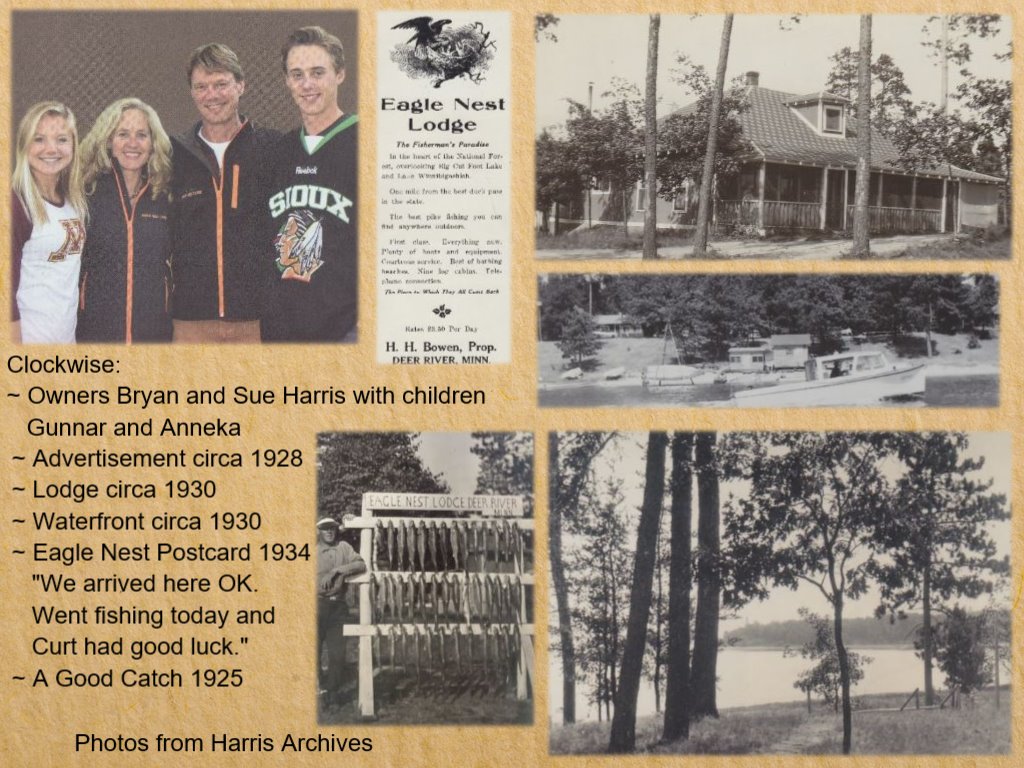
Eagle Nest was the dream of a family with a vision. Herb and Jessie Bowen, proprietors of the Cut Foot Sioux Inn, realized that they could no longer accommodate the growing number of fishing and hunting guests, and decided to build another place.

By the end of July 1924, two large main buildings were being constructed on the north side of Cutfoot Lake, about two miles from the Inn. The lodge and sleeping quarters were ready for hunters in the fall, and the plans progressed as scheduled into the following year. 

The Bowens sold the Cut Foot Sioux Inn to daughter and son-in-law Stella and Al Christie in March and had their cabins at Eagle Nest ready for the fishing opener of 1925. Seventy seasons later, after searching for the right resort to own and raise their family, Bryan and Sue Harris bought Eagle Nest, and have no plans of being anywhere else!

Bowen 1924-1931

Bowen Resort One of the Largest ~ Grand Rapids-Herald Review 6-10-1925

“H.H. Bowen is now finishing on Cutfoot lake what is to be one of the most complete summer resorts in northeastern Minnesota.  The ‘Eagle Nest’ as the place is known, was started last year after Mr. Bowen had sold out his interests in the Cut Foot Sioux Inn at the bridge.  The new place is on the north shore of Cutfoot lake about two miles off from the main highway, the present road to the lodge winding through beautiful timber and bringing the visitor to a full view of the Cutfoot with Winnibigoshish in the distance.

A half dozen commodious log cabins have been built, and the main lodge is a very well-constructed building with its large lounging room and dining room.  The place has its own electrical generating plant.  The most important construction now is a large building which will be divided into three housekeeping apartments. The visitor may later get to Bowen’s any type of accommodations which he may wish.  When the present work is done, Mr. Bowen says that he is through for a while, and he will devote his attention to beautifying the premises and to the entertainment of his guests who are coming in larger numbers every week.  The Eagle Nest has access to all the fishing and hunting of the Cutfoot Sioux-Winnibigoshish district.”

A lot of supplies were needed to take care of resort guests. Some of which could be harvested from the land and others procured in bulk from merchants in Minneapolis and Chicago. In January 1927, the Bowens and Christies were heading south on a buying trip and passed through Deer River. Herb proudly proclaimed they were getting ready for a busy summer. “We have 6,541 cakes of ice, 19-inch square, stowed away for the summer season and also 250 cords of wood in the woodshed.” [Deer River News 1-21-1927]

And based on newspaper coverage, it was a busy summer, starting with 75 Shriners from Duluth, Superior, and Hibbing. Later there was high praise from the editor of the St. Cloud Daily Journal Press, who came fishing, and also from auspicious executives of a large publishing company from Dayton, Ohio.

The following years were prosperous too, but when Herb Bowen died in February 1931, Jessie sold the resort to George and Rhonda Van Wagenen.

Van Wagenen and Others 1931-1994

During the next sixty years, the resort was owned by many individuals.  Those parties staying the longest, were the Van Wagenens and Walter and Alice Rickert, along with Al Schultz, both groups of owners for fifteen years.  Other proprietors include Isaac Fleener, Bill and Genie Lauterbach, John and Louise DeLoge, Bill and Valma Boller, Lee and Harriet Bondhus, Jim, Ginger and Kris Tomlinson, and Jack and Marion Zwicky.

George Van Wagenen’s brother, John and wife Harriet, were hired as managers.  They lacked the culinary skill of Ma Bowens and Stella Christie, so a chef was hired.  “For this position, they have secured Mr. E.J. Fisher, formerly chef at the Spaulding hotel in Duluth.  Mr. Fisher comes here strongly recommended and with an enviable reputation, and there is every assurance that patrons of Eagle Nest will continue to be well fed.”  [Deer River News 4-2-1931]

One of the very first groups the Van Wagenen’s entertained was somewhat famous. “Bert Baston of Minnesota football fame and All-American end a few years ago will head a party of eighteen who have made reservations at Eagle Nest Lodge over the coming weekend.  All members of the party are from the Chevrolet branch of General Motors.”  [Deer River News6-18-1931]

A brochure from the Van Wagenen ownership about 1935 was found in the late 1980s when Zwicky’s were remodeling.  It states they can accommodate 55 guests in either sleeping cabins, with meals provided in the dining room, or in housekeeping cabins, where they can prepare their own meals. “Sleeping Cabins, Meals and Boat, per person $4.50 per day.  Children under 12 half price. Housekeeping cabins including linens, bedding, dishes, fuel, ice, etc. and one boat per cabin, $25 to $35 per week.”

Meals were still prepared by Chef Fisher, and for those visiting for the day, breakfast or luncheon was 75 cents, $1.00 for dinner, and $1.25 for the Sunday Specialty dinner.

A newspaper clipping from about 1940 was sent to the Harris’ in 2002 came from longtime guests of the resort.  It had been found in his mother’s scrapbook – “Attorney William B. Schroder is telling friends about his good fortune on a trip the last two weeks to Eagle Nest Lodge at Cut Foot Sioux, Minn., on Lake Winnibigoshish in Chippewa national forest.  Mr. and Mrs. Schroder and their

sons, William B. Jr., and Robert C. made the fishing excursion.  Mr. Schroder caught the limit of wall-eyed pike in an hour one morning.  His party landed 40 wall-eyes in that time, he reports.  Describing the adventure, he says, ‘That was the best sport I ever had.  It was all we could do to keep the hooks baited and land the fish, they bit so hard.”’ [Rock Island Argus]

Eagle Nest was really a fishing camp before 1988 when Jack and Marion Zwicky became owners.  Their goal was to complement the excellent fishing the area was known for, with activities for all ages.  One of the unique family-oriented events was the creation of a twenty-foot high totem pole erected overlooking the beach in 1992. 

Harris Traditions 1995

Working in a resort was not new to Bryan or Sue Harris. They both worked at Fair Hills Resort near Detroit Lakes, Minnesota summers during college and for a while after graduating.  Soon after they married, Sue and Bryan left their real jobs to pursue a career in resorting. 

“We stopped looking after our first visit to Eagle Nest,” Sue explained, “We wanted a resort on the north shore of a lake, it was the size we wanted, and we saw the potential to attract families.”

Bryan and Sue, along with their children Gunnar and Anneka (now at college when not at the resort) have instilled many traditions that bring families back year after year. Snapshots taken during the Sunday evening ice cream socials are proudly displayed in hand adorned frames before the week is out. Throughout the week the staff coordinate activities for young and young-at-heart such as treasure hunts, hikes, bingo, and fish painting t-shirts.  These are just a few of the events that have become traditions. 

Sue said, “I have boxes of the framed photos of my kids – every week they had a new set of friends and loved doing the rec activities with them – other resort families had the pictures for every year, I have them for every week!” Chances are Gunnar and Anneka had plenty of decorated t-shirts by the end of each summer as well. Oh, and the hands-down favorite tradition is waterslide down the resort hill into the lake.

It has been 24 seasons since Harris’ greeted their first guests, and they have seen many of those same faces every year.  “We have some guests that have been coming to Eagle Nest for forty or more years,” Sue said. “Those that come the same week every summer and joke about being cousins even though they are not related!”

The family that has been staying at the resort for the most significant number of consecutive years is the Ieuter’s. Earlier this month they were here for their 70th annual vacation. The first Ieuters, William and Ruth, came from Chicago with their three sons.  Ten years ago, 40 relatives came to Eagle Nest the same week.  This year they occupied five of the resort’s fifteen cabins with four generations. The Ieuter’s like many other Eagle Nest families have a few of their own traditions. This year as always, they had a fishing contest, wore themed t-shirts and enjoyed gourmet dinners prepared by Bill, the eldest of the crew.

Fishing will always be a very popular resort activity.  And with fishing, comes the occasional fish hook misadventure.  Sue says, “Bryan is really good at taking fishing hooks out.” 

“Not really good,” Bryan clarified, “just good enough!”

The Harris Family is as much a part of Eagle Nest as Eagle Nest is a part of them.  They have owned the resort the longest and anticipate many more years of greeting familiar faces.  “For us, the resort is a great place to raise a family. Our kids work hard and play hard, pretty much the same as we do, and we’re glad they are still spending their summers working with us.”

When Weddings Included a Charivari or a Pan-Can-Cowbell Band

8.21.2022 [archived ~ 6.22.2017]

Wedding photo of Maude Taylor and Edward Scheer 1906 [my grandparents]

At the turn of the 20th century, it was rare that weddings took place in the towns of Deer River and Bigfork.  Instead, the betrothed took the train to Grand Rapids, Duluth, or Minneapolis.  The ceremonies did not occur on a Saturday, but maybe a Monday, Wednesday, or Thursday.  And the time?  Morning or evening was as good as midday.  The young couple looked for a justice of the peace or preacher as soon after the license was obtained as the law allowed.

The witnesses were usually members of the officiant’s family, or close friends, as in the case of a double ceremony.  There were no notices to save the date, and in fact, more often than not, few people even knew that a couple was to be married. A celebration of some sort might occur when the married couple returned to the home community as a dance was always popular and might lead to another wedding!

The following are a sample of the wedding announcements between 1897, when the Itasca News began publishing in Deer River (the Bigfork Settler was open for business in October 1903), and 1904.  The headlines that are not centered were inserted by me as the ‘notice’ was in a general body of news.

Father of the Bride Had a Change of Heart “The father who passed through town last Tuesday from Bemidji in hot pursuit of his eloping 17-year-old daughter and her 50-year-old lover, overtook the pair at Grand Rapids, where he witnessed the wedding ceremony and joined them in the wedding tour back to Bemidji.” Itasca News7-31-1897

Mother Unaware Daughter Had Married “We are reliably informed that about two weeks ago, Miss Ina Gibbs and J.A. Quigg were quietly, and unknown to the bride’s mother or anyone else here, married in Minneapolis.  Mr. Quigg left here Monday to rejoin his wife and take in the fair. 

He informed Mrs. Gibbs Monday morning that she was his mother-in-law.  She was opposed to the girl marrying, and she quietly went to Minneapolis and saw her daughter.  She returned yesterday and says the report is true.  Mr. and Mrs. Quigg have not returned yet.” Itasca News 9-7-1901

Raucous Charivari “One of the heaviest bombardments heard by anyone in this section took place around the Northern hotel last Monday night in the charivari tendered Bob Clark and bride, formerly Margaret Welch, who has been an employee of the Northern hotel for more than a year.  The couple were united in Duluth last week and returned home Monday.  Mr. Clark is our hustling village blacksmith, an old resident of this place, and he has many friends with whom the News joins in extending congratulations.” Itasca News 3-1-1902

Three Prominent Deer River Couples Spliced ~ Itasca News 3-15-1902

[1] “Joseph T. Girard and Miss Lena Klinert were united in marriage at Duluth Wednesday and returned yesterday noon and put up at the Northern Hotel, where the two have courted and wooed during the past year.  The bride was formerly a resident of Duluth, is an amiable young lady and has a host of warm friends in Deer River.  Mr. Girard has been a resident of Deer River for seven years.  The past two years he has been agent at this place for the Duluth Brewing company… This couple will soon go to housekeeping, having secured the Baker cottage which they will occupy as soon as it is vacated by Mr. and Mrs. J.A. Quigg. [*Couple married a year ago]

[2] Host and Hostess Howard had arrangements all in order for a reception banquet in honor of the bridal party and also their guests Mr. and Mrs. R.J. Clark, who were married last week. [Couple from Raucous Charivari]

[3] But surprise and good feeling ran high in the community when at about three o’clock in the afternoon ‘Stub’ Hamilton announced that he ‘be gol darned if he and Lena didn’t marry too, for a triple wedding.’ And it was done.  Groom-elect Girard being a justice of the peace, he forthwith tied the knot in the presence of all the members of the household, which made John Hamilton and Miss Lena Gathercole husband and wife till death shall part them. The latter couple has resided in Deer about two years, and both have till recently been in the employ of W.J. Coffron.

Early in the evening crowds began pouring into the hotel, and soon all the public rooms of that popular hostelry were comfortably filled with friends, of some or all of the contracting parties.  Dancing was the order of enjoyment until one o’clock.  The supper was highly enjoyed.

This was the first, and it will most likely be years before a triple wedding will again occur in Deer River, and the memory of it will linger long in the hearts of many.”

The Pan-Can-Cowbell Band “Ed Bangle, the popular land locator of Big Fork river, and Mrs. Josephine Skallerud of Grantsburg, Wis., were united in matrimony at Grand Rapids Thursday.  The boys expected the event when the twain boarded the train for the Rapids.  On the evening local they returned, and at about nine o’clock the cannonading commenced at the Itasca hotel where they stopped.  The pan-can-cowbell band gave then a warm greeting and smoked cigars with the best wishes to the happy couple.  Mr. and Mrs. Bangle will remain in Deer River about a month and will then make their home at Mr. Bangle’s homestead of the Big Fork.” Itasca News 10-4-1902

Prominent Citizens Wed ~ Itasca News 4-9-1904

“Announcements were received by their many friends in Deer River of the wedding of Miss Alice Poupore and Mr. William C. LaCroix, which took place at the home of the bride’s parents at Poupores, Minn., on Wednesday, April 6th.

The parties are both prominent Deer River people.  The bride has for two years been a school teacher in the district, a sister of Mrs. Archie Stephenson and William and Robert Poupore.  She is a handsome girl of 21 and a society favorite.  The groom is well known in Itasca county, having for the past fifteen years been the superintendent of operations for the Itasca Lumber company.  He is 40 years of age, a friend of all who knows him.

Taking out a license to wed at the same time were Miss Clara LaPointe and Mr. Andrew Marcell, according to the clerk of court record published in the Duluth papers, and it is said both ceremonies were performed in conjunction.

Miss LaPointe’s home is in Duluth.  She has been for the past year in the dining room service at the Northern hotel in Deer River and is well and favorably known in society here. Mr. Marcell is also an old employee of the Itasca Lumber company, having for the past ten years been train master of that company’s railroad here.  He is about 38 years of age, a steady official and a jovial friend all along the line. 

Both couples will make their home in Deer River, which, is joyful news to the community.

When one comes to count up the number of homes contained in the village, it adds up the astonishing result that there are more couples here who were married while living here than those living here and were married before their residence began in this place.” 

The last comment by editor Taylor was very astute and designated the beginnings of a new generation.  Before long a new school was needed to accommodate the offspring of these and many other young couples. And yes, the Deer River school will be featured in an upcoming Schools Days series!

Itasca County Resorts with a History: Cedar Point Resort

“Maple Syrup and Morel Mushrooms”

8.14.2022

It is probably because North Star Lake is known for trophy Northern Pike, that there have been resorts here since the late 1910s. By 1938, when Cedar Point was established, there were five others and at the peak of the resort industry there were nine. Today three resorts which have been around since at least 1938 remain – North Star Resort, Big Timber (formerly Pine Crest) and, of course, Cedar Point Resort!

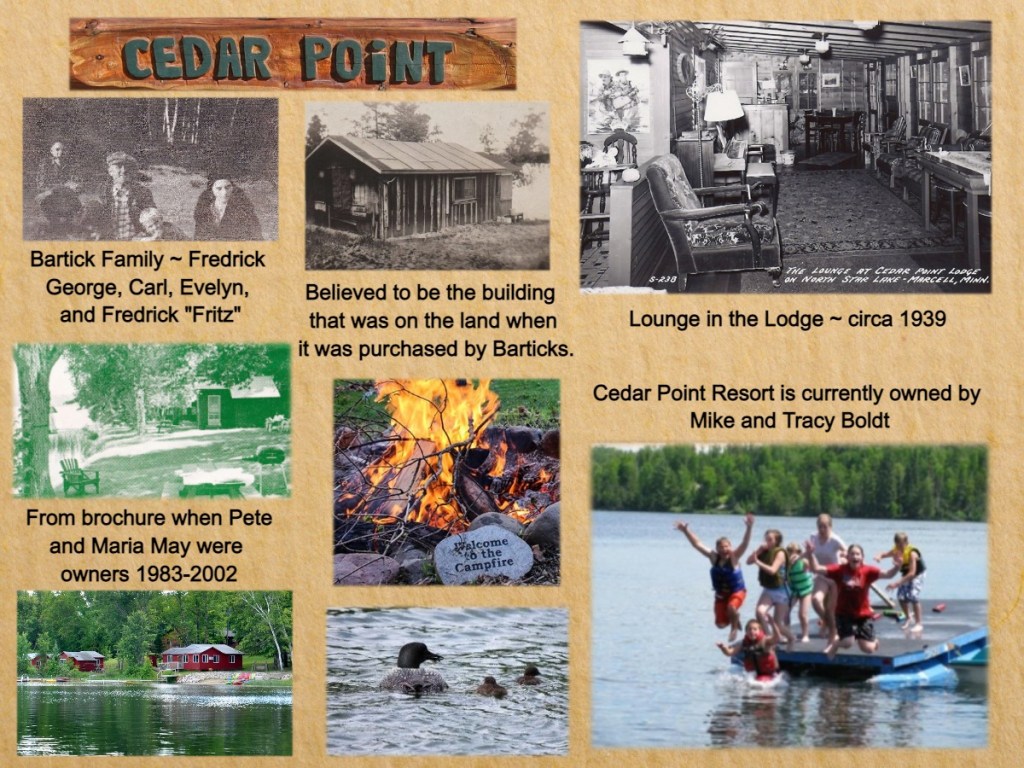
Carl & Evelyn Bartick 1938-1967

Carl and Evelyn Bartick came to Itasca County from Champlin, Minnesota in the late 1920s or early 1930s. They bought about fifteen acres on the west side of North Star Lake with the intention of establishing a resort.

Carl’s parents, German immigrants, perished in an apartment fire in Geneva, NY in November 1888. Seven-month-old Carl and his sister were passed through an open window and saved. The young children were placed in an orphanage and lived in foster homes.  Carl was not yet ten when he first ran away and, on one adventure, lost his left arm when he attempted to jump onto a train.

As a traveling salesman, Carl had been on the road for over two decades. He was ready to settle down when he married Evelyn in 1925.  Several years later, Carl and Evelyn moved north with their young son Frederick “Fritz” and Carl’s seventeen-year-old son from a previous marriage who was also named Fred.

According to great-grandson Frederick George Bartick II (son of Frederick George, eldest son of Carl), there was a cabin on the property when they purchased it which later burned down. It is probable that this became cabin #4, as it was destroyed by a fire in the 1970s. “My great-grandfather got the idea to establish a resort because a traveler passing through stopped and asked if they would rent him a room overnight,” Frederick George Bartick II said. His father started Fred’s Bait shop, on highway 2 in the early 1960s.

When the Barticks started the resort, Highway 38 was still a rutted road. To get to the property from Marcell, there were three miles of the old railroad bed (“Gut and Liver”), and then a mile long horse trail to the beautiful cedar timbered point of land.  The lodge (office, dining room and kitchen) and root cellar were built in 1936 and the rest of the cabins during the first ten years. A neighbor, for whom Bill’s Lake (just west of the resort) is named, helped Carl and Fred build the cabins.

Two more children, Gary and Marlys, were born during the years the resort was being built. They named it Bartick’s Cedar Point Resort.  Like many in the area at the time, the resort catered to fishermen and ran on the American plan – all meals provided in the dining room. These meals were cooked by Evelyn and Marlys when she was old enough to help. There were plenty of maple trees which were tapped, and morel mushroom collected.  In addition, there was a large garden. Bait was purchased from a local source and sold to the fishermen.

In the early 1940s there were eight modern cabins, all painted white. Modern meant bottle gas, electricity, running water, and showers or bathtubs. The rates were $22.50 a week for cabins and $4.50 a day for meals. Activities offered included tennis, croquet, horseshoes, and saddle horses. Before long three larger cabins were built as there was more emphasis on family vacations.

Carl was a crowd pleaser and spent time developing a clientele. In a brochure from the late 1950s he adds a personal message. “To those not acquainted with Cedar Point or the North Woods, let me say it will be a pleasure to talk things over personally and to try to make you feel the friendly spirit that prevails. I have lived here a number of years and am well acquainted with the country and will be able to help you plan your vacation, select your fishing grounds, etc…—C.H. Bartick.”

By the mid-1960s, a swimming pool, putting green, and shuffleboard court were added, as there were now more families than just fisherman that came to the resort.

Carl died in 1965 at the age of seventy-eight, and for a year or two, Evelyn continued to run the resort on her own. She was still doing most of the cooking and cleaning but, even with help, it was really too much.

In Between Years 1967-1983

Evelyn Bartick sold the resort to Larry and Charlotte McKibbons for $52,000.  The McKibbons changed the cabins to housekeeping – adding a kitchen area and ran the resort year-around. They no longer served meals, but the lodge was still the hub of the resort. In 1971 the McKibbons sold to Dick and Eileen Schmitz. At some point, the white cabins were painted red.

In 1982, the Schmitzes looked at the option of selling the ten cabins as a condominium type arrangement but, when potential buyers of the entire resort approached them, the plan was halted. They sold the resort for $195,000.

May & Senger Families 1983-2019

“The reason that we bought the Cedar Point Resort,” Maria May said, “was because my husband loved to fish.”  Twenty years earlier Maria and Pete met and married in Germany where Pete was stationed in the army. Karen, their middle daughter, moved with them from St. Cloud and worked there for three years before heading to the Twin Cities to work. After she married Tim Senger, and her folks were ready to retire, the Sengers bought the resort.

Pete & Maria May 1983-2002

Pete and Maria had talked about owning a resort and started looking at the ads in the newspaper. They settled on Cedar Point because they liked the lake and the layout. The pool was a plus as the Mays focus was on families.  To that end, some of the first things they did were to update the playground, put in a boat launch, and establish a campground. The campground option was less expensive for families, but they were still entitled to all the amenities.

One of the biggest initial challenges for the Mays was building a clientele.  The resort had been closed the year before they bought it. Many guests had stayed at another resort and, when that happens, they sometimes don’t come back. “We updated the cabins and offered activities for families,” Maria explained. “We had a spaghetti dinner one night a week that included salad, bread, and dessert. It was a very popular event.” The Mays also made caramel rolls one morning each week, had a movie and popcorn night and, of course the makings for s’mores.

With the introduction of the Polaroid camera, Pete and Maria began taking photos of guests who caught big fish.  These were displayed on the walls of the lodge and then put into a photo album. Pete was the one who came up with the idea to fill a gallon jar with colored water and see if the kids could drop a quarter in the glass to win fishing tackle.  The jar still sits on the counter. The water is a new color every year, but the prizes have changed to pop or a candy bar.

Games in the lodge were a great way to spend a rainy afternoon.  Maria recalls the Trivial Pursuit craze. “Families would play against families, it seemed to work best when there were large groups. There was always plenty of laughter and fun.”

“We had the resort for nineteen years,” Maria said. “It was a lot of work, but we really enjoyed it.”

Tim & Karen (May) Senger 2002-2019

“We came up to the resort with our kids as much as we could,” Tim said. Even before he met Karen, he and a friend had looked at buying a resort.  When Karen’s parents were getting ready to sell, everything fell into place for Tim and Karen to be the next owners.

The Sengers turned the owner’s living quarters into a cabin and updated the other cabins and put in air-conditioning. “We renamed the eleven cabins,” Karen explained. “Instead of being numbered we gave them names that fit our surroundings like Beaver Lodge, Bear’s Den, and Eagle’s Nest.”  They continued with most of the family traditions Pete and Maria had started. “Except we no longer had the spaghetti dinners.  As my mom said, they were a lot of work, and it just didn’t fit our lifestyle.”

Instead, they tried a few new food items over the campfire.  The pizza on a stick bombed, but the doughnuts were a hit. Cake doughnuts are put on a two-pronged roasting stick until they are warmed all the way through.  Then they are rolled in a cinnamon sugar mix.  They taste just like the mini doughnuts at a fair and are really good.

Before the end of every week, the Sengers took photographs of each family and put them in photo albums. Families that came here year after year loved paging through to see what they and the friends they made while vacationing used to look like.

The Senger’s daughters, Holly and Courtney grew up at Cedar Point Resort, and graduated from Bigfork High School. “Resorting is a great way of life,” Karen said. “Our girls had a special connection with some of our guests and those relationships have lasted.” Like the Mays, most of the guests have come from the Twin Cities, and other Minnesota locations, Indiana, Iowa, and Illinois. Several families had been staying at Cedar Point for three and four generations.

In 2015, Tim decided the playground needed to be updated so he built an incredible Pirate Ship. Cedar Point truly was a family-focused resort. “My fondest memories,” Karen said, “were hearing kids yelling and screaming on the beach and playground. I also loved my time with the guests when we’d make roasted doughnuts and s’mores.”

“On ice cream social night,” Tim explained, “I’d dish out sixty bowls of ice cream and everyone would put on their own toppings.  My favorite memory is on check-in day when all the kids would jump out of the cars and do everything in the first half hour!”

Mike & Tracy Boldt 2019-current

In 2016 Mike and Tracy Boldt decided they wanted to buy a resort.  Originally from Lansing, Michigan, Mike knew that over thirty years working for General Motors was long enough.  Tracy, an RN, held a position that allowed her to work remotely, so they looked at resorts in Illinois, Minnesota, and Wisconsin. They drove into Cedar Point one beautiful spring day. “I thought, oh my gosh this is a big place, Tracy said. “Mike believed it was perfect. He really wanted to leave the corporate world…it was his dream, so we decided it would work for us.”

“The summer of 2019 was our first year,” Mike said, “and we learned a lot! Then we had two years of COVID.”  It is evident that the Boldts have settled into their new role as resort owners. They have made a few changes, a new swimming pool, a relaxed check-in system, and a few new water toys. Mike is updating the bathrooms and putting on new roofs.

“We’ve added making cake shakes and playing bingo,” Tracy said. “And replaced caramel rolls for cinnamon rolls, just like the water toys—you’ve got to have new things for the kids. If the kids are happy, the parents are happy!” The Boldts have three cabins that are available year around. The largest can accommodate sixteen people. This year they purchased Chapel Hill, a small resort on Sand Lake (about 30 minutes away) because their largest cabins are always booked. One of the cabins there, as well as three at Cedar Point are winterized. Chapel Hill was established in 1936 and has a history all its own.

The Morris family has been coming to Cedar Point since the early 1970s when Doris cajoled her husband Jack into taking a short family vacation.  The next year they stayed for a full week. Since then, all members of the Morris family do everything in their power to be together at Cedar Point for their designated week. Jack has passed away, but 91-year-old Doris and her children and grandchildren now occupied four cabins. They have instilled many family traditions, including taking turns making dinner within the chosen theme of the year.

Traditions at a resort are special. “People still talk about Pete and Maria’s spaghetti dinners,” Mike said. “And, of course, evening campfires and s’mores are a requirement!” The Boldt’s are very happy they found Cedar Point and anticipate long-term relationships with the families that have been staying there for generations, as well as the families that spent their first summer there this year.