First Comes Love ~ Erick & Viola Carlson

5.29.2022 [originally published 2.12.2015

Viola and Erick Carlson’s Wedding photograph ~ August 11, 1953

It wasn’t necessarily love at first sight, but almost.  Erick Carlson and Viola Wass met at the infamous VFW roller rink at Talmoon in 1951. Erick was twenty-one, and had dated a little, but thoughts of other girls were gone from his mind once he got the shy gal from Bigfork talking and laughing.  Their long distance (it was 25 miles of mostly dirt road) relationship continued while Erick farmed, logged and worked in the commercial fishing operation at Cutfoot; and Viola helped her mother with four younger children at home. 

About two years later, Erick sauntered in to the jewelry store in Deer River with his hard earned cash.  He took Mr. Samela’s advice on his selection, and while dining at the Sportsman restaurant, Erick pulled a small jewelry box from his pocket.  He extended it towards Viola and said four very special words, “Will you marry me?”   Viola’s heart was all aflutter and she nodded affirmatively before the word “yes” came out of her mouth. 

Erick is the younger of two sons.  His birth was uneventful, but the journey from the hospital in Grand Rapids to the family home in Sand Lake took a week. “Doctor Hursh, who cared for Agda and delivered Erick, brought them by car as far as Ted Alzen’s home in Jessie Lake.  The roads were blocked by a snowstorm, so they remained there for one week.  A. D. Grant, a missionary pastor who lived at Jessie Lake started out and got as far as 4½ miles west of Spring Lake.  Travel by car became difficult and the mailman, Pete Ostlund came along with a team of ponies and small cutter with a small shelter on it and brought them the next 4½ miles by US Postal Delivery.” Excerpt from Erick’s memoir written in 1995.

Erick had lived and worked with his father and brother on the 80 acres farm on Little Sand Lake for as long as he could handle the tools needed for the job.  His parents, John and Agda, had emigrated from Sweden in 1923 and were pleased with his decision to marry Viola, for they knew she was a farm girl and understood what it meant to keep a farm going.

Viola was one of nine children.  She was born in Long Prairie, but her family moved to Bigfork when she was 8-years-old.  Yes, Erick’s parents were correct, as Viola’s father had farmed and she was used to helping him with chores along with her older brothers.  In fact, she admits that she was quite a tomboy, and loved summer when she didn’t have to wear shoes.  She had a great fondness for farm animals, especially cats and would spend many hours in the barn with them as a youngest. 

Viola’s mother and sisters helped her plan her and Erick’s wedding.  The date of August 11, 1953 was set with Reverend Dean Carlson (no relation) officiating at the parsonage in Bigfork.  Rusty Wass was the best man and Carol Hansen the maid of honor.  After the wedding Erick spirited Viola away for a trip up the North Shore in his 1946 Chevrolet.

Upon their return, they lived with Erick’s folks while Erick and his father built a second house on the property.  The following year, John and Adga moved into the new home.  Erick and Viola settled into the “big house” as it was now called and started a family.  By the end of 1960 they had two daughters and a son.  Erick always maintained a day job, but also worked on the farm with his father.  He and Viola had a large garden which they supplemented with woodland products of wild rice, maple syrup and game as time and the seasons allowed.

From the beginning of their life in the “big house” Erick and Viola worked well together.  Viola was resourceful and organized.  She used what she had on hand to make good home style meals (frequently meat and potatoes as that is what her family preferred) and always had cookies or cake and coffee like every other Swedish family in our county.  She was proficient on the sewing machine and sewed dresses for herself and daughters Cindy and Sherry; and shirts for Erick and son Curtis. 

When the children started school, both Erick and Viola took an active role, and soon became a part of the Parent Teacher Organization.  It didn’t take long for others in the area to see the leadership of the Carlson’s and between them, during the past fifty years Viola and Erick have represented the communities of Sand Lake and Squaw Lake in just about every capacity possible.  “Finally,” Viola says with a relieved sigh, “I think I am done volunteering.”

Always ready to try something different Erick and Viola took square dance lessons, and were a part of the North Country Swingers club for many, many years.  “I made all our outfits,” Viola said, “They had to match, and we had to look good when we gave exhibitions.  She and Erick laughed recalling the time an exhibition at Showboat required them to step lively and NOT get too close to the end of the platform or they’d land in the Mississippi River!

Erick has played the accordion since he was six years old.  He loves music and enjoys performing with others.  In 1983, he and Viola thought it would be fun to have a big music jamboree with all the musicians in the community, and held the first Pick’n’Post event in a pole barn on their property on that 4th of July.  “We didn’t advertise, except for a cardboard sign at the end of the driveway, but always had close to 100 people who attended,” Erick explained, and Viola added, “It started right after supper and went on late into the night.  We’d clean out the pole building, stack hay bales for seats and we even bought a sound system.”  This much anticipated musical endeavor became an annual event for 17 years!

Viola and Erick agree that their marriage has been a good one.  Viola believes that it this is in part because they have tried to live by the Ten Commandments.  “We give and we take,” Erick says.  “We talk things through and we listen to each other.”  He looks at Viola, she nods in agreement so he continues, “She is the organized one and I rely on her to keep me on the right page.”  

This is certainly true as I listened to both of them talk.  Viola has kept a journal for 56 years.  She began it in 1959 and has written in it nearly every day.  When they started Carlson Excavating in 1974, Viola was in charge of the bookkeeping.  They ran this business together, though Viola also worked outside the home.  The excavating company  is now in the capable hands of their son Curt.

They learned at the time of Viola’s cancer diagnosis in the early 1990s just how much they depended on each other.  Thankfully, Viola was part of a clinical trial that worked very well and she has been cancer free for 24 years.  In 1995 Erick experienced several health problems, but her support and his determination brought them over that hurdle together.   They began taking things a little slower about this time and did some traveling.  The Carlson’s have been to Sweden for three extended vacations, meeting more relatives with each visit.  A few winters in Arizona was a relief from the Minnesota cold, but as of late, winter or not, Minnesota is home and that is where they are.

Erick had a stroke in the spring of 2013 and though they managed at home for a while, by the end of the year he was moved to Homestead.  Viola talks to Erick everyday and visits several times a week with their little dog Duke, who has become a favorite four legged creature of all the residents.  Each Sunday Erick spends time back at Sand Lake, attending the Northwoods Chapel where Chris Reed is pastor, and eating one of Viola’s home cooked meals.

One of the wonderful things about the Carlson marriage is that that have celebrated the milestones in style.  On the 25th anniversary they dressed up in the square dancing outfits Viola had made, and had a party with family and friends. In 1993, on the 40th anniversary they renewed their vows with Reverend Dean Carlson once again officiating, and had a garden party at the lake on a beautiful summer day.  Erick looked good in a new suit, but he says that Viola was stunning in her 40 year-old wedding dress and said that no alternations had to be made!

Their children and grandchildren planned, organized and honored them for the 50th anniversary in 2003.  There were poignant and humorous memories shared by Cindy, Sherry, Curt, the spouses and children.  There was music (of course), friends and plenty of food. The Carlson’s have four grandchildren Andrew, Elizabeth, Ashley and Travis.  Last November, the first great grandchild, Adeline Rose was born.  On August 11th of this year, Viola and Erick will have been married for 62 incredible years.  That is almost the same as a fancy box of Crayola color crayons!

Itasca County Bear Tales

5.15.2022 [archived ~ originally published 6.2.2016]

This is Boo-boo, the bear that made a second visit in 2016!

Like most of us who chose to live in Northern Minnesota, I pay attention to the wildlife.  In fact, I record the activities around Chase Lake in the months there is no ice on the water.  Two weeks ago, was the first time I saw a black squirrel.  And last Tuesday was the first time I saw a black bear, and I don’t mean a fleeting glance, I mean right outside my window. 

He ambled over to a suet feeder like he’d already cased the place and was just waiting for the right opportunity. In one neat swipe he had ripped it down, moved under a large pine and proceeded to eat the remains of the woodpecker’s suet.  I snuck outside and watched in awe from a safe distance, until he left ten minutes later.

Boo-Boo as we dubbed him, was not wearing his customary bow tie, but a fancy radio collar.  He also had tags of orange and blue in his ears.  I read on MN DNR website that to keep bears from becoming a nuisance, bird feeders should be brought in at night, which I have since made a habit.  When I saw Boo-Boo checking my deck for handouts again on Thursday, I made a visit to the “bear guy” at the DNR in Grand Rapids to find out more about the biggest furry critter to come into my yard 

Based on their records and my description, we believe this was one of the recently collared bears in the Suomi-Deer River area.  Apparently Boo-Boo has a range of about 100 square miles, and though he and other bears are still living off of winter body fat, they are struggling somewhat because of the late spring.  As soon as the sarsaparilla is blooming, I was told, the bears should spend more time feeding in the woods. 

In honor of Boo-Boo, who I hope to see only from afar in the future, I found a handful of articles from the Bigfork Settler newspaper, between 1903 and 1908.

The first is simply called “A Bear Story” and though published in December, it is assumed the event described took place in late autumn.  “The most interesting story we have heard for some years comes from one of a party of land lookers in the region north of Deer River.  A party of six ‘tender feet’ started out last fall to secure homestead and stone and timber claim on lands not yet opened to entry, intending to squat upon the soil and make entry as soon as declared open. 

The party was camped one night on a hardwood ridge north of the Big Fork River and soon after the evening meal was partaken of, the young men and one woman were snugly curled up under the blankets for a nights rest.  Sometime in the night, our informant does not know the exact hour, a rustling was heard in the bush just back of the camp and the warning danger signal was given to the party. 

‘That’s a bear,’ said one of the campers, a dapper red haired clerk in a Minneapolis department store and this opinion was readily assented to all because none had experience and neither had ever seen or heard a bear in the forest.”

The story continues in great detail, but in summary, the very wide-awake campers chose the man with the steadiest hands to be in charge of the double-barreled shot gun. Another rustling in the woods, caused a yell of fright and two creatures could just barely be seen scrambling up a nearby spruce.  When daylight came, there was no sign of the bears, not even cubs, but there were two porcupines!

And speaking of bear cubs, years ago there was an occasional woodsman, or maybe several trying to ‘best’ each other and that is probably what happened when these cubs were found.  “Last Monday Will Norberg and  John B. Rahier were on their way to Effie when they came in contact with an old bear and two cubs near Axel Damgren’s place.

The cubs were up a tree and Mr. Damgren was called who came with his rifle and then the three men proceeded to capture the cubs alive.  Mr. Norberg climbed the tree after them and being unable to handle them both in the tree, he threw one to the ground which made its escape taking with it a red handkerchief belonging to Mr. Damgren, that had been tied around its neck in order to hold it.  The old bear ran off through the woods and also escaped uninjured.  Mr. Norberg gathered the remaining cub in his arms and started for his home. 

Mr. Damgren now advertises as follows:

LOST – One black cub with red handkerchief tied around its neck.  If the finder will return same, he can have the neck wear for his reward.” [12-31-1903]

I especially enjoyed this story from exactly100 years ago.   “John Duff and Chas. Larson, two well-known and successful hunters in this vicinity, had a little experience last week which caused them considerable astonishment.

Near Mr. Duff’s place on Coon Creek fresh tracks were seen in the mud and the discoverers thinking they were bear tracks hastened to inform the two experienced bear hunters of the fresh signs. After making careful examination the two men started in hot pursuit after their game stopping occasionally to make sure they were on the right track and after they had covered several miles through the swamps and brush they began to feel quite anxious as the shades of night had begun to fall upon them and still no bear had yet been seen when suddenly two dark objects were noted ahead and with a look of triumph and determination written in their features the pursuers grasped their rifles firmly and cautiously drew near their eagerly sought prey but imagine their chagrin when they found our two old dusky friends, Busti and his wife who had been traveling through the woods wearing moccasins.” [5-31-1906]

And finally, bear meat for the supper table. “Arthur Gilbert and Fred Peloquin came in contact with a bear while out boating on the Rice River last Sunday and when they returned home Mr. Bruin rode in the boat with them with an ugly wound in his body which was the cause of his death.” [8-6-1908]

Boo-Boo and his friends are certainly not as numerous in our woods as they were back when these stories were written, but I am still glad the DNR is keeping a close watch on them.  And I checked, and according to John Latimer’s phenology report on KAXE, the sarsaparilla is starting to bloom.

Itasca County Resorts with a History: Georgene’s Haven

5.8.2022

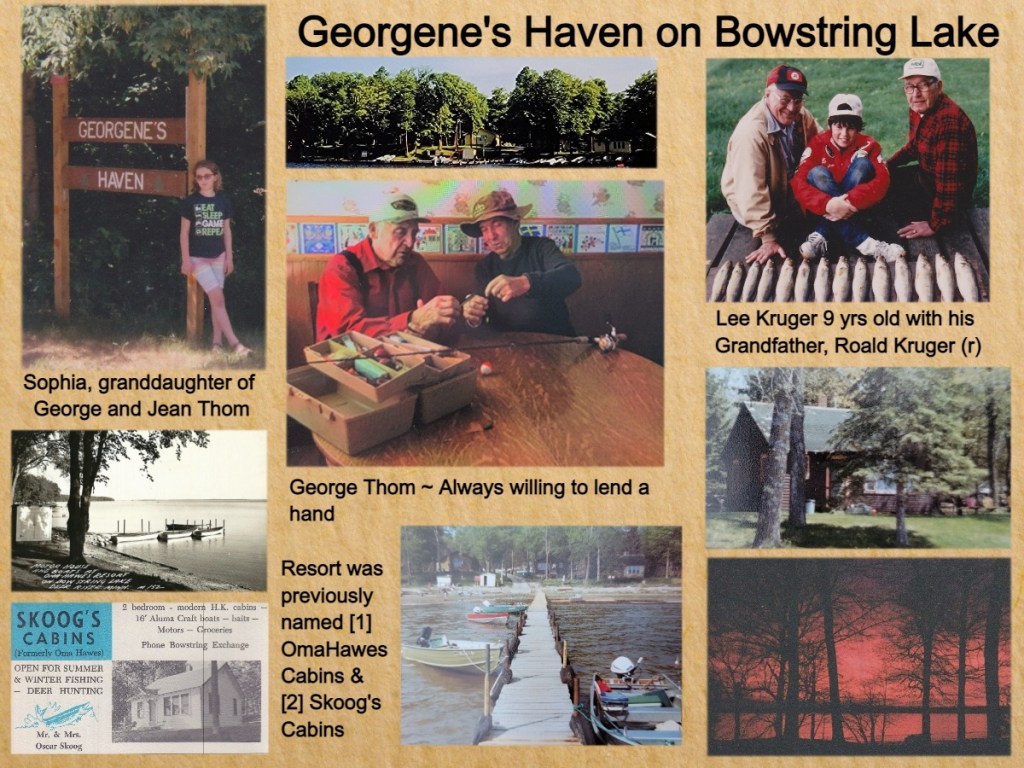
This is the twentieth Resorts with a History column I have done since I began them in 2017. All the resorts featured started early in Itasca County’s tourist industry and are still in business today. Georgene’s Haven on Bowstring Lake has the unique distinction of being owned and managed by George and Jean Thom for fifty-four years!

Dr. George Fredrick & Esther Hawes 1932-1946

This little piece of paradise was first referred to as a resort in the mid-1930s when Dr. George Fredrick and Esther Hawes bought four hundred feet of lakeshore on Bowstring Lake from Maley and Rose Johnston. Hawes had served as an Army surgeon in France during WWI and resumed his medical practice in Omaha, Nebraska, until he began looking toward retirement. It is not known if Hawes had learned of Itasca County fishing lakes from a buddy in the army or a patient, but it didn’t take much to convince him and Esther it was where they wanted to spend the rest of their years.

In 1933 they began the construction of their log home and a guest cabin for their friends. The following year Hawes re-enlisted and spent three years at a Medical Corps Field Hospital in Pennington, North Dakota. Of course, he was at Bowstring Lake as often as his schedule permitted. By 1936, Hawes added a second guest cabin and named their place “OmaHawes Cabins.”

The 1940 United States Census lists George Hawes occupation as proprietor of a summer resort. Others having summer resorts on the same census sheet are Rose Johnston, Olaus Coffman, Keith and Amy Scott, and Rose Williams. The Hawes lived in their log home until their deaths in the late 1960s. They are interred at the Pine Ridge Cemetery, Deer River. The house is still owned by a private party.

In-between Years 1946-1967

OmaHawes Cabins stayed under that name through two more owners, and sometime after 1958 was renamed Skoog’s Cabins.

In 1946, the Hawes sold the property to the west of their home, along with the two guest cabins and an icehouse to Charles Perry and his wife from Hammond, Indiana. George and Esther continued to live in their home on the lake. The Perry’s referred to the first two cabins as #1 and #2. They remodeled the old icehouse for their living quarters and a small store. They also built cabin #3, invested in a deep freezer so guests could take part of their catch home, and continued to call the resort OmaHawes Cabins.

The Perry’s sold the resort to Elmer Robbins and his wife in 1951. The Robbins owned the resort for only two years and did not make any changes.

Oscar and Isobel Skoog were owners for more than thirteen years and eventually renamed it Skoog’s Cabins. They updated and winterized the living quarters (former icehouse), built cabin #4, and purchased a sixteen-foot alumacraft boat for each cabin. In the late 1950s the Skoogs bought an additional five hundred feet of lakeshore which included a house and garage. The Skoogs built cabins #5 and #6. They also renovated the additional property (built in 1942) as cabin #7.

In the early 1960s, the Skoogs built a two-bedroom house on the sloping hill overlooking the lake. The home that had been previously occupied by the owners (the icehouse) became the final cabin, #8. At that time the Skoogs modernized all eight cabins with gas heaters, gas water heaters, showers, etc. They also purchased additional fishing boats. Adjacent land came up for sale in 1965, so the Skoogs purchased another one hundred feet of lakeshore. Two years later, they sold the resort to the Thom family.

Thoms & Georgene’s Haven 1967-

Bernett and Thelma, along with their son George, his fiancée Jean, and her young son, had no trouble selecting Skoog’s Cabins as the perfect resort for them. Bernett wanted to do something besides farming for the last years of his life, so he and Thelma moved from Jamestown, North Dakota before the start of the summer season in 1967. They loved the size of the resort and didn’t plan on adding cabins.

George and Jean married in 1968 and worked side by side with George’s folks as their summer schedules allowed. George was a teacher and Jean a registered nurse. “When Dad died in 1972, we took over,” George said. “My mother was a nurse, like Jeanie, so she moved to Grand Rapids to be closer to work, and we settled into the house here. That’s also when we decided on the name, Georgene’s Haven.”

The name was distinct from the other thirteen resorts that were on Bowstring Lake about the time the Thom’s purchased it. There are now only four (others are Trails End, Northern Acres and Bowstring Shores). “Owning a resort is a tremendous amount of work,” Jean said. She smiled, “but a great place to raise our three kids. They all had a hand in cleaning cabins, lawn care, boat maintenance and selling bait.” George and Jean, both in their eighties, have help with all of the above now, but they aren’t ready to give up the resort life.

During their ownership, they have learned to be a Jack (and Jill) of all trades. The first septic systems, they put in by hand. After hearing Jean recount the experience, I would say that was a true test to their marriage commitment! Cabin #2, one of the oldest, was taken down early in their ownership. The other seven are all the original cabins (built between 1933 and 1960). Of course, have been renovated and updated as necessary to meet the needs of the families.

Raising their children while running a resort and working took a tremendous amount of cooperation and patience. Their children. Ronald, Rebecca, and Ryan attended school at Spring Lake and/or the Deer River High School. George worked at Blandin Wood Products (Blandex), which later became Potlach for 30 years, retiring in 2003.

Thirty years ago, Jean chose to continue her education and was accepted into the medical program at UND in Grand Forks, North Dakota. She obtained both her nurse practitioner and physician assistant certifications. Most of her practice was at Grand Itasca Clinic and Hospital. Her last three years were at Essentia Health in Deer River, where she retired at eighty years of age.

In the 1970s the Thoms added a swimming pool and game room. Later they established four campsites. Most recently they put up a large building with bathrooms and plenty of storage. They are proud of their resort. “We own Georgene’s Haven, we don’t owe it,” Jean said.

Over the fifty plus years, their guests have come from Iowa, Indiana, Missouri, southern Minnesota, the Twin Cities, and Duluth. And, they return year after year. Even through the two Covid summers their numbers were good because guests could maintain their distance. As with so many of the resorts that I have written about, resort loyalty is generational. And of course, each family has its preferred cabin.

Lee Kruger and his brother Mark have been coming to Bowstring Lake with their father, Bruce, and grandfather, Roland for as long as they can remember. Lee said, “My dad’s paternal grandmother was related to the Spierings who owned Snug Harbor, so that’s where they first went. When Spierings sold it, we just slid over to Georgene’s. I was six years old in 1977, our first year there. And except for a time or two I’ve been there every year since.”

One of the many memories Lee recalled about the early years was that it would take a long time to get to the fishing spot from the resort in the boats with a 9 hp outboard motor. He liked to curl up in the bow and take a nap to the lull of the engine and lapping of the water.

“We must have stayed in cabin #2 for many, many years,” Lee said. “My grandfather wanted to stay there because it was closest to the dock (and only forty feet from the lake). He loved watching the boats come in as he wanted to see what others had caught. He reluctantly moved to a bigger cabin as the family grew. Our family has been coming to Georgene’s for five generations now and we need two cabins!  We always have a fish fry on Saturday night with an open invitation for George and Jean to come.”

Another long time and multigeneration family are the Schjenkens from St. Louis, Missouri. This summer will be Kelly and Vicky Schjenkens forty-second year at Georgene’s Haven. If the name sounds familiar it’s because there have been, and still are, Schjenkens in the area. In fact, Kelly’s grandfather, Knute Schjenken, owned a farm in Oteneagen Township, as did his great grandfather, Thor Gullickson. Both farms are just south of Bowstring Lake. When Kelly’s father was growing up, he, his brothers, and cousins rode their horses to the lake to fish. “My dad recalled that they used a community boat left by a neighbor,” Kelly explained. They trolled by rowing the boat and caught crappies, northern, and walleyes.” 

Kelly and Vicky originally chose Georgene’s because they wanted a quiet place near their family farms. They keep returning because they loved it. “Most years we have stayed in cabin #8, which is the largest cabin, but as our family grew, we have needed two cabins and sometimes camp sites!” Kelly said. “Our grandchildren each have a bed they call their own and look forward to George and Jean’s ice cream socials.”

“One of my favorite memories is when my grandparents, Knute and Alma, joined us at Georgene’s to fish, visit and of course have a fish fry. With my parents, Ken and Vi, we’d have four generations together. And now with our grandchildren, we still have four generations.”

“My father included me in his fishing adventures, and I have passed on the love of fishing, hunting and the outdoors of northern Minnesota to my family. I hope they will continue the tradition started six generations ago of fishing Bowstring.”

The Thoms go out of their way to ensure their guests have what they need for an enjoyable and memorable vacation. “We love all the people we meet and look forward to seeing them every year,” George said. Jean added, “Many have become close friends. George and I had our fiftieth anniversary a few years back, here at the resort because we wanted to include our resort guests, as well as family in our celebration.”

When asked about their resort honed skills, George says, “Jeanie is an expert at taking out a fishhook.”

“I learned how from Dr. Goodall.” Jean explained. “I say it’s going to hurt, and it does. But its fast and it works every time. George’s skill, sometimes to a fault, is that he’ll drop everything to take care of anybody at any time.”

George agrees. “I do go overboard sometimes, but I really enjoy taking care of the people that come to Georgene’s Haven.” If you have any memories to share about Northern Itasca County resorts, please contact me 218-244-2127, chrismarcottewrites@gmail.com or at my blog chrismarc

Mother’s Day 1939

5.1.2022 [archived ~ originally published 5.12.2019]

NOTE: I didn’t realize when I wrote this three years ago it would be the last Mother’s Day I would spend with my mom, Marie Scheer. She died unexpectedly in her home just days before Mother’s Day 2020.Imiss her every day.

Hellen (McQuillen) Scheer and daughter Marie 1939

Like most other young children, I made crayon drawings of flowers, hearts and stick figures with smiling faces to give my mother on Mother’s Day.  As the oldest of five, I’m sure I made my brothers and sisters stop their playing long enough to at least get something on paper as well. 

We all knew our Mom was special, particularly, because she claimed she had no bellybutton!  I have no idea how that myth got started, but it went on for many years. I’d say her sense of humor is from her dad and her ambition is from her mom.

It wasn’t until I began gathering family stories to incorporate into genealogy that I realized just how special my mother’s birth was, and how hard my grandparents worked during their first year as a family.  Mother’s Day 1939 was certainly something to be celebrated.

What follows are snippets of that year as remembered by Grampa, who wrote in his later years; and Gram, who told me a few antidotes, as well as memories from a booklet my Mom put together for them.

My Grampa, Clarence “Conny” Scheer was born and raised in Bigfork.  In the 1930s he joined the Civilian Conservation Corps (CCC) as a local experienced man.  He was promoted to assistant and then leader, earning a little more with each change in status.  During his last six months he was transferred to Itasca State Park. Though it was further from home, he had a chance to go to Bemidji occasionally.  One afternoon while in Bemidji, Conny bumped into a friend from Bigfork who was enrolled in the Teacher’s College and introduced him to Hellen McQuillen.

Hellen, my Grama was born in the northwest corner of North Dakota and had moved with her family a few times until they settled in Warba.  At the time their paths crossed in Bemidji, she, like Conny’s friend, was studying to become a teacher.   It wasn’t until the summer of 1936, after Hellen’s first year of teaching, that she met Conny again and their courtship began.

On Mother’s Day 1938, Hellen was married and six months pregnant with her first child, my mother.  She and Conny were living with his sister and brother-in-law and looking forward to a place of their own.

“As soon as spring and warm up time came so the snow was gone, and the logs had thawed we started on our cabin.  Hellen and I began to peel logs and get the base work set in, to start cutting and fitting our cabin together piece by piece.  I would work some on small short jobs, some for cash to keep living and others for second hand lumber for the roof, and for floorboards, and flooring plus windows and doors.  One of my part time jobs was tearing down some of the old CCC buildings at Itasca State Park.  By hook or by crook we got it all finished and moved in and cleaned up in time for our baby to be born.” [CS]

Conny’s brothers helped to construct the 16 x 20 log cabin on the edge of their father’s property on what is now called Scenic Highway, about a mile from Bigfork.  The Itasca Progressive newspaper noted that the young couple moved into the cabin the second week of July.  In the subsequent issue it announced: “Mr. and Mrs. Clarence Scheer are the proud parents of a seven pound girl which arrived at their home Friday.  The little one was named Elva Marie and she promises to brighten the home of her parents with her prattle.”

According to Marie’s written recollection, this is the way her father remembered it happening.  “Mom awoke him early in the morning and said that she thought that the baby was coming.  Dad had to leave her alone and go into town, just a mile away, to get the doctor.  The doctor had just gotten home from an all night call, and said that since it was her first baby it would take quite a while, so he was going to get some sleep and would be out later.

“Dad went back to the cabin and could see that someone needed to be there with her who knew about delivering babies.  He went to the home of the midwife and asked her to come and take care of this situation.  I believe that Mom was also alone during this period of time, which must have been lonely and frightening.  It had been agreed to previously that the midwife would trade some of her time caring for my mother, for my father’s help with the haying at their farm.” [MS]

The midwife Conny went for was Mrs. Almina McKay.  As a nurse, she had worked at the Mayo Hospital in Rochester, before she and her husband had moved their family to Bigfork a few years earlier.  Mrs. McKay had experience delivering babies which, as it turned out, was a very good thing.

Hellen’s labor progressed more quickly than expected, perhaps brought on by a slight tumble the previous day and it wasn’t long before Mrs. McKay realized that the baby was going to be born breech.  It wasn’t an easy delivery, and all were glad when the baby’s wails filled the cabin.  The midwife tended to the mother and newborn while waiting for the doctor to arrive.  Hellen recalled, “When he did, Mrs. McKay stepped outside and closed the door behind her. I could hear enough to know that she was putting the doctor in his place for neglecting his responsibilities.”

Conny wanted Hellen to name the baby and she decided on Elva Marie.  Elva was a family name, and Marie was for the midwife Mrs. McKay, whose middle name was Marie.  As was the custom in Hellen’s family, the middle name was used, so she was called Marie.

Six short weeks later a baby boy was temporarily added to the family. “In October, Mom also took on the care of her sister’s new baby, Lenny.  She cared for us as though we were twins, and for a time we shared the milk, the crib and her love.  This continued until December, when the baby boy was taken by another family.” [MS]

The decision to move Lenny was necessary because Conny, Hellen and Marie were going to spend the winter deep in the woods. It would be a challenging winter for Hellen.  She and her sister-in-law, whose own baby Marlon was only a couple weeks younger than Marie, were cooking and housekeeping for the family crew and caring for their two young infants.

“Three of my brothers and I got a logging contract to cut 80 acres of light burned spruce to cut into 8 ft length pulp wood and no plowed road till spring when the two pulp trucks owned by the contractors Lindy Kendall and Ted Lovdahl of their first contract job come in on the then frozen swamp roads and hauled it away to the paper mills at International Falls.

“We had to build a logging shack for sleeping and to cook for a light crew plus a barn for horses and a bunk shack on the end of our set up and an outdoor biffy. We also made tables and benches and shelves and bunks and assembled out there and dug a swamp well.  Our camp was nine miles off the small highway on an old wood road and we were isolated with only horses to get to the highway and five miles to Effie from there for our monthly go for groceries and a load of hay for the horses.  The nine mile road was snowed in and unplowed until April 1939.

“We had grocery credit at Anderson’s store in Effie and hay for horses, so once a month two of us men took the team and sleigh 6 miles to town for hay, food and mail.  The women and kids never left camp from December to April and we guys always knew that the two gals were the busiest workers of all of us cooking, washing dishes and clothing plus.  We had no radio, however, we wore out several decks of cards and told the same jokes several times!” [CS]

On Mother’s Day 1939, I can imagine how pleased Gram was to be out of the woods.  Her ten month old daughter Marie was happy and healthy and her husband had a steady job driving a truck the Bischoff Bakery. So many things to be thankful for on her first Mother’s Day!

School Days ~ Garden School

Itasca County, Minnesota

4.24.2022 [archived ~ previously published 5.7.2018]

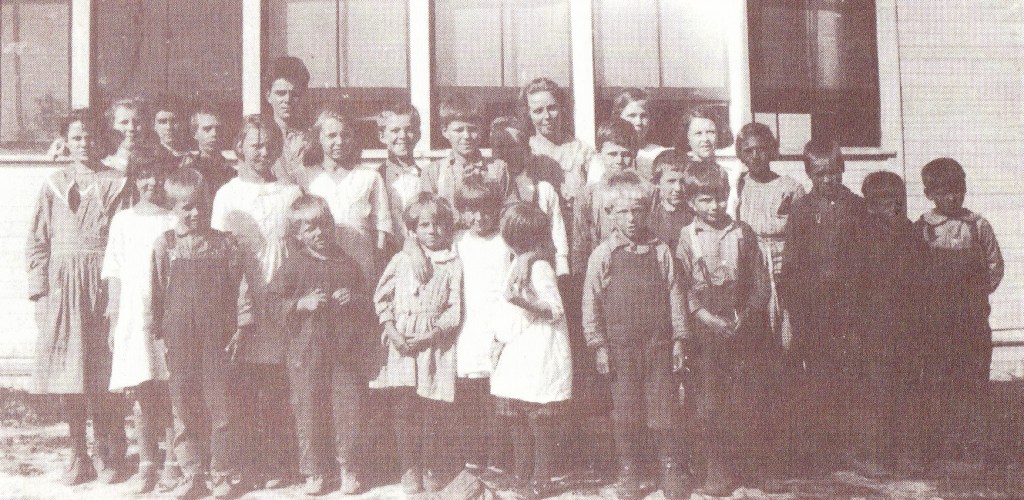
Garden School ~ 1920 Front Row: Martin Korpi William Newman, Edith Korpi, Lillian Venne, Helen Newman, Felix Ikola, Taito Mattila, Fred Newman, Harold Hellamn.  Middle row: Dorothy Housen, Vivian Venne, Sylvia Kohonen, Vivian Hellman, Richard Venne, Joe Housen, Omar Erola, Sula Mattila, William Hill, Nels Korpi. Back row: Imri Erola, Unk, Herman Korpi, Frank Housen, Fannie Niemi (teacher), Irma Erola, Ella Venne, Millie Korpi

Garden School was located in Oteneagen Township, just west of what is now Hwy. 6, about ¼ mile south of County Road 37, on County Road 125. I didn’t find much information on the school, whose land it was on, when it was built or if an updated school was constructed, but I do have a couple of good stories.  Based on sketchy records it was in operation from the late 1910s to mid-1930s.    

The first mention of it from my files is a letter to the editor written the first week of March 1920, in response to discussions of the Deer River school board. Julius Venne, who it appears had four children attending school, wrote, “Does the school board believe that we are not as anxious to have our children educated as are the parents of the Deer River children?

The Garden school, with an enrollment of 20 pupils, about 25 next term, would make a fairly good wood shed.  It is a sort of Sears, Roebuck knockdown garage about 20 feet square.  On cold windy days drafts can be felt almost anywhere along the walls and the children shiver in their seats.

No well is provided; across the road is an open well where rats, mice, or most anything else can drown their sorrow and where germ may flourish.  That is the water provided for our children.  The old tin pail and tin cup, that the board of health in every modern city has condemned, is being used…

School has been closed since February 13th, and from all appearance, will be for the remainder of the term.  Last year we were served the same way.  The excuse is made that no teacher can be secured…

The farmers are becoming restless, and some are agitating the reorganization of the district, with Deer River left out.

Julius Venne

After a few more back and forth letters, Venne brought his concerns officially to the school board. Apparently, there was talk of having the rural Deer River schools a separate district, and it was voted on in a special election the following year.  According to the 8-13-1921 issue of the Itasca News, the independent school issue was voted down.

Taito Mattila, born in 1914, attended the Garden school for all eight grades.  His parents, Victor and Lydia, and his brother, Sulo had immigrated from Finland in 1910, to northern Minnesota, where Victor homesteaded on 160 acres in the Oteneagen community.  They were not the only Finnish family, and many were pleased that some teachers were fluent in English and Finnish. 

“When I went my first day to school I didn’t know a single word of English.  We never talked English at home.  I was very fortunate, we had a Finnish teacher.  She helped us along and explained in Finn what each word meant till we got started.  In fact, my first three grades I had Finnish teachers…I started talking English after starting the first grade.  [Taito’s Stories – Taito Mattila]

Norvin Korpi, who went to school at Garden at about the same time, stated, “I learned English from older brothers and sisters. We spoke Finn at home most of the time but the kids when they started going to school then we I could speak English pretty well.” [Interview was done by Elmer Mattila with Norvin Korpi in 1997]

The Finnish teachers lived at Alex and Lily Kohonen’s who were about a quarter of a mile from Garden School.  The non-Finnish teachers stayed at Andrew Niemela’s because Mrs. Niemela was American-born and she knew the English language.  The teachers who lived at Niemela’s walked to school, a mile and a half.  Some of the teachers were: Ragna Knudson, Elsie Launa, Helmi Lofroth, and Fannie Niemi. 

One of my sources for this article was a family history filed at the Itasca County Historical Society.  Taito’s Stories ~ A History of Taito Mattila’s Family, was compiled by Louise Heine Mattila, and Elmer E. Mattila in March 2000.  Taito attended Garden School from about September 1919 to June 1927.  He has many memories of those years, but two I thought particularly interesting was about fellow students Herman Korpi and Elmer Davis.   

Porcupines in the Outhouse

“There was a funny experience at school when the teacher would go and inspect the toilets to see how they were.  She would go after school to look at the boys’ toilet. This one morning, she wanted to know which one of you boys has a pocketknife.  Only one kid in school had a pocketknife, and that was Herman Korpi. She took it away from him.  She said that he’s been carving the toilet seats.  And all us kids said, ‘No, it’s when the boys relieve their bladder, that once in a while it sprays on the boards, and porcupines go in there and chew the boards.’ The teacher wouldn’t believe it.  When she went home, she was staying at Kohonen’s, she was telling them what happened, and that she took Herman’s knife away, Kohonen said, you better give it back, that’s true, it’s porcupines that have been chewing.”

Elmer’s Bad Day

“They did some remodeling around the school house in the summer time…Elmer Davis was running around the schoolhouse and stepped on a board with a nail in it.  It went right through the top of his foot.  Of course the board broke, but the nail was there.  You could see it right through the top of the shoe.  So we ran over to Steve Madden’s.  He came over there with pliers.  He was going to pull it out, and Elmer wouldn’t let him.  So, I ran over to Toivo Erola’s and got him with his Model T.  He got that started, and we took him to see Doc Miners.  He was above MJ Bakers Store, where he had his practice.  I asked Elmer Davis this winter [1995], ‘How did we get you upstairs?’ He said he doesn’t remember, but we got there.  He said, ‘That was quite an experience. Dr. Miners, he pulled that nail out, and grabbed the shoe off.  Then, he put a yarn on some kind of a needle, he dipped that yarn in some kind of medicine, and pulled that through.’”

Field Day 1927

I think there was always a healthy competition between neighboring schools, not only academically (spelling and debate) but also athletically.  Especially in the spring when everyone was anxious to get outside.  In 1927, the Deer River School District seized the opportunity for fun and games, instituting organized athletic events and a way to recognize rural schools, including, of course, Garden.

To Hold Playdays in Rural Schools ~ Itasca News 4-14-1927

“A number of rural school field meets have been planned for rural schools of District Six. The district has been divided according to geographical location in eleven sections and a meet will be held in each section, according to plans made by the superintendent, the rural supervisor, and the rural teachers…

There will be contests in various athletic events such as pull-up or chinning, balancing, running races, running high jump, running board jump, tug-of-war, sack races, three-legged races, etc. for boys and girls and their teachers…

Section 3 was West Oteneagen, Garden, Kennedy and Poplar Grove schools at Kennedy on May 6.”

Three out of five students from Garden School were chosen to represent the section 3 sub-division at the final meet.  They were: Martin Korpi, Nels Korpi, and Vivian Venne.  Garden also had three of five alternates: Edith Korpi, Taito Mattila, and Harold Hellman.

The final field meet was held in Deer River on Friday June 3rd.  There were over 50 students participating and Martin Korpi placed 3rd in the running race in the boys under 75 pounds category.  In complement to the visitors, local businessmen financed a free matinee at the Lyceum theater following the awards ceremony, for rural students and their parents.

“Young Editor is Wed – Maybe Twice”

A 1911 Marital Predicament

4.17.2022

Pearl Phillips as a young man ~ circa 1911

This was the headline of the Itasca News in Deer River on December 16, 1911.  Two days earlier, the marriage of Mr. Pearl Phillips to Miss Abygail Leeman was announced in the Itasca Iron News (Coleraine). The editor had gleaned this information from a Duluth newspaper. On the same day, December 14, in the Deer River Times, it was reported that Mr. Pearl Phillips had married Miss Mildred Oothoudt.

Which newspaper was correct? Who had Mr. Pearl Phillips married, and when? Or had he married twice, and why?

First, some background information on these individuals.

Pearl Phillips

Martin Pearl Phillips was about fifteen years old when his family moved from Wright County to the Bigfork Valley.  His parents, Samuel Nelson “Nels” and Laura were farmers who, after hearing the favorable reports of neighbors who had homesteaded in Itasca County, came north. It wasn’t long before the family had their own 160 acres in section 62-26.

Martin preferred his middle name, Pearl, even on most important documents. He was a good student and enjoyed learning. There was no high school in Bigfork, and Pearl wanted to finish school, so he lived on his own at Deer River and graduated from the Deer River High School.

In February 1911, twenty-three-year-old Pearl negotiated with the owner of the Bigfork Settler newspaper, and on March 7th, ownership was transferred to him. Pearl was smart, curious, and considered a man of good moral character. He covered several high-profile stories including the murder of George Rahier in July, and the arrest of physician Delbert Dumas for arson at Blackduck in October.

Coverage of the news and working with businesses for advertisements required Pearl to travel by train to the communities of Deer River and Bovey. It was probable he was gone several days at a time and would stay in a local hotel or boarding house.

Abygail Leeman

Abygail “Abbie” Leeman is the daughter of Charles and Ottilla. When she was three, the family lived in Trout Lake township in Itasca County, then relocated to Cass Lake within a couple of years. On the 1910 United States Census, Abbie was living with, and employed as a waitress at a hotel in Bovey owned by Charles and Ida Nelson.

Abbie may have become acquainted with Pearl when he was in Bovey on business. It is also stated that she was in Bigfork part of the summer 1911.  Abbie may have worked at the cafe owned by John Pinette, or the Woodland Hotel owned by Pinette’s brother Louis.

Mildred Outhoudt

Mildred “Millie” Grace Outhoudt was born in Sherburne County, Minnesota to Aaron and Blanche in 1894. Her father was a mason, and the family moved to Bagley by 1910, where he was employed to construct sidewalks. Millie was only sixteen when she began her work as a printer for the Bagley newspaper.  Through word of mouth or advertising, Pearl hired Millie to help put the layout and publish the Bigfork Settler.

Who was Right?

Back to the facts.  Both newspapers were correct. Pearl Phillips had indeed married two different young women during the same week. As you can imagine, those newspapers as well as many others in the area were having quite a time keeping up with the rumors. One marriage was planned, but the other, which happened first, took place with a bit of persuasion. It seems that Pearl’s predicament spun out of control rather quickly, and it wasn’t until after the second marriage that all was out in the open.

As best as I can determine, Pearl had asked Millie to marry him sometime after the first snowfall, and that is what they had planned to do following the publication of the December 7th issue of the Bigfork Settler. It is safe to assume that the news of the impending nuptials reached Abbie Leeman, who was several months pregnant with the child of Pearl. Abbie (or someone on her behalf), sought legal counsel.

Based on the newspapers, this is the timeline for what took place during one week in December 1911:

12/9 (Sat) ~ Pearl was in Deer River and was seen getting on the eastbound train. “He was called to Grand Rapids Saturday night by a lawyer and forced to marry the girl.” [Itasca News 12-16-1911] This type of marriage is often called a “shotgun wedding.”

12/10 (Sun) ~ Pearl and Abbie Leeman are married before Judge Webster in Grand Rapids. It is unclear where Abbie is at this time, but Pearl returned to Deer River on the noon train. He met Millie Outhoudt there and they shared with others news that they were soon to be married in Bemidji.

12/11 (Mon) ~ Pearl and Millie took the noon train to Bemidji.

12/12 (Tue) ~ Pearl and Millie were married in Bemidji.

On or about 12/13 (Wed) ~ Millie learns of Pearl’s marriage to Abbie Leeman. She had Pearl arrested and put in jail in Bemidji.

12/15 (Fri) ~ Nels Phillips, Pearl’s father, is seen in Deer River and it is believed he took the train to Bemidji or Grand Rapids to figure out how to get his son out of the predicament he was in.

A week later, the newspapers still didn’t have all the facts.

Is Doubted by Many ~ Deer River Times 12-21-1911

“The many tales that have come to the writer in regard to Editor Pearl Phillips of the Bigfork Settler and the story that Phillips married at Bemidji as published in the columns of this paper last week, is disbelieved by his many friends of which the writer is one.  We are unable to give the public the facts but believe that a young man with the knowledge that Mr. Phillips possesses would not jeopardize his liberty and bright future prospects in such a foolish manner. There is no doubt, but that the matter within a short time will be cleared up and many of the false stories circulated properly corrected.”  

I could find only one more reference to Pearl Phillips in the local newspapers during the month of December. The Itasca News picked up and reprinted from the Bagley Independent, the following. Word was received here last week of the marriage of Miss Mildred Outhoudt, daughter of Mr. and Mrs. Aaron Outhoudt of this place to Mr. Pearl Phillips, of Big Falls, Koochiching County.

“The young couple are expected to pay a visit to the bride’s parental home during the holiday season, after which Mr. Phillips will launch a newspaper at Oaklee, up on the Soo line.” [Itasca News 12-30-1911]

It seems that the newlyweds decided it might be best to have a fresh start. Had the Bagley paper been given revised town and county details? At any rate, Pearl sold the Bigfork Settler newspaper to Zade Cochran before the end of the year.

The Rest of the Story

Pearl and Millie (Oothoudt) Phillips

Descendants of the Samuel Nelson Phillips family say that Pearl’s first marriage (to Abbie) was annulled. One newspaper speculated that Millie was pregnant at the time she and Pearl were married. If this is true, the baby wasn’t carried to term.  Millie’s first child was born December 22, 1912, in Elk Point, South Dakota.

Pearl and Millie moved from SD to Duluth before the birth of their third child in 1917.  In the 1930s and 40s they were living between the states of California and Washington. All census records document that Pearl stayed in the newspaper business. The Phillips were married for 64 years. Pearl died in 1975 and Millie in 1982.  They are buried in the Acacia Memorial Park Cemetery, Lake Forest Park, King County, WA.

Abbie (Leeman) Phillips Pinette

Abbie was living in Cass County when her son was born in March 1912.  She named him Pearl Edward Phillips.

Pearl Edward died shortly after his 2nd birthday and is buried in the Pine Grove Cemetery in Cass Lake near his maternal grandmother.

It appears that Abbie did use the last name of Phillips when she was living in Cass Lake. There is a notation on the Find a Grave website that the mother of Pearl Edward was Mrs. Abbie Phillips.

On November 28, 1916, Abbie Phillips married John Pinette of Bigfork. The Pinette’s celebrated 49 years of marriage and had four children.  The couple remained in the Bigfork community. John died in May 1966, and Abbie just two months later.  They, along with several of their children are buried at the Bigfork Cemetery.

Mad Hatters ~ Millineries of Deer River

4.10.2022 [archived ~ originally published 5.3.2018]

Wedding Party ~ All but the bride is wearing a hat [circa 1920]

In the early years, there were considerably more men than women living in the Deer River area. But once the village was established, more families moved in, and by the spring of 1903, there was welcome news for fashion-conscious women. “The ladies of Deer River and vicinity will be pleased to learn that a long felt want, a millinery store is about to be established here.   Mrs. W.J. Phifer, formerly of Duluth, an experienced ladies’ hatter, is proprietress.” [Itasca News 3-7-1903]

Until the arrival of Mrs. Garnett Phifer, for women wanting a hat, their choices were to send for it through a mail order catalog; makeover their existing hat with new ribbons and fresh feathers; or take the train from Deer River to Mrs. Katherine Lent’s millinery parlor in Grand Rapids.

“Milliners create hats for women; hat makers make hats for men. This is the nineteenth- and twentieth-century differentiation of the two trades, which, although related, require very different technical skills and working practices.” [Wikipedia] 

During about a twenty-year period when it was the fashion to update women’s hats every season, there were four women who tried their hand as a milliner in Deer River: Garnett Phifer, Helen Ryan, Minnie Tollefson and Mae Swanson. Their shops carried adorned and unadorned hats, ribbons, beads, feathers and silk flowers. Some also specialized in other clothing items exclusively for women.

Mrs. Garnett Phifer 1903 to 1909

Garnett married William Phifer, a barber in Iowa in 1902.  They moved to Duluth for a brief time before settling in Deer River.  Mrs. Phifer brought with her a stock of goods, upon arrival rented space, and established her business. 

Phifer’s first advertisement stated: “Announcement!  Having received my full stock of up-to-date millinery, I am now prepared to deliver at a cost not greater than is common in the cities, hats of the latest shapes and trimmings to suit the most fastidious of ladies.  In cheap hats, I have an abundant assortment.  They are durable, and I am sure you will be pleased with the assortment. I also take orders for tailor-made suits, made by the Edward B Grossman Co., Chicago.  Their make is the best. The ladies of Deer River and vicinity are respectfully invited to call. Yours to please, Mrs. W.J. Phifer” [Itasca News 3-28-1903]

Mrs. Phifer did a fine trade until January 1908 when a fire damaged several village businesses, including hers.  Within a week she had moved into the old Methodist Church building wear the remainder of her hats were sold for half price. By mid-April, the News noted, “Judging from the large sample trunks stacked almost every day in front of the local millinery the style of the ladies hats this spring will be wide, long and high.”

When the M.J. Baker store ran an ad announcing the opening of their new department of millinery in August, Mrs. Phifer countered with one stating, “At the only millinery store in the city.  Early fall hats.   Also, untrimmed shapes.  New styles received every week during the season.  Old hats made over to look like new.” This last item was important because M.J. Baker only had a limited number of ready-made hats from which to choose.

In January 1909 Mrs. Phifer filed for separation from her husband, alleging cruel and inhuman treatment, nonsupport, and drunkenness.  She also asked for the complete title to all the property holding in her name, an order to restrain the defendant from entering her house or interfering with her or her business pursuits.  After the fire, Mrs. Phifer had purchased her own building. When the divorce was final in September, she decided to move her millinery business out of the area.

Mrs. Helen Ryan 11-1909 to 10-1916

Shortly after Mrs. Phifer left, Helen Ryan, with the backing of her husband William, decided to open a millinery next to the post office.  Most of her advertisements included enticements of current trends, ostrich feathers and turbans, as well as waists, skirts, corsets, hose and ‘hair puffs.’

By 1911 Mrs. Ryan secured a better location and had a second store in Marble. I could not determine if she split her time between the two stores or had an assistant running one.  One possibility is that Garnett Phifer, who had returned to Deer River by 1910 according to the United States census, was managing one of the stores.  Garnett is shown living on her own, next to the Ryan family.  Her occupation, as well as Helen Ryan’s, is listed as a milliner in a store.

In late summer 1916, Helen and William Ryan made plans to move to Michigan. Mrs. Ryan consolidated her millinery and other stock at the Deer River store and sold it to George Herreid and Minnie Tollefson.  George, a well-known businessman, was a silent partner in the millinery establishment named the Style Shop.

Minnie E. Tollefson & George Herreid 10-1916 to 11-1917

George Herreid, along with his brother William, and their wives Agnes and Anna, were owners of a large general store and mortuary, and agents for the Ford Motor Company at this time.  I could find very little information on Miss Tollefson.  According to ancestry.com, no one by that name resided in Deer River in 1910 or 1920. There was a Minnie Tollefson living in Blackduck in 1910.  She was born in Norway in 1888 and immigrated in 1906. She was a waitress at the Olson’s Hotel.  It is possible she was in Deer River by 1916 (and maybe even working for Helen Ryan), or perhaps answered an advertisement for the business that I did not locate.

At any rate, I believe the arrangement was tentative and based on profitability.  On 9-29-1917, less than a year after the shop opened, a Notice of Dissolution appeared in the paper: “Notice is hereby given that the partnership lately existing between the undersigned, George H. Herreid and Minnie E. Tollefson, carrying on business of ladies’ wearing apparel and millinery store at Deer River, Minn., under the style of firm as the “Style Shop,” was on the 1st day of August, 1917, dissolved in the future will be carried on by the said George H. Herreid, who will pay and discharge all debts and liabilities of and receive all moneys due to said late firm.”

A ten-day ‘Quitting Business Sale’ including full-page advertisements was held in early November 1917. I found nothing more to indicate where Minnie Tollefson had gone.

End of an Era

Records are a bit sketchy after the Style Shop sold out.  Garnett Phifer apparently did start a millinery parlor again, but when an Airtight stove exploded, starting a fire in the store in April 1918, and she lost everything, she decided that was enough.

The last mention I found of a millinery in Deer River was an advertisement for the opening of Swanson’s Millinery Parlors ~ Opening March 21, 1919.  Mrs. Mae Swanson, the owner, was a widow with small children.  She married again and moved to Canada. During the twentieth century, women’s lives changed drastically and imposed a lifestyle not compatible with the beautiful hat creations. The twenty-first century has become a bare-headed era, and glamorous hats have become “special occasion wear,” only worn for weddings and high-society horse races.

“Talkies” Come to Deer River Lyceum

4.3.2022 archived [originally published 4.6.1915]

There was a packed house for the film “Weary River” shown at the Lyceum Theater in Deer River on Tuesday May 28, 1929.  It was not the actors, Richard Barthelmess or Betty Compson that drew the crowd in the middle of the week. It was the first talking film to be shown in Deer River, or anywhere in Itasca County for that matter!  Up until then all of the films were silent, though often the management hired a piano player to play what they thought was appropriate music for the sad, romantic, scary or dangerous scenes. 

While billed as a talkie “Weary River” is actually classified as a part-talkie, part-silent hybrid made at the changeover from silent movies to sound movies.  No one in the audience complained however, as it was such a remarkable development to hear what the actors were saying.  By 1929 when this was produced, most films were made with the Vitaphone, which was at the time the leading brand of sound-on-disc technology.

John Johnson manager of the Lyceum knew that he had to invest in sound equipment at his theater or his patrons were likely to go elsewhere.  Johnson and Charles Perrizo, manager of the theater in Grand Rapids traveled together in early April 1929, to Oconto, Wisconsin for a demonstration of the Merritone Machine which would project the sound of the vitaphone films.  Both men purchased them on the spot, and arrangements were made to have the machines installed at the beginning of May.  Of course a few complications delayed the installation, but by the end of May all the kinks were worked out and the citizens of Deer River were ready and waiting to see and HEAR whatever film was to be showing.

The April 11th issue of the Deer River News explained a little about the upgrade: “The Merrittone is designed to meet the special needs of the small town theater, though it is used with equal success in the larger places.  The equipment provides everything necessary to satisfy the movie patron, including synchronizing devices, amplifier and auditorium speakers.  The synchronization is assured to be perfect, and the sturdiness, compactness, simplicity of construction, quality of material used, ease of operation and the lack of complicated mechanism, make the Merrittone of superior desirability for any theater.

Mr. Johnson’s purchase confirms confidence in Deer River, and is found to add greatly to the popularity of the Lyceum, which has already attained a high degree.  Local movie patrons will strongly commend this advanced step on the part of the Lyceum management and its apparent desire to afford Deer River the best that can be given.”

Indeed, the business community rallied their support by taking out an advertisement that helped pay for a full page ad for the film in the May 23rd issue of the paper.  Thirty-two businesses congratulated Johnson and the Lyceum with messages such as “Welcome vitaphone as another step in the development of our community”, “Congratulations Mr. Johnson and welcome everything that will make Deer River a bigger and better town”, “Extends congratulations and welcomes Vitaphone as another of the big boosts of the year for this community’, “Appreciate Mr. Johnson’s enterprise in giving Deer River better pictures.”

Deer River was not too far behind the times with this advancement.  The first feature length film originally presented as a talkie was the “Jazz Singer,” released October 1, 1927.  It actually had very few spoken parts, but a lot of music.  By the end of 1927, most films being produced were talking/silent hybrids. By the early 1930s, the talkies were a global phenomenon. In the United States, they helped secure Hollywood’s position as one of the world’s most powerful cultural and entertainment venues.

According to Internet Movie Database  (IMDb) “Weary River” is a 1929 American romantic drama film directed by Frank Lloyd and starring Richard Barthelmess, Betty Compson, and William Holden. Produced by First National Pictures and distributed through Warner Brothers, the film is a part-talkie, part-silent hybrid made at the changeover from silent movies to sound movies. Based on a story by Courtney Riley Cooper, the film is about a gangster who goes to prison and finds salvation through music while serving his time. After he is released and falls back into a life of temptation, he is saved by the love of a woman and the warden who befriended him. The film received an Academy Award nomination for Best Director in 1930.

“A bullet whizzed through his bushy eyebrow” Law & Order in Itasca County

3.27.2022 [archived ~ originally published 10.8.2015]

Advertisement for Moose Brand Beer ~ Itasca News circa 1900

We have all heard that Deer River was a very rough and tumble town at the turn of the century.  Main Street referred to as Whiskey Row had nearly twenty saloons and there was at least one house of “ill repute” in the vicinity. 

The story of the murder of Charley Grant reads more like a dime novel than a newspaper article, but based on the subsequent trial testimony appears to have been true. The headline I used for the column comes from the testimony of the bartender, Alexander “Sandy” Phair.  He stated there were four shots fired in all and “that the third one passed close to Tom Murray’s head who was reclining against the bar asleep.  The whiz of the ball through his bushy eye brow awoke him.”  Murray was not the intended target and is lucky he did not become a casualty in the saloon skirmish.

The articles are rather lengthy so here is the abbreviated version with enough excerpts to give you an idea of what happened on November 30, 1900 through the trial verdict on January 18, 1901.

After folks had eaten their Thanksgiving dinner, many of the young people or those without families, went to Deer River.  It was rumored that there was a clandestine boxing match, where bets were readily made by all men present.  In the early evening there was a dance at the Hotel Deer River.  Most of the saloons were open, and laughter or conversation could be heard spilling out of the doors and windows.

Sandy, the bartender of the saloon in the Northern Hotel said that the men were a bit more rowdy than usual, in part because the band at the Hotel Deer River next door was quite loud. The city marshal, Mike McClusky had been making the rounds, or perhaps had been summoned and was present at the time the melee began.   The main characters were Patrick Burke, a 40- year-old single man from Grand Rapids; and recently married 35-year-old Charley Grant.  Both men were known in the Deer River community and neither had a honorable past..  Burke had been in prison for manslaughter and Grant had just gotten off parole following a sentence at the Stillwater Prison for robbing a woman.

The men were acquainted with each other and though it is not clear if they were together that night, all agreed that Grant and Burke were drinking and began arguing.  Grant succeeded in knocking Burke to the floor and was leaning against the bar and smiling in victory.  Suddenly Burke stood up and “whipped a revolver out of his hip pocket and aiming at Grant exclaimed: ‘Grant I won’t take a licking from you!’

With these words he fired, and though he was only ten feet away the ball missed Grant, and whizzing past the bar tender’s ear, bored into the lower part of the mirror frame behind the bar.  Mike McClusky, the village marshal, then jumped in and tried to wrest the weapon from Burke.  While in this tussle McClusky says he pleaded to the ten or twelve men present to take the gun away, but none attempted to do so. 

Grant, it appears, was too drunk to know enough to move out of the room, and Burke in the hands of the marshal, got a second shot at him and Grant began moving toward the back door when a third shot came.  It was then thought the second shot killed Grant because he suddenly scrunched his shoulders and moved sidewise toward the back door, but as he was still facing the gun it may be that it was the third shot which hit him.  The bullet entered the left breast about two inches above the heart, and passed out of his back under the right shoulder.  As Grant was nearing the door the fourth shot came but went wild and the ball went in the wall over the door. [Itasca News 12-1-1900]

Grant fell through the side door into the washroom and died within a few minutes.  Burke was arrested and spent the remainder of the night behind the bars.  Sheriff Tyndall arrived and took the prisoner to Grand Rapids on the afternoon train.  The county coroner was also in town and removed the remains to Grand Rapids. 

The jury in the coroner’s inquest over the remains of Charles Grant returned the verdict Tuesday that Grant was killed by a bullet from a gun discharged by Patrick Burke.

Burke’s preliminary hearing in justice court was set for Thursday December 6th, but he waived examination and his case came before the grand jury in January.  He was indicted for first degree murder by the grand jury, and trial was set to begin on January 11, 1901.

About ninety jurors were subpoenaed before the following jury of twelve men was secured: Edward Bergin, H.E. Graffam, R.A. McAllister, E. Keabie, M. Hagen, Jas. Patterson, David Cochran, George Lemrod, A.M. Sisler, Frank Voight, Irving A Martin and James Affleck.  Other names you might recognize from your own family history include these witnesses: Sandy Phair, W.C. Robbyn; C.W. Robinson, Frank Caldwell, Tom Murray, John Hawley, John O’Reilly, Harry Oakes, Charles Porter, and Joseph Girard.

Burke’s defense was that he considered his life was in danger and drew the revolver in self-defense when he saw Grant’s hand in his hip pocket.  The jury was out about twenty-four hours.  “Yesterday forenoon at 9 o’clock the jury reported that they were unable to agree and it was understood that eight voted not guilty while four favoured a verdict of manslaughter in the first degree.  Judge McClanahan asked them to try again and at 3:30 the foreman announced to the bailiff that an agreement had been reached. 

The word soon spread through the village and the court room was well filled when the twelve men filed in and handed their findings to Clerk King.  In just one week to the hour from the time the case was opened and the work of securing a jury begun Patrick Burke was pronounced ‘not guilty’ of the crime of murdering Charles Grant.” [Grand Rapids Herald Review 1-19-1901]

Diapers on the Clothesline

3.20.2022 [archived ~ previously published 4.12.2018]

In the March 21, 1908, issue the Itasca News reported that the “population was increased to the village this week by four. On Saturday, last, a daughter was born to Mr. and Mrs. Joseph Collard. On Tuesday, the 17th to Mr. and Mrs. Sam Lance, Mill Division, a son.  On the same day to Mr. and Mrs. A.G. Hachey, daughter.  On Monday the 16th, to Mr. and Mrs. W.H. Obert, a son.”

Twenty-five years later, a very similar story was published about four more children.  I decided to follow the lives of these eight individuals using ancestery.com. It was easier to find information on the 1908 babies because the census records go through 1940, but I found some on those born in 1933 as well. All were too young or too old to be drafted into WWI or WWII. One of the eight did not live to adulthood. Most moved from the area.  At least two are buried in local cemeteries.  And only one is still living in Deer River.

Born March 14th, 16th, & 17th, 1908

Fernandel Ida Collard was the second child born to Joe and Mary.  She was named after her paternal grandmother, though everyone called her Fern.   Joe was the proprietor of a temperance (alcohol-free) pool hall in Deer River, which he established shortly before Fern’s birth.  Her mother, Mary (Wallace) Lozway, was widowed and pregnant with her 10th child in 1905 when she and Joe married. In addition to Fern, the Collards had two other children, Joseph Jr. and Helen.  In 1921 Joe died of an accidental gunshot, and the siblings were split into several homes. 

When Fern was 17, she married Claude Couillard, who quite possibly might have been a distant cousin on her father’s side.  She and Claude resided in Duluth and had three children, later they moved to Moose Lake for the remainder of their lives.  Fern lived to be 90 years old.

Vernon Cedric Lance was the first of ten children born to Samuel and Alma (Christopherson). Sometime after 1910, the Lance family moved to Wisconsin.  As a young man, Vernon returned to Minnesota, settling in Olmsted County.  He married Irene Luhmann, and they had four children.  Vernon had a dairy farm which supplied milk and butter to the St. Mary’s Hospital in Rochester, MN.  He died in 1961 at the age of 53.

The baby born to Albert and Mabel (McAlpine) Hachey died just two short weeks after her birth.  The Hachey’s moved to Grand Rapids, and according to the 1910 United States census, Albert was a deputy sheriff, and there was a son, Ronald several months old.

Lincoln Eugene Obert was the fifth child and only son born to William and Thalia (Post). The Oberts had moved from Fergus Falls, and Lincoln was the first child born in Deer River.  It was his uncle Arthur Obert whose murder was the subject of two recent Reminisce columns.

Lincoln enlisted in the Navy and spent four years at the Panama Canal Zone.  After discharge, he married Hazel Krumholz.  They lived in St. Paul where Lincoln was employed as a streetcar motorman for the Twin Cities Transit Company. The Oberts had three children, LaVaughn, Rosemarie, and Michael.  It appears that Lincoln moved back to Deer River as he died at the age of 63 years in Grand Rapids and is buried at the Pine Ridge Cemetery.

Born November 28th, 1933

Four New Boys ~ Deer River News 11-30-1933

“Four brand new boys came to town this week.  Sons were born Tuesday to Mr. and Mrs. Henry Jurvelin, Mr. and Mrs. J.W. Garner, and Mr. and Mrs. George Hawkins, and on Wednesday to Mr. and Mrs. Fred Tripp.”

According to the Minnesota Birth Index, the Tripp baby was also born on 11-28-1933, which meant the four Deer River boys were born on the same day.  I wondered if this was unusual, so I looked a little further.  In all, there were seven children born in Itasca County on November 28, 1933, and statewide there were 136 births. (For those of you with a curious, analytical mind, the day before there were 102 Minnesota, and two Itasca births.  The day after there were three County and 116 state births. I checked the full moon was December 1st.)

John Robert Gardner was born to ambitious parents.  William, his father was an attorney and his mother Bessie (Milne), a teacher at the high school. When they married, they were 45 and 31 years of age, respectively.  John’s brother George was born two years later.  The 1940 census shows that William was the probate judge for Itasca County, and the family lived in Grand Rapids.  I could find nothing more on John, except that he died at the age of 39 years in Los Angeles, CA.

Ruth Hill’s father was a road building contractor at the time she met and married George Hawkins, who might have been working on the roads as well.  Their first child, Ronald George Hawkins, was born on November 28. Not long after his birth, the Hawkins family moved to St. Paul.  In 1940 they were living in Cedar Rapids, IA, where George was employed as a mechanical engineer for a road machine manufacturing company.  As with John Gardner, I could find no additional information on Ronald Hawkins, other than his death in 1998 in Cass County, Texas.

Harvey Tripp was the sixth child born to Fred and Wilma (Sharp) Tripp. In 1940 the Tripp family was in Kinghurst where Fred is a truck driver for a logging camp.  The 1958 voter registration for Los Angeles documents Harvey as a Republican.  He has lived in Kettle Falls, Washington for quite a few years, and is living there now.  The internet is amazing; I even found his phone number!

And last, but not least is Richard Henry Jurvelin.  We all know him as Dick, the guy who early each morning places seasonal merchandise out in front of the family hardware store.  He is the only child of Henry “Hank” and Olga (Sjolund). Hank and Olga worked for Deer River merchants for many years and secretly married on April 27, 1930.