Frogs in February & Other Signs of Spring in Itasca County

3.13.2022

Many people consider the official start of spring to be the equinox in mid-March. Because I crave green growing things, I made an executive decision to call March 1st the first day of spring as the meteorologists do. My young grandson and I exchanged the crystal snowflakes that had hung on the patio door since November, for the bright pink crystal flowers. Both cast rainbows when the sun is shining, however, the flowers signify to us that the garden will soon be full of blooms.

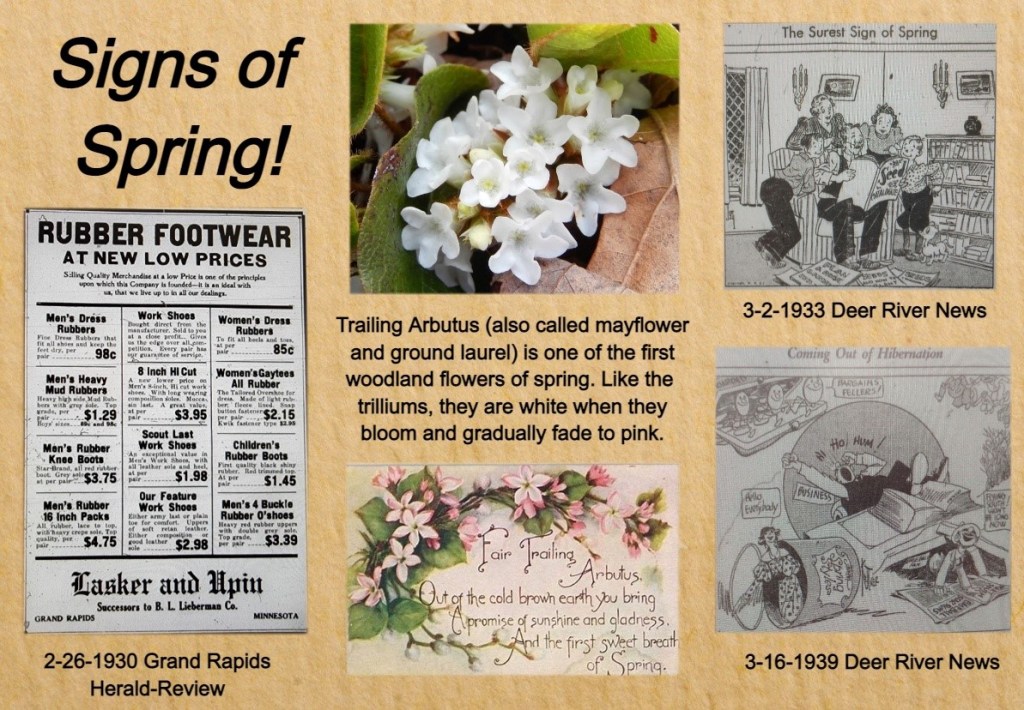
Minnesotans are hearty souls, but still it seems that by the time we have had even two months of snow and cold weather, we look for signs of spring. Of course, we always have at least six more weeks of winter, no matter what the groundhog predicts. But little signs, like crows in early January 1929 (now they stay for the winter) and frogs in February 1907, give us hope.

My grandmother, Hellen McQuillen Scheer, proclaimed spring was really here when she could smell, and then locate, the trailing arbutus (also called mayflower and ground laurel) in the woods near their Marcell cabin. Grandma introduced me to this lovely flower when I was a kid, and I have never forgotten the scent. Another place I found trailing arbutus is at the Lost Forty. [https://www.exploreminnesota.com/profile/lost-40-sna/5508]

If you go in search of these flowers, you need to look down, as it is low growing. “Tight clusters of up to eight, short-stalked, tubular flowers in the upper leaf axils and the tips of branches. Flowers are ½ inch across with five pink to white petals that are fused forming a tube about ½ inch long. The inside of the tube is densely covered in white hairs.” [https://www.minnesotawildflowers]

The following news articles highlight signs of spring in the early years.  In addition to the blackbirds and robins that we consider the first birds to return to our region, eighty years ago crows were also harbingers of spring. 

For this column I have arranged the news tidbits by month rather than year.

January

3rd ~ Sober and Saw Crows

“Additional comment on the weather!  Frank Miller called The News office last Friday morning and said, ‘Mike Guthrie saw three crows this morning, and Mike was perfectly sober!’ We’ll take their word for it, but if those crows didn’t get out of the country before 1929 arrived, they didn’t have a happy New Year.” [Deer River News 1929]

12th ~ Stays All Winter

“It was a wise out blackbird that knew months ago that we were going to have a January thaw. To see a blackbird in Deer River in mid-winter is something unusual, but there is one right here.  He can be seen daily feeding in the alley back of the F.W. Miller residence.

Mr. Blackbird didn’t go south when cold weather came.  He found a gracious hostess in Mrs. Millie Hickthier, mother of Mrs. Miller, who feeds him daily.  If there is no lunch out when he appears, he scolds in no uncertain terms. Mebbe you can fool the wise guys, but you can’t fool the birds on northern Minnesota winters.  Our January thaw this week is a sample.” [Deer River News 1928]

22nd ~ Pussy Willows, Skunks are Signs of Spring

“With seed catalogs arriving daily and small boys getting out their marbles, folks are beginning to think spring is on the way. Our friend, Old Timer, pooh-poohed such things yesterday, but we stuck him with two others that made him scratch his head.

Last Tuesday morning David Robinson brought to the News office a willow twig on which there were two as fine Pussies in full bloom, as you ever saw in April. ‘Ike’ broke that twig off to chastise his unruly pup, and when he saw those Pussies, they reminded him of spring and baseball, and he forgot all about ‘Spud.’

Henry Jurvelin adds another. Last Friday evening, while going north on 61, within the village limits, a full-grown skunk crossed the road in front of him. It was one of the four-legged species, and Henry, as he always is, was perfectly sober. Seeing these animals early in February is not unusual, but when they’re out a month ahead, it means something.  Nature knows, and these are sure signs of spring.” [Deer River News 1931]

February

11th ~ Spring Goods have Arrived

“Already the express and freight are bringing fresh supplies of spring merchandise.  Among the goods already on the counters and in transit are the following:

~ Motor Coats –Long tweed, caravanette garments in size 18 to 44.  Price range in this lot is $29.90 to $49.50.

~ Dresses—This shipment left New York Jan. 28 by express, and will no doubt be here when you read this.  It contains silk and wool dresses in black and colors; sizes 16 to 42.  Prices from $19.75 to $67.50.

~ Shoes—Ladies “Aunt Polly” large ankle shoes, Selby fine shoes in military or Louis heels, children’s shoes in sizes infants’ 1 to misses’ 11.

~ Underwear—Groundhog says six weeks cold, but we have little faith in him and have the summer underwear ready.” [Grand Rapids Herald-Review 1920]

10th ~ Sees His Shadow—Six Weeks Cold

“Saturday was ground hog day and according to the ancient sign there will be six weeks more of cold weather in Itasca County.  The day was cloudy, except at noon, but on the night before it was 33 below at the dam, near Mr. Groundhog’s home, and so he stayed in until at noon, when he ventured out.  He saw his shadow and went back to sleep. However, the people of this section are not paying much attention to signs and omens.  We are going to have six weeks of cold weather, anyhow.” [Grand Rapids Herald-Review 1918]

13th ~ Another Week for Loggers to Work

This week will probably bring to a close what has been one of the most prosperous winters for logging and forest products operators ever in the history of northern Minnesota. A week or ten days ago most men were not prepared for a thaw and the destruction of the roads.  By today, however, most of them have finished their work and only those with an unlimited amount to do will suffer by the break up. The sleighing was pretty well gone last week when the sudden cold snap and two inches of snow brought as good roads as have been found in the woods any time during the past three months. [Grand Rapids Herald-Review 1918]

16th ~ Frogs Coming Soon

“Indications point strongly towards a free open air concert on the banks of the Bigfork River at Bigfork in about three weeks time.  The concert will be given by an assembly of frogs that will pour forth all those vocal spring selections that are so welcomed in these parts after a period of several months of 30 below zero weather.” [Bigfork Times 1928]

19th ~ Saw Crow Sunday

“Donald Wagoner and Reynold Corwin claim the record of seeing the first crow of the season, spying one of the black fellows near County Road last Sunday.  Others report seeing crows Tuesday.  These dates for seeing the caw-caws in this region are unusually early and will probably stand for some years. This is deemed a pretty sure sign of the approach of spring, for Old Black Crow is a wise old bird.” [Deer River News 1931]

20th ~ Spring is on the Way

“Emory Hadley called up yesterday afternoon and reported the first crow of the season, seen near County Road station.  A few moments later Mrs. Henry Truempler reported seeing three of them.  Here’s hoping these harbingers of Spring won’t get their toes frosted before the Mayflowers begin to bloom!” [Deer River News 1930]

25th ~ Find Pussy Willows

“On Friday, Feb. 12th, Wm. Mastellar and John Yuill, while working near the new state fish hatchery at Cutfoot Sioux, found a most unusual token of our fine winter weather.  Popple buds were found that were opening, and fully developed “pussies” were waving in the breeze.  The circumstance is most unusual, indicating that the weather has not been severe enough to entirely freeze the tree and stop the sap from running.  That’s another boost for our fine Northern Minnesota winter weather.” [Itasca News 1926]

29th ~ First Crow

“Melvin Olson, son of Mr. and Mrs. Peter Olson of Chase Lake, sees first crow.” [Itasca News 1936]

March

22nd ~ Officially Spring

“Today is officially spring, and sleighing petered out on Thursday in open places.  In the village very little snow is to be seen and where for the week water and slush has been, is now some dry ground.” [Itasca News 1919]

23rd ~ Crows

“Since the crows have made their appearance, we feel satisfied that spring is at hand, and it is a good time to prepare the farm machinery for the spring work.” [Bigfork Times 1928]

26th ~ Crows and Robins

“The crows and robins have returned to Bigfork after spending the winter in the south and their return here receives a cordial welcome.  This nice spring weather, which has taken away that great white blanket that has covered mother earth for the past few months, gives us the assurance that the croaking of the frogs and the buzz of the mosquitoes will soon be heard.  With all the necessities to add to the pleasures of life what chance is there for any complaints in these parts?” [Bigfork Settler 1926]

April

1st ~ Fish Tales

“Foster Root, who lives out on the Scenic Highway, was in town this week with some more of his big fish yarns which is another sign of spring.  His latest is that the lakes weren’t safe for travel this winter on account of the many holes caused by the bass poking their noses out to look at the sun.” [Bigfork Times 1927]

10th ~ Long Winter and Cold Spring

“The weather, notwithstanding the early melting snow, has now every indication of a late spring.  For ten days up to yesterday morning the wind remained strong and steady in the northwest and the ground has been freezing all of that time.  With soft weather and warm rain, it will take more time than is left for conditions to make early grain seeding this year, it is feared.  The country never saw such a long winter and cold spring.” [Itasca News 1920]

May

2nd ~ First Arbutus Blossoms

“Trailing arbutus is in blossom.  The first blooms were brought into town last Friday, although some were reported on Thursday.  The time is long past when this beautiful flower could be gathered in the vacant lot in the village, although there are people living in Grand Rapids who remember gathering it where the Central school now stands.  It is fund in abundance, however, within two or three miles of the village, and is always eagerly welcomed as the first wildflower of spring, as well as one of the most fragrant and pleasing of the entire season.” [Grand Rapids Herald Review 1928]

16th ~ The Frogs are Back

“The frogs have commenced to croak, and what an awful croak it is.” [Bigfork Settler 1907]

23rd ~ Four Inches of Snow

“A heavy snowstorm Tuesday afternoon and evening covered the ground with four inches of the beautiful white and on Wednesday afternoon the haymaker spread his hot rays upon the earth which now leaves our rich soil in splendid condition for rubber boots.” [Bigfork Settler 1907]

Let’s hope we don’t get four inches of snow in May, but even if we do, perhaps the trailing arbutus will appear the next day when the snow melts!


Young Writers from the Northwoods 1929

3.6.2022 [archived ~ previously published 3.5.2015]

School assignments for middle grade students of yesteryear, just as today encourage creative writing.  Not only does a child work on their penmanship, but also on grammar and most importantly imaginative thinking.  The latter being something we have as children but tend to lose as we age. 

For whatever reason, the 1929 local newspapers covered the writing endeavors of a few students which I will share.  The March 15th issue of the Bigfork Times published a story by sixteen-year-old Earl Peloquin, son of Alfred and Hulda.  His story How the Fawn Got its Spots was written for an assignment in English class.

“Long, long ago, when the earth was young, Old Mother Nature told all the animals to clean up their babies because she was coming around to vaccinate them for there was an epidemic going around that killed young animals.  Now Old Mother Deer was afraid that the vaccination would kill her precious little baby, so she gathered some herbs and mixed them with water, making a very sticky glue.

When the morning inspection for the young animals came, Old Mother Deer dipped many flowers in glue and stuck them on her baby and told him to lie in the grass to hide. So when old Mother Nature came around Mother Deer was weeping bitter tears, or maybe salty ones, whichever deer weep.  She said that her baby had died, and she pointed to an ant hill saying, ‘that is his grave.’ So Old Mother Nature, on seeing the grave believed her and went her way.

When she was out of sight, Mother Deer called her young to her and began to pull the flowers from his hide.  This caused so much whining and groaning on the little one’s part, that Old Mother Nature, who was by no means deaf, heard and came back to see what the trouble was.

When she saw how Mother Deer had deceived her, she said ‘From now on, at this time of the year, every baby deer will have spots on his hide.’ And from that day every fawn has a spotted coat.”

When school started in the fall, students had to get back in the practice of wearing shoes and using a pencil.  Reading, writing, and arithmetic were only three of the many subjects that the school day entailed.  Before long, most kids got back into the swing of things.

In particular, the Luko sisters from Deer River were doing well and must have made their Finnish immigrant parents John and Ilona very proud when they both had stories published in the Duluth Herald newspaper during the same month.  In October 1929, eleven-year-old Mayme Luko had a story she wrote entitled The Doll Party printed in the Fair Play section of the Duluth Herald.  The Deer River News reprinted the story.

“Susan Brown was to give a doll party and Mary Jane and her doll were invited, but her mother would not let her go. So Mary Jane decided to run away to the party.  She dresses herself and then her doll and started off to the party.  She did not have a very pleasant time at the party. On the way home it started to rain.  She stumbled on a stone and broke her doll into a thousand pieces.

She was awakened by her big sister, Polly Ann, who was sprinkling water on her face to wake her up. When she opened her eyes she found her doll lying on the floor which had rolled off the bed during the night. She had planned on running away to the doll party, but she thought she would have the same trouble as she had in her dream so she stayed at home, which was the best thing for her to do.”

The following week, Mayme’s oldest sister Eileen won a literary credit in Fair Play with her story called The Burglar Alarm.  Unfortunately this story was not printed in the paper.  In fact, after the October issue and through the 1930 papers, I have found no mention of the talents of any young writers.  But for the last two weeks of October, a total of four scribes were recognized.

The rival Duluth newspaper, the News-Tribune published a poem written by 13-year-old Geneva Martindale, daughter of Harvey and Eva in the Kiddie Club Corner at the same time Mayme’s story was printed. The Deer River News reprinted the poem.

The June Berry Tree

Have you ever noticed me?

I’m the June berry tree.

The children shout with glee

When they look at the pretty colors on me.

It is autumn, you know,

Everything is all aglow,

One of these days the wind will say,

“You have been pretty many a day.”

So the wind did blow

And then came the snow,

But the June berry tree

Was still happy you see.

A week later, Evelyn Houser, 13-year-old daughter of Sherman and Mary, received honors for two poems published in the Kiddie Club Corner of the Duluth News-Tribune.  The poem entitled “Nursery Rhymes” was awarded a first-place prize and her poem “How Charley Minded” received an honorable mention.

I do hope there is time during the school year for students of all ages to indulge their imagination without looking online for inspiration.  And I do hope that parents, teachers, grandparents and great-grandparents nurture any inkling in the desire to create in any medium.  And of course, it’s never too late for anyone to paint, write, sing, play an instrument, dance or dream!

George Washington Pancake and Other Stories

2.27.2022 [archived ~ previously published 2.23.2017]

Image of George Washington made from two pancakes, two grape halves, and a little whipped cream. 

George Washington Pancake was well-known in Deer River in the 1890s because he was one of the fastest railroad tie makers for the Itasca Lumber Company.  George was born in about 1855, during an era when many families named a son after the first president of the United States.

History Lesson

On the 1850 census, (which only gave the name of the head of household), there were 70 men in the nation with the first and middle name of “George Washington.” By 1860, when children were listed too, there were over sixteen hundred men and boys bearing that name! 

For those of you needing the rest of the story, the number was about the same in 1900, which given the shorter life span. meant there were probably George Washington juniors as well.  By 1940, the last census available for public review, this number dropped to eight hundred.  Therefor it is hard to say if the name was carried to a third generation, or if it was no longer vogue to name children George Washington.

Back to Mr. Pancake

Though born in Ohio, George Washington Pancake was a lumberjack living in northern Minnesota by the time he was thirty.  Eventually, he became a camp cook and was given the nickname of, [G1] “Pancake Bill.” He married a widow with several young sons. George and Minnie had a daughter, Josephine and the family moved to the eastern part of Itasca County.  It was here that George made the headlines of the Duluth, Bigfork and Deer River newspapers.

The First Accident – George Washington Pancake the Victim ~ Itasca News 11-21-1903

“The first accident in this section in the wild fray of deer hunting was that at Swan River last Sunday in which George Washington Pancake was the victim. The report written in the Duluth News Tribune is as follows:          

‘While hunting with a party at Beauty lake eleven miles from this place, yesterday morning, George Washington Pancake, an old hunter and tie maker, who is better known in this vicinity as “Pancake Bill,” was shot either by a set gun or by some unknown person, receiving injuries that may prove fatal.  This is the first casualty among deer hunters in northern Minnesota.

Mr. Pancake, in company with William Carlin and Ed Clarke, both prominent citizens of Floodwood, went to Beauty lake to hunt deer.  This morning, when commencing the day’s chase, the party separated.  A short time after the injured man had left his companions Mr. Carlin heard a shot, which was followed by a cry for help.

He immediately ran in the direction from which the shot came and found Pancake lying on the ground.  On examination is was found that a full charge of buckshot had entered the man’s body in the vicinity of the abdomen.  He was taken to Swan River station and sent from there to Grand Rapids.  His injuries are such that it is thought he cannot survive.’

It is supposed that either Mr. Pancake stumbled across the trap of a set gun, discharging it, or the charge was fired by some hunter who was in the vicinity of deer trails.

Usually, the guns are set very near the trail, but no indication of such a trap has been reported.  It is a violation of the law to attempt to kill deer in this manner, but set guns are known to have been placed.[G2] 

George did live through that life-threatening accident and the owner of the weapon was never discovered.  Apparently, George remained in good physical condition because the Pancake family moved to Seattle, Washington, and in 1910 he was still listed as a woodsman making railroad ties. 

More Pancake Stories

Lumberjack Stealing Pancakes – Lucy Gill and William “Will” Buentenmeire got married in St. Paul in March 1902.  The couple then set off for their honeymoon to the homestead Will had near Bridgie (now in Koochiching County).  Years later, Lucy was interviewed during a WPA project, “I will never forget the first morning we ate breakfast in our new home.  It was only a lean-to open on the south side.  The stove sat just inside this lean-to.  I baked pancakes for Mr. Buentenmeire while he ate.

After he finished, he started to bake cakes for me.  He said, ‘well, you can have this one in about a minute.’ I was sure I saw him take it off the griddle and put it on a plate on the back of the stove, but when I went to get it there was no pancake there.  I asked him where it was and he said, ‘Oh, you were too slow, a lumberjack just got it!’ I looked at him to see if he was trying to make fun of me, as the only lumberjacks I had ever seen or heard of were men who worked in the woods.  I was sure no man had taken that pancake.

Will said, ‘You just watch this one,’ So he put another one on the back of the stove.  It hadn’t been there long enough to cool off when a gray and white bird flew in and took the whole thing.  I’ll bet my eyes bugged out!  Will said, ‘well, that is your first lumberjack.’  I afterward found out they would steal a person blind unless you kept everything covered up.[Work Projects Administration, Interviews and Biographical Sketches, Minnesota Historical Society, St. Paul, Minnesota.]

Pancake Eating Contest ­– in her book The Last Frontier, Bergit L. Anderson recalls hearing of an incident that happened in the summer of 1902. “…one of the most outstanding parties took place at the Wetzel and Lusby cabins.  The girls invited the whole community to a pancake-eating contest and offered a prize to the person who could eat the most.  Hugo Zaiser won the prize.  He was a boy in his early teens, visiting his brother, Art, on his claim.” 

Bachelors and Pancakes – I have found numerous references to northern bachelors eating pancakes three times a day, so I was surprised to see this mentioned in the Bigfork Settler in February 1907: “Ben Rahier was down on his claim last week enjoying a feast of pancakes.” Perhaps Ben was tired of his own cooking or had designs on a gal that worked at the cafe.

President Washington’s Hoecakes

Nelly Custis Lewis, Washington’s step-granddaughter, who was raised at Mount Vernon, recorded her grandfather’s habit of eating hoecakes for breakfast.  Nelly wrote “He rose before sunrise, always wrote or read until 7 in summer or half past seven in winter. His breakfast was then ready – he ate three small mush cakes (Indian meal) swimming in butter and honey, and drank three cups of tea without cream.”

And finally, to tie it all together I found this image of George Washington made from two pancakes, two grape halves, and a little whipped cream.  This was on a blog called Kitchen Fun with my Three Sons, February 2012.

Hamalainen Brothers Murder ~ Law & Order in Itasca County

2.2.2022 archived [originally published 2.4.2016]

Max Store ~ circa 1930. Following the murder of Victor Hamalainen, Walter walked to the Wuori Store. Frank Wuori then called Albert Anderson at the Max store and post office. Albert notified the authorities.
Quarrel Ends with Murder ~ Grand Rapids Herald Review 6-9-1926

“Walter Hamalainen of Squaw Lake, thirty-two miles northwest of Deer River, shot and instantly killed his brother, Victor, last Saturday evening, as the final act of a quarrel and disagreement which had been long continued.  The killing was done in the presence of the murdered man’s wife and small son, and the wife’s brother and sister.

The two men had disagreed for some months over division of property.  Their mother, before she was committed to Fergus Falls several years ago, deeded the homestead to Walter.  The two brothers divided the large house, which stands at the outlet of Round Lake, into two parts with a partition and Walter, who is single lived on one side, while Victor and his family lived in the other part of the house.  The quarrel became more heated recently and Victor went to Grand Rapids last week to consult an attorney, who advised him to move his family to some other place.  He was preparing to do so and had moved part of his property before the fatal climax of Saturday evening.

Walter came down the stairs in the part of the house occupied by Victor and his family.  The two men resumed their disagreement, and Victor is said to have started toward his brother, who warned him to keep back.  Disregarding the warning, Victor went to the foot of the stairs, whereupon Walter fired the twelve-gauge shotgun striking Victor in the eye and tearing out the back of his head.  Victor fell to the floor, killed instantly.”

Walter immediately left the house, walked to Frank Wuori’s store a quarter mile away and told him what happened.  Wuori called Albert Anderson, the postmaster at Max, who then called the sheriff, Dr. Miners, and the coroner at Deer River.  Within a half hour of the crime, officials were on the way to the scene.  Walter remained at Wuori’s until deputy sheriff Dunn arrested him. 

“Coroner W.A. Herreid called an inquest Monday morning at 9:30. County attorney R.A. Stone conducted the examination of witnesses.  Those called upon to testify were Mrs. Victor Hamalainen, wife of the deceased, her sister, Miss Mary Wentworth, her brother, Wm Wentworth, and deputy sheriff S.A. Dunn.  The jury, composed of Rev J.W. Schenck, Fred Breid, J.T. Miller, Wm Bahr, Andrew Hannula and P.J. Daley, brought in a verdict that ‘Victor Hamalainen came to his death as a result of being shot with a shotgun held and fired by his brother, Walter Hamalainen, and that said Walter Hamalainen was at the time insane.’

The verdict means that a commission will be appointed to examine Walter Hamalainen as to his sanity.  If he is declared insane, he will be committed to the hospital for criminal insane at St. Peter, Minn.  Should the examiners declare him sane, he will be held on a charge of first-degree murder.” [Itasca News 6-10-1926]

The first commission ruled that Hamalainen was sane, but Judge Rhoda McCullough wanted to be sure, so she set a second insanity hearing.  This included two more local physicians and Dr. Charles Ball, alienist from St. Paul.  (Alienist is an old term used for psychiatrist or psychologist.) All three physicians declared that Hamalainen was sane. He appeared before a grand jury in September and was indicted for murder in the first degree. 

Family History

Victor Hamalainen was born in February 1898.  His brother Walter came along two years later.  It was about this time that their parents, John and Minnie decided to travel from Finland to the United States.  They settled in what is now Max Township, Itasca County and on January 24, 1906, John was appointed postmaster. [United States Postmaster Appointments 1892-1930] In fact according to an interview done with Bud Anderson in January 1996, John may have named the community.  Bud explained, “The first post office was over at Squaw Lake where the Harbor is now.  In those days there were a lot of Finnish people that came from Finland and settled around Squaw Lake and Round Lake.  The first postmaster was a Finnish man by the name of Hamalainen.  The story is that he couldn’t talk English very well and he just picked a real short name and it happened to be Max. That is one story.” [Itasca County Historical Society Archives – Anderson, Robert]

Minnie had two daughters Hilda and Embi after her sons.  The Hamalainens were all together according to the 1910 United States census, but shortly thereafter things changed. By the end of the year John went to California, leaving Minnie with two adolescent boys, a toddler, and an infant.  It is unknown why he left, or if the intent was for the family to follow.  Nevertheless, Minnie filed on a homestead.  I suppose she was considered head of household if he had been gone for a certain amount of time or wasn’t sending money to support them. 

Victor was in WWI and Walter stayed to help his mother manage the farm.  The 1920 US census shows Minnie, Walter, Hilda and Embi living in the house with Victor, his wife Ruth, and their son Harold.  I did find John Hamalainen living in San Francisco, California on the 1920 US census.  He was listed as a liquor distributor and a widower.

In the early 1920s, Minnie deeded the house and property to Walter. It should be noted that Walter was the second son and did not yet have a wife or family, but Minnie had her reasons for choosing to deed it as she did. In 1923 Minnie was committed to the Fergus Fall Asylum for the insane.  I do not know where the girls (ages 17 and 13) were living at this time, but there is no mention of them. The discord between Victor and Walter continued, leading to the death of one, and imprisonment of the other for nearly a year.

Not Guilty Was Verdict ~ Grand Rapids Herald Review 12-8-1926

“It took members of the jury which heard the evidence in the Hamalainen murder case but a few moments to decide on a verdict when the evidence was all in and the attorneys had made their plea, and the judge had given his charge.  That verdict was not guilty, and it was reached, so it is said, on the first ballot.

The trial of Walter Hamalainen, charged with killing his brother Victor at their home near Squaw Lake on June 5, was commenced Tuesday of last week and continued without interruption, until Saturday, the verdict being reached early Saturday evening.

No attempt was made by the defense to deny the killing of Victor by Walter, but the plea of self-defense was entered and the witnesses for the defense assisted in bringing out this point at the trial.  Testimony was introduced to show that some six years earlier Walter had been the victim of his brother’s anger when he had been pounded on the head and left unconscious and a pitchfork thrust into his arm.

Testimony was also brought out to show that Walter had since that time lived in constant fear of his brother and also to show that he was a quiet, inoffensive man to his neighbors and relatives.

Apparently, the quarrel which resulted in the death of the elder brother was brought about through ownership of the family homestead.  Walter had received the land from his mother, and had permitted Victor and his family to occupy it for some years, but had of late insisted that the control should pass to himself…

…The jury included six men and six women.   Its personnel were made up of Chas. Olson, Mrs. Peter Wilvert, John McCaffrey, Mrs. Ed Johnson, Howard Helm, A.F. Williams, Mrs. W.W. Fletcher, Chas. Lawson, Mrs. Joe Palmer, Mrs. Gertrude Gates, Mrs. Myrtle Hendrickson and Ewald Younggren.”  [*As you can see by this list, the women are or were, married. Women who were married are referred to by their husband’s name, ex. Mrs. Peter Wilvert. Widows are referred to by their first name and their husband’s name, ex. Mrs. Gertrude Gates. I do not know if a divorced woman who be selected for jury duty at this time.]

“Battling” Buddy Cochrane & “Knockout” Harvey Saunders ~ Boxing in Itasca County

2.13.2022

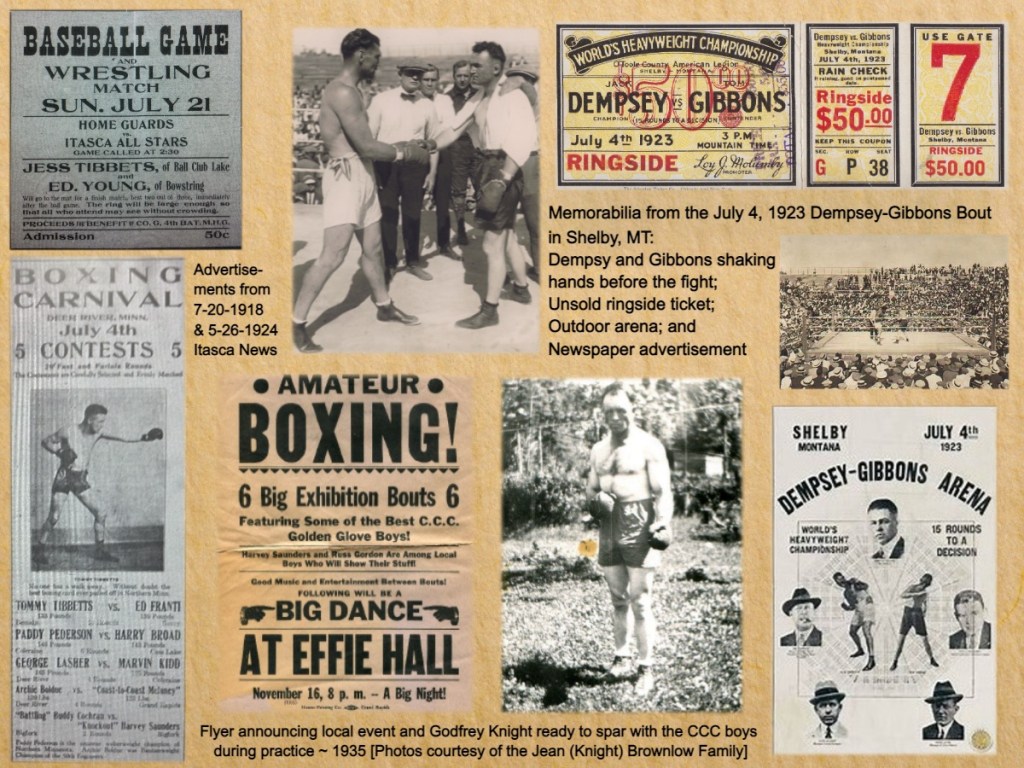
In 1923, Joe Poliquin from Effie traveled to Shelby, Montana to attend the highly promoted boxing match between Jack Dempsey and Tommy Gibbons. In his book, Tim-BERRR, (1991) Benhart Rajala wrote that Poliquin and Dempsey were on the same train. “Joe happened to meet Jack Dempsey in the aisle.  Joe tossed his turkey on a seat, pinched Dempsey in the belly, and stepped back quickly, ‘Haw-haw-haw!’ he said. ‘I just wanted to see what it felt like to sock a world’s champion!’ For a second, he was ready when he saw at the killer expression that crossed Dempsey’s face, but he kept his own broad grin in place.  Dempsey relaxed, and they shook hands.  It gave Joe a story he was fond of telling again and again.  ‘Dempsey’s belly was as hard as a rock,’ he would say.”

Gene Rajala confirmed the story his Uncle Ben related and added his own. “Joe owned a tavern in Effie, and he believed himself to be the authority on fights.  He always had the radio tuned in to listen on fight nights. Joe was a husky man with a big stomach but was pretty agile. One evening an old lumberjack was arguing with Joe about the Dempsey-Gibbons match and things got out of hand. The ‘jack’ got in front of Joe, ready to throw a punch, but Joe was quick.  He knocked him across the floor, and he laid there. Joe thought he killed the 150-pound man. Fortunately for all, he lived.”

Boxing in 1898

The following article was the oldest I have found about boxing matches in our local history. The writing of the newspaper editor, Murry James Taylor is so colorful that I’m sharing a good portion of it.

Was a Hot Bout ~ Itasca News 11-26-1898

“The sporting fraternity of Deer River was last Wednesday night treated to one of the most entertaining and genuine of any pugilistic ring bouts that ever took place in the county.  The contestants were Tom Murray of Grand Rapids, and Jack Cross of Montana.  Murray has been a resident of this section for a number of years and has had several hot contests with known men of the Northwest.

Jack Cross, who claims to be of Montana, is a total stranger here, having drifted in a week before the scrap, and is likely ‘on the rods’—judging from his personal appearance. He is a young man, under thirty, is smooth shaven, and looks like a hayseed.  In fact, when it was known about town that he was to meet Murray, pity was felt for him, and he was dubbed ‘The Reuben.’ Going about in clothes that bespoke better days past, and a gait indicative of slowness, he was immediately put down as a licked man, notwithstanding Murray’s ill condition.

The fight took place in the table room of Kelly’s saloon and began at 10:45 in the evening.  It was for an equal divide of the gate receipts.  The admission price was one dollar, and about fifty tickets were sold.  There were about seventy-five spectators present, including a dozen women.

Owing to Murray’s ill condition, and the fact that his opponent was a total stranger, there was no betting done whatsoever.

When the fighters came out of their rooms into the ring, stripped, there was immediately a lull and in many minds a change of opinion as to the outcome of the fight; or at least a doubt shadowed the minds of some of Murray’s admirers.  The young man’s massive shoulders and long arms, and the surprising amount of weight he had stowed away in the recesses of his flimsy garments caused a look of wonderment to spread over the countenances of the spectators.

Murray, like an old-timer, took the seat in his corner with perfect composure and seemed to have plenty of confidence.  He had two active rubbers attending him with all kinds of bottles, cloths, and fans.  Cross took his seat with an old pair of apron overalls on, and they were removed by his sole attendant, a young fat lively lad who had all the appearance of a typical hobo.  He had one bottle of water and a towel, which constituted all his apparatus for the rubbing down act.  Long before the fight and until he stepped to the center of the ring, Cross felt uneasy, never sitting, or standing still nor engaging in conversation.

The bout was advertised to be ten rounds; but when the fighters took their corners and Frank Hart was chosen as the referee, Murray called the referee to him and in an undertone, they talked about a minute.  Hart then had a few words with Cross, and after this the referee turned to the audience, and after introducing the contestants he explained that owing to the smallness of the ring, and the ill condition of Mr. Murray, the men would prefer to go six rounds real hard fighting, and if there was any indication of fake the people would get their money back. ‘But,’ said Mr. Hart, ‘If you want ten rounds you can have it.’ At this several voices answered that six would do; and ‘Go ahead,’ and ‘Fight hard.’

By the end of round six both men were weak and breathing heavy. Murray was spitting blood and Cross had a bloody nose.  Referee Hart declared the bout a draw and the decision met with the approval of the fans. Boxing either in Deer River or Grand Rapids continued through the turn of the century, often with a local boxer and a contender from out of the area.

After WWI

It seems that after the war, there were more newspaper advertisements for local boxing and wrestling competitions.  Frequently the events were billed as fundraisers for the American Legions and other civic organizations.  Some of the nicknames I found for boxers in the1920s were Coast-to-Coast McIaney of Grand Rapids, “Battling” Buddy Cochrane and “Knockout” Harvey Saunders, both of Big Fork, Battling Knotts of Effie, and Kid Greeley of Big Falls.

The William and Nettie Tibbett family had at least three sons who were talented pugilists – Jesse James, Tommy Phillips and William Burnham, Jr.

Archie Bolduc, one of sixteen children of Majoric and Georgianna, enlisted in the army at the same time as his twin brother Theodore.  According to a 1924 advertisement, Archie was a Bantamweight Champion of the 50th Engineers. In this same ad there is a photograph of Tommy Tibbetts in a boxing pose.

Brothers Godfrey and Jim Knight of Bustitown were not only boxers, but also coaches and referees.  Lew Brownlow wrote about his father-in-law. “Jim was also an enthusiastic boxing fan in those years and with his usual drive, he coached many of the local youth in the art of fisticuffs.  The training ring for these amateur boxers was in the hay mow of the Knight’s dairy barn.  His contented cows must have known many evenings of disturbances as the barn echoes with the clap, clap, clap of jump ropes against the floor and shuffling of feet as the sparring athletes perfected their techniques with the gloves.  Boxing bouts were promoted with contestants coming from neighboring communities.  These bouts were held in the Ward Johnson community hall in Effie, and after the last round, the ropes were removed, and the floor cleared for a dance.” [from Toward a Good Life by Lewis Brownlow, 1976]

Lew and Jean (Knight) Brownlow are enthusiastic Reminisce readers and contributed two photographs to this article. It is believed that the Amateur Boxing poster dated November 16th is from 1935.  Brownlow explained that Godfrey and Jim Knight were instructors in the use of tools and equipment at the Deer Lake CCC Camp southeast of Effie. “The photo was a for-real-suit-up. The pose was for show. Jean says the photo was taken by her dad back of their house. Some of the ‘boys’ were coming over to spar and workout in the barn. As trainer, old-man Godfrey sparred with the boys.”

Dempsey-Gibbons 1923

My husband’s family owns an unused ringside ticket to the July 4, 1923, Dempsey-Gibbons heavyweight title boxing bout. This is the match that Joe Poliquin probably paid thirty dollars for a ticket in the “outer ring.”

This might seem like an unbelievable find, until you realize there were at least 32,000 unsold tickets! The town of Shelby, with a population of about 1000, thought that by hosting the event they could put their municipality on the map. After the details were worked out, an outdoor arena, at a cost of $82,000, was constructed and loans were secured for upfront capital.

“This fight is often referred to as the ‘fight that broke Shelby,’ because the small Montana town almost went bankrupt in order to meet Dempsey’s purse of $300,000. That fee, which was to be paid in three installments, was negotiated by Dempsey’s manager, Jake Kearns, who made sure that the champ was well compensated for his efforts. Incredibly, raising that amount proved so onerous to the town of Shelby that challenger Tom Gibbons received no money for the fight. His only remuneration was a chance at the title. That was obviously incentive enough for him, as he shocked most pundits by lasting the entire fifteen rounds with Dempsey in a losing effort.

Only 7,000 tickets were sold for the fight, and the town eventually opened the gates to allow 13,000 fans in for free just to fill the arena. Needless to say, it was the first and last heavyweight title fight ever held in Shelby, Montana. That low attendance figure is the reason for the survival of full tickets today.”

In the end, Dempsey retained the title with a 15-round unanimous decision. William Harrison “Jack” Dempsey (June 24, 1895 – May 31, 1983) reigned as the world heavyweight champion from 1919 to 1926, retiring from boxing in 1927.

Thomas Joseph Gibbons (March 22, 1891 – November 19, 1960), was born in St. Paul, Minnesota and was a professional boxer from 1911 to 1925. After he retired, Gibbons was elected four times as the Sheriff of Ramsey County. He won six consecutive four-year terms before retiring at the age of 68.

Boxing has been a Summer Olympic sport since its introduction in 1904. Beginning with the 2012 Summer Olympics, women’s boxing has also been part of the program.

“Cold Blast” Equals Winter Fun 

2.6.2022 [originally published 1.18.2018]

Union suits ad 10-15-1921 Itasca News

“The extreme cold blast of Monday and Tuesday did not injure the feelings of the average school boy in Deer River for on those two days it was too cold to keep school.”

This statement was printed in the February 21st, 1903 issue of the Itasca News.  The article went on to explain that the furnace was kept going night and day, but that it was Wednesday before the temperature could be raised to an acceptable level for the students to return to the schoolhouse.

The following items highlight the fun of outside winter activities of years ago.  The first is written by John Broberg in his memoir, The Green Wing Story. John was a student at Scenic Park School in the late 1930s through early1940s.  His teacher, Mr. John Jarvela, taught at several rural schools in the northern part of Itasca County. 

The Ice Path

“One winter morning, the older boys had taken buckets of water from the pump and made an ice path completely around the school house.  The water froze in minutes when it was splashed on the ground.  We would line up and run to the ice path.  The person who could slide the longest distance was the champion.  We slid around and around the school.  Making the turn at the corners without falling down was the tricky part for all of us. 

I made one slide, tried to navigate around the corner, slipped, and fell on my face.  Just as I started to get up, a big boy came whipping around the corner and tromped down on my right arm above the wrist. The pain was excruciating.  My arm below the elbow was bent like a bow. I rolled on the ice and cried until the initial shock passed. Mr. Jarvela looked at the arm and thought it might just be a bad sprain.  There wasn’t much he could do about it.  He couldn’t call a doctor or my mother.  He couldn’t close the school since there was no way the students could get home without very long hikes.  He didn’t have his car at the school and, even if he had it, he couldn’t leave the kids.  I was stuck at school all day until it ended at four o’clock and the bus picked us up.  Skip and I got home that afternoon and Mom took one look at the arm and cranked the phone for the doctor in Big Fork.”

Sleigh Rides and Parties

Sleigh rides to winter gatherings were half the fun. It afforded small groups of young people an opportunity to visit with others they hadn’t seen since the busy planting and harvesting. The horses could travel more easily over snow and frozen water.  And the dances often lasted until daylight.

“A sleigh-load of young folk took in the dance at Turtle Lake last Friday evening, given in honor of Mr. and Mrs. Emil Krantz who were married Monday, Dec. 4. The boys presented them with a set of silver knives and forks and received in return each a piece of the wedding cake.  A bounteous supper was served after a most enjoyable time the young folks departed for Bigfork, wishing the newly married couple a successful journey along life’s pathway. – Mr. and Mrs. Krantz have accepted positions about three miles from Bigfork in one of the Pillsbury logging camps.” Bigfork Settler 12-14-1905

“A sleigh party will be given by the Caesar Club next Saturday night, each member to invite one friend.  Sauerkraut and wieners will be served after the ride.  All the members of the club are anticipating a good time.  We hope the weatherman will be good to them.” Bigfork Settler 1-25-1929

Skates and Snowshoes

For a few years there was an ice skating rink in Deer River, but with no funds for the upkeep, it was a short-lived endeavor.  As modes of transportation, skates and snowshoes were essential for those living in the wilds of the Big Fork Valley. 

“Orin Patrow of Evergreen made a flying trip to Bigfork early Friday morning, coming all the way from his home on skates.” Bigfork Settler 2-23-1911

“HD Horton and Ed Carlson skated up the river to town a distance of about twenty miles and report this as being the quickest way they have ever made the trip, making it in one and a half hours.” Bigfork Settler 12-18-1913

“Another nonstop record broken: Archie Randall snowshoed from Lunde’s camp near Togo to Bustitown in seven hours, a distance of 29 miles. (What is the attraction, Archie?)” Bigfork Settler 2-21-1930

Sleds, Toboggans and Barrel Staves

Snow, a hill and something to put between yourself and the ground is all you need for this age-old bit of frosty fun.  I remember how thrilled my siblings and I were to slide down a section of Mt. Baker, a glaciated volcano in the Cascades on pieces of cardboard in July of 1974.

“The ‘Rough and Tumble’ club (ladies), after an hour’s burlesque with bobsleds. Barrel staves (and one had a clothes pin) on Creamery hill Saturday night, ‘tore’ over to the Erik Johnson home nearby where by previous arrangement Mrs. Johnson had the coffee hot and a swell lunch in waiting, which they devoured and making the welkin ring, ‘hollered’ good night so we could all hear it.  The late Mrs. Wicklund, who passed away this week was also a hostess, having helped furnish the lunch.” Itasca News 2-10-1923

Ski Tournament in Coleraine

The first ski jumping hill of Coleraine was built up in 1906 out of wooden battens and plates from a sawmill on the banks of Lake Trout. A Ski Jump Club was formed in 1907.It only took a few more years before the ski jump achieved notoriety. Arrangements could sometimes be made for trains to make limited trips to special events or have reduced fares for excursions to Duluth or Crookston.

“A special train has been secured by Agent Beall to run an excursion to Coleraine and return to accommodate Deer River people who wish to witness the National Ski (skee) tournament tomorrow.  The fare for round trip is one dollar.  The train will leave Deer River at 12 noon, and returning leave Coleraine at 7, arriving home at 8.  Some who cannot leave at 12 o’clock will take the regular passenger train at 2:10 and drive to Coleraine from Grand Rapids.” Itasca News 2-19-1910

A Post Office No More ~ Rosy, Itasca County, MN

1.30.2022 ~ [archived ~ originally published 1.12.2017]

Rosy Post Office 1988 ~ T148N R29W, section 2, SW1/4 of SE1/4 [ICHS Archives]

Several months ago, I asked for information from readers regarding four categories of historical interest that I wanted to highlight during 2017.  Last week’s column had the first character sketch.  This week is about a community that no longer exists on the map and next week’s will be about a rural school.  Resorts, the 4th special interest series will start in late spring.  Throughout the rest of the year, I will periodically feature a column on one of these four categories.  Your suggestions, memories and photographs are always appreciated, so please keep them coming!

The community of Rosy was located on the northern boundary of section two in Third River township.  It is said that the name was given to the area because of the pink sand roses which grew in abundance. Mail came to Rosy from Bena.

In the fall of 1900, the neighbors volunteered to carry the mail from Bena to Rosy once a week. Apparently at the time, doing so for at least three months demonstrated the need for a post office in a community.  The postmasters in the thirty-some years the post office was active were Peter Bohn, Harry Sorby and Oscar Bohn.

The official register of the United States Postal Service, documents in long-hand that the post office at Rosy was established on February 1, 1901.  It was not expected that the post office be a special building, just a designated space.  In this case, it was in the home of the postmaster Peter Bohn.

The Bohn family had moved from Delano to Deer River in 1891, and then homesteaded in Third River Township.  Oscar, son of Peter and Anna, wrote “As the govt got the land surveyed it was open for homestead settlement and my father filed on the homestead in 1893, and in 1894, my mother and two sisters and I and our hired man Hans Bjurlein spent one winter from Jan to April 1st on the homestead and that $40 per month job my father had [when the family lived in Deer River] paid living expenses for us all.  My father had bought a small team of horses and a wagon for $20 and we had about three head of cattle as well.

The Fred Roberts and Frank Roberts also filed on homesteads in Third River township and also Matt Nolan and Charley Nolan took up homestead land, and in 1898 my sister Selma died of typhoid fever and about that time Emil Johnson, or possibly 1899, Emil Johnson came to us from Delano and filed on the homestead which later became and is now the Jack Westrem place.” [Oscar Bohn 8-20-1958]

There were enough families in the community to warrant a school, and on September 23, 1901 school commenced in an abandoned building on the property of Fred Roberts. The first teacher was Ada Fay Collins, whose salary was $40 per month.  She boarded with the Thomas Daigle family and three of her nine students were Daigle children; Fred, Flora and Philomina. There were also the Erickson children Minnie, Carl and Augusta; and Oscar Bohn, Nolan Cass and Alfred Johnson.  This school was known as the Decker School, Daigle School and even later as the Rosy School.

When this first school burned down, residents of Rosy donated logs and a new school was built closer to the hub of the community, near the Rosy Post Office.  By this time the Bohn’s had moved and built a large home across from the original location.  The post office and living quarters were on the first floor.  The second floor was one room that served as a meeting place, community center and dance hall. 

Another family who moved to the area were Norwegian immigrants Arnt and Sigrid Jamtaas. Their daughter, Gertina “Tina” was also a teacher, and split her time between Rosy and the Third River school between 1903 and 1905.  This was an unusual arrangement, but the school district felt it satisfied the needs of the two very rural communities.

The Peter Bohn family made plans to homestead in Canada, so Harry Sorby, a carpenter from Norway, who had lived with the Bohn’s for nearly ten years, was appointed postmaster on June 30, 1913.  Fulfilling a long-time community need, Sorby added a mercantile in the Bohn building.

Esther (Johnson) Connell’s Swedish parents were settled on a homestead in Good Hope Township when she was born in 1909. In 2001, at the age of 92, Esther wrote “Remembering Rosy,” dedicated to her children who pestered her to “put my memoirs down on paper.”  She shares fond memories of Sorby.

“Harry Sorby, a bachelor, was the postmaster and shopkeeper.  He sold a small line of groceries, such as flour, sugar, coffee and salt…also stocked kerosene for our lamps. My sister, Hazel, and I would walk or ride a horse to pick up flour and sugar for Mama. On a lucky day, Mr. Sorby would give us candy.  I especially liked the peppermint sticks.  I’d enjoy them all the way home.”

Esther started kindergarten at Dunbar school, which served the Rosy community by 1913. [Some records indicate the Rosy school closed in 1912.] “A bit jittery about what lay ahead, my teacher, Miss Agnes Murdock, made me feel at home. She was paid $40 a month. (And did she ever earn it.)

Quite primitive, the school was a small log cabin with a big wood stove that the boys kept filled.  Outside was an outhouse – a three holer and a handpump for water.  In the school yard we had a swing and teeter totter that one of the fathers made.  We girls liked to skip rope the best.  There were 11 of us in the school.  I can still remember all their names:  John Bardsley, Eino John, Irja Kuusela, Anna Kuusela, Helga Kuusela, Jacob Leinonen, Lempit Leinonen, Ida Sandness, Edward Simonson and Ronnie Simonson.

Most of the time we walked the one mile to school.  There were some days in winter – it got 30 below where we lived – when Papa would get out the sleigh and a team of horses and ride us through the snow.”  

Peter Bohn and his family returned to Rosy in the early 1920’s. They hadn’t been settled very long in the old homestead when Bohn was stricken with heart trouble and passed away in January 1924. Oscar, now 30 years old, stayed on the family home place.

The official register of the United States Postal Service indicates that Oscar Bohn became acting postmaster in September 1929 and was appointed postmaster on March 19, 1930.  Oscar married Grace in 1934 and they were the parents of three boys, Reynold, Peter and Donald.  Oscar died in 1960 and his wife Grace lived to be 102 years of age.

I am not sure exactly when the Rosy Post Office actually closed, but according to the United States census of 1940, Oscar was no longer postmaster, as he was working on a WPA project.

The building which housed the Rosy Post Office stood until 1990 when it was destroyed by a fire.  It was the last landmark of Rosy.

I think Esther (Johnson) Connell’s words ring true… “Rosy is gone now, but there‘s a mystique about it that lives on.” Her book, “Remembering Rosy,” is available for review in the library of the Itasca County Historical Society.

Groundhog Tails

1.23.2022 [archived ~ previously published 2.2.2017]

This looks just like the juvenile groundhogs I have seen around my cabin!

Well, here it is another Groundhog Day, and chances are regardless of whether Punxsutawney Phil sees his shadow or not Itasca County will have at least six more weeks of winter.  The official first day of spring is March 20, 2017, six weeks and four days after February 2nd

For me, the end of winter is when the yellow cowslips can be seen in the lowlands.  For some it might be the pussy willows blooming and others say winter is not over until the ice is out of their favorite lake. According to the MN DNR Climatology Office, the average ice out for Lake Winnibigoshish is April 24.  The earliest was March 30, 2012, and the latest was May 10, 1996. 

But back to the woodchuck.  Yes, a groundhog and a woodchuck are the same animal. They belong to the group of large ground squirrels known as marmots and are one of the few species that enter true hibernation.  Other names include groundpig, thickwood badger, whistler, whistlepig, and red monk. 

In Minnesota, groundhogs are likely to hibernate from October to March or April.  If we had to wait until say April 15th for a groundhog to emerge and he saw his shadow, guaranteeing us six more weeks of winter, that would bring us to the end of June!   I’ll stick to the cowslips, if you don’t mind.

I have two interesting articles specific to woodchucks from the archives of our local papers. 

Bags Black Woodchuck ~ Itasca News 6-30-1927

J.L. Cartwight late last week captured an odd animal, a coal black woodchuck.  It is a rare specimen.  Mr. Cartwright sold it to F. M. Williams, who added it to the collection at his zoo.

Jesse Levi Cartwright was a dairy farmer in Morse township.  He was married to Elsie May and they were parents of a large family.  Their children were Floyd, Ernest, Rosetta, Minnie, Everett, Ray, Violet, Vernon and Ruth.

Mr. Williams, who was affiliated with Williams’ Narrows resort, boasted in an advertisement earlier that year, that the “Largest Private-Owned Zoo in the State was open to the public after May 20th and was Absolutely free.”

Unusual ‘Mother’ Substitute ~ Itasca Progressive 6-2-1938

Clarence Horner of Wirt is the owner of a female Fox Terrier dog that mothers a young wood chuck and feeds it regular with her litter of little puppies.  The baby woodchuck nurses with its strange pals and huddles up with them to sleep just the same as if it was not an odd member of the family.

Mr. Horner’s children drowned the mother woodchuck out of a hole and captured the young one and carried it home alive and placed it among the little puppies to be nursed by the dog mother.  It proved a welcome member to the family by the mother dog as well as the pups and this peculiar incident has proven of keen interest to the

inhabitants of Wirt who visited Mr. Horner’s home to be satisfied with their own eyes that this freakish occurrence is really true.

Clarence Horner worked in the lumber camps near Wirt, and his daughters Della and Dolly were married with children of their own in the late 1930s.  I believe it was probably Mr. Horner’s grandchildren who found the young woodchuck and brought it home to be nursed.

Since I didn’t have enough stories about the groundhog for a whole column, I am also sharing a few “tails” about a very distant cousin, the muskrat.

650 Muskrats! ~ Bigfork Settler 5-16-1907

Jesse Bowerman who has been trapping at Wirt since last fall returned to Bigfork last Sunday and reports a very successful winter’s work.  He succeeded in capturing twelve fisher, twenty-two mink, two wolves, two bob cats, one fox, four lynx, two coons, two skunks, eighty-five weasels and six hundred musk rats for which he received the neat little sum of four hundred and twenty-five dollars.

As is evident from the article, Jesse’s full-time occupation was that of a trapper.  He was born in Kansas, homesteaded near Bigfork and spent more time outdoors than he did inside.  He was a very

solitary man, never married and died at Effie in 1923 at about the age of fifty.

I learned that muskrat was good eating, much to the surprise of the editor of the Bigfork Settler. In the October 10, 1907, issue of that paper, W.E. Johnson explained that he and several companions were visitors of the Magnuson and Peterson lumber camp. There over the noon hour, they were served a dinner of muskrat. 

“While it was our first feast on this kind of meat, we hope it will not be our last, especially if it is prepared in a manner that would tempt the appetite of the most delicate, as was the case in this event. 

We might add that if the people in general realized how delicious a meat the muskrat made, ‘Uncle Tom’ would have more competition in the trapping business.”

Uncle Tom was actually Damas Neveaux. He was a Frenchman who had settled in the Big Fork Valley very early, before others had arrived.  He was so hospitable to the newcomers, he was given the nickname of “Uncle Tom.”

Today, woodchucks are considered a nuisance, except for Punxsutawney Phil and his family.  The woodchuck is also eatable and has more meat on it then a muskrat.

Cooking Woodchuck

Woodchuck should be handled in accordance with the general rules for game in the field. The blood should be drained, and the entrails removed, and the body cavity wiped clean. When hung for 48 hours, they are ready to be skinned and cooked.

Woodchuck meat is dark, but mild flavored and tender. It does not require soaking; however, many people like to soak it overnight in salt water. If the woodchuck is caught just before he begins his winter sleep, there is an insulating fat layer under the skin. Remove excess fat. remove 7 to 9 ‘kernels’ (scent glands) in the small of the back and under the forearms.

Woodchuck

1 woodchuck

2 slices of bacon

Potatoes, carrots, onions

2 onions or 1 onion and 1 apple

Salt and pepper to taste

4 c. water

Soak woodchuck in salt water for 24 hours before cooking.   Rinse well and place in roaster.  Put onion and apple in cavity.  Lay bacon over breast.  Salt and pepper to taste.  Place vegetables around woodchuck.  Add water.  Place in 350 degree oven and roast 3 to 4 hours.

This recipe is NOT Reminisce test kitchen approved, but I did find it in my grandmother’s game recipes folder.  Who knows…maybe I have sampled woodchuck at her kitchen table!

Winter Underwear and Union Suits

1.16.2022 [archived ~ previously published 1.8.2015]

1908 Sear & Roebuck Company Catalogue

The January 2, 1913, edition of the Bigfork Settler features an article titled “Winter Underwear – How to Make it Last”. Of course, the first thing that came to mind was long underwear. I consulted my 1897 Sears, Roebuck & Co. catalogue for additional information about longies, as we called them growing up, and discovered there wasn’t a category for long underwear. I soon found out why. All of the underwear, men’s, women’s and children’s was long (from the waist to at least the knee) so there was no need for a distinction!  I also learned that the selection was divided into summer underwear and winter underwear.

The summer underwear for men were made of cotton and sold in two pieces. The top was a long sleeved pullover undershirt with four buttons. The ankle length drawers (so called because they were ‘drawn on’) had three buttons at the fly. The colors available were blue, white and tan.

Ladies summer underwear was of white or ecru cotton and these too were sold separately. The top, called a vest looked like a modern tank top with ribbon and the drawers were lace trimmed in either knee or ankle length.

There was also winter underwear for both men and ladies which was made of cotton and lined with wool or cotton fleece. Again, they were two pieces, but the women’s vest was long sleeved and buttoned up the front like a man’s though it might have a bit of lace or ribbon at the neck.

The catalogue also advertised union suits for women, children and misses. Although I have worn long underwear during our coldest months most of my life, union suits were not a part of my wardrobe. I was surprised to see both summer and winter union suits.

The ladies summer union suits were short sleeved and knee length, with a low neck and of course, a drop seat. Some styles buttoned part way and most were in white, ecru or grey. Winter union suits were wool and fleece lined cotton and had as many as twelve buttons down the front. But there were no union suits for men!

Further research revealed that the union suit was patented in 1868 and was sold as a garment for women only. It is believed that ‘union’ referred to the uniting of the top and bottom pieces of underwear. Union suits were most likely always store-bought as the construction was somewhat cumbersome. They were initially made of flannel, and although not cited, it is believed they were red. While warm and cozy, flannel is a tight woven cloth and therefore had very little give to it. With the changes in manufacturing, cotton knit fabric was developed which had some stretch and was more practical for a one piece garment. As noted in the catalogue, the color red was not even listed as a choice.

So, when did men start wearing union suits and what were the color choices?  I referred to my other old Sears book dated 1908 and again found no mention of union suits for men. Based on the absence of them in 1908 and the newspaper advertisement that caught my eye in 1919, we can narrow it down to the intervening years.

I think we have all watched western movies and TV shows like “Little House of the Prairie” that depicted men in union suits – probably red – getting ready for a swim, a bath, or running from a catastrophe of some sort at an inopportune moment. The history detective in me wants to go back through the newspapers from 1908-1919 for the emergence of union suits for men; and determine if the classic programs appropriately dressed their characters for the time.

With the theme of winter underclothing I wanted to share a few amusing anecdotes I have saved for just this occasion. The first comes from Taito’s Stories – A history of Taito Mattila’s family in Deer River.(Compiled by the Mattila family in 2000 and is available for review at the Itasca County Historical Society.)  Taito relayed to his son an incident he recalled about an elderly Finnish neighbor, Andrew Niemela:

 The old smoke sauna Andrew had was pretty dark inside. Once in the wintertime, Andrew came in from there and told his wife there is something wrong with my underwear. They just don’t feel right. She said, well, let’s see what’s wrong. Here he had put his feet through the sleeves.”

The second anecdote is an epitaph for Peter Daniels from a 1915 issue of The Country Gentleman:                                                                                            

“Beneath this stone, a lump of clay

Lies Uncle Peter Daniels

Too early in the month of May,

He took off his flannels.”

Back to the article about mending winter underwear…it was very detailed in describing how to use an embroidery hoop to secure the damaged area, and carefully darn it using a small crochet hook. I would be happy to share it with anyone inclined to mend their long underwear or union suit.

And whether we call them long johns, longies, flannels, union suits and long underwear, it is essential that we keep a pair around, just in case it gets really cold this year. It is said that many people wore them from Halloween to Memorial Day. Some even say they wore the same pair…But I for one would not be doing any mending on them! 

Spuds, Taters, Murphies, Tubers, Goobers or Ground Apples part 2

Itasca County Homegrown Potatoes

1.9.2022

Note: Part 1 of this two-part story appeared in the December 12, 2021, issue of the Herald-Review.  It covered the growth of the potato industry in Itasca County from the turn of the century until the late 1920s.

The Kremer White Gold Potato

George Kremer was one of four adult siblings who in the 1890s moved from Saginaw, Michigan, to the prosperous village of Grand Rapids, Minnesota.  George is the one most of us know because of the Geo. F. Kremer store which occupied a city block in Grand Rapids from 1893 until 1991. [Incidentally, in October 2021, his brother Arthur was featured in a two-part Reminisce column Law & Order ~ County Treasurer Embezzled Funds.]

George was a curious man, and the potato farming of his youth never quite left his thoughts.  It was probable that in the early 1910s Kremer put the word out to local farmers that he was interested in the “seed balls” that sometimes appeared on the potato plants. Kremer knew that by experimenting with the viability of the seedlings he could develop a new variety of potato.

Having never heard of a potato seed ball, and assuming readers might not either, I did some research. “A potato plant can occasionally sprout what look like a few tomatoes from the main stems above ground. Those aren’t the result of some strange experiment in your garden, but rather the result of potato flowers finally being pollinated. Those round seed pods are also called potato fruit, potato berries and seed balls. They look like green cherry tomatoes and usually appear in small clusters. The interior of a seed pod has up to 500 tiny seeds distributed throughout a mass of moist tissue.” [http://homeguides.sfgate.com/potato-vines-tomatolike-growth-97967.html]

When Kremer was given a seed ball, he saved and planted the seeds. It is thought that hundreds of seedlings were grown and discarded as they did not have the qualities Kremer was looking for. In about 1922 he thought he had a seedling that might have promise.  For eight years Kremer grew this new variety in trials.  He had the potatoes grown under ordinary conditions by farmer friends George Heinrich of Bass Brook, and Alva Sisler of Grand Rapids.  He also had the potato grown on different types of soil in Itasca County. Finally, Kremer was ready to share the potato he felt showed great value.  It was clear skinned, white, mealy, grew to good size, and ripened several days in advance of Bliss Triumph or other early varieties grown by Itasca County farmers.

Kremer was pleased with the potato harvest of 1930, especially when his new variety received a first-place prize at the Minnesota State Fair.  It was also at the fair that an established nursery took an interest in marketing the variety throughout the state.

May Contract for Kremer Potatoes ~ Deer River News 9-24-1930

“Geo. F. Kremer, originator of the locally famous early white potato, which is known here by his name, is negotiating with the Farmer Seed & Nursery Company of Faribault for the purchase of a large quantity of the potatoes grown here this year.  While the deal has not been entirely closed, Mr. Kremer is confident that an agreement will be reached which will be satisfactory to him and to the farmers who have grown the potatoes for him from seed which he originally supplied.

The potatoes were grown in large quantity this year on the Geo. Heinrich farm in West Cohasset.  In spite of the dry weather, the potatoes yielded well.  Their high quality was attested by the fact that they won first place at the state fair in the “any other variety” class.  Representatives of the Farmers Seed & Nursery Company saw them at the fair and opened negotiations for the purchase of a large quantity for sale as seed.

It is anticipated that the seed company mentioned, if successful in getting the selling agency for these potatoes, will have their yearly supply grown in Itasca County, where the potato originated, and where it appears to develop so successfully.  Mr. Kremer has been asked to name several good potato growers here who might be willing to grow them for seed under contract with the Faribault firm.  A distinctive name will also be selected for this potato which will associate it with Itasca County.” The name chosen was Kremer’s White Gold.

The Farmer’s Seed & Nursery Company is one of six horticultural companies that had a long life in Minnesota.  The others are Bachman’s, Bailey Nursery, Jewell Nursery, L.L. May & Company, and Northrup King. Farmer’s was originally founded in Chicago, but when the owners, William F. Kueker and his brother-in-law, Otto Kozlowski realized that most of their sales were to farmers in southern Minnesota and Wisconsin, they moved their firm to Faribault in 1893. In 2018, the company closed.

Potatoes are an Itasca County Crop

For many years locally produced Kremer White Gold potatoes were stored, graded and shipped by rail or truck from a warehouse on 4th Street in Grand Rapids. The Cooperative Growers Association of the earlier potato years changed to the Arrowhead Potato Growers Association. It consisted mostly of Itasca County farmers and served as the marketing vehicle for the local producers of all potato varieties.

Since many farmers in the county were growing the new potato, in 1931, the Kremer White Gold was declared a separate category at the Itasca County Fair.  White Gold proved a successful yield, as did other varieties, especially in the community of Jesse Lake.

Itasca County has Potato Champion ~ Deer River News 10-15-1931

“Western Itasca County may now claim the residence of the champion potato grower of the world!  That’s taking in a lot of territory, but there is nothing lacking in the facts to prove it! E.J. Youngren of Jesse Lake, from his hill selected seed plot, this year harvested a yield of 1,100 bushels to the acre.

The figures are amazing but have been carefully checked and are reliable.  So far as is known, records of the nation do not reveal a greater yield at any time. For two years Mr. Youngren has been carefully developing his seed plot of Green Mountains.  Last spring, he had enough seed to plant a test row, and when the potatoes were dug recently the yield was at the rate of 1,100 bushels per acre.

And just to prove it was no accident, Mr. Youngren’s main field of potatoes gave a yield of 545 bushels per acre, second highest in Itasca County this year, surpassed only by that of Clair Cole, south of Cohasset, who secured a yield of 585 bushels of Rural Russets.

Mr. Youngren’s remarkable crop was not the only one in his community.  Other Jesse Lake farmers gave him a run for his honors. Among them were Lee P. Allen with 426 bushels of Rural Russets, O.B. Bendix with 422 bushels of Green Mountain, Theodore Alzen with 347 bushels of Green Mountains, and Eric Mortenson with 338 bushels of the same variety.

These remarkable yields stamp the Jesse Lake region as outstanding for the growing of potatoes.  It has furnished three-seventh of all the growers who thus far have qualified for the ‘300 Bushel Club’ in the county this year.  Our hat is off to Jesse Lake!

The Cohasset community is another with a remarkable showing.  In addition to the yield of Clair Cole, cited above, Geo. Heinrich grew 402 bushels of Kremers and 397.4 bushels of Green Mountains to the acre.  H.H. Keeler 399 bushels of Kremers, Matt Kassler 336 bushels of Rural Russets, R.B. Rasmussen 318 bushels of Green Mountains, and Ed Scherf 312 bushels of Green Mountains.

Chris Erickson of Wendigo, with 357 bushels of Rural Russets and Henry Thaxter of Harris with 330 bushels of the same variety, are other Itasca County growers who qualified for the ‘300 Bushel Club.’”

In 1939 there were sixty-three potato entries in the Itasca County Fair, proving potatoes were still the number one crop in the county. About this same time though, the Kremer White Gold lost its popularity because of its susceptibility to blight. George Kremer remained an active member in the Arrowhead Potato Growers Association until his death in 1942.  The following year, the Kremer family established the George F. Kremer plaque for best of show for a display of potatoes at the Itasca County Fair.  James Haugen of Pokegama Lake received the plaque in 1943.

Farmers continued to bring big potatoes into the newspaper office. “Victor Sandgren of the Chase Lake neighborhood brought in a huge potato Tuesday that is on display in the window of The News office. The spud is a Sebago, Mr Sandgren says.  He bought a small quantity of the potatoes for seed to fill in a small patch of ground, and in marketing the potatoes Tuesday, picked out the large one that is on display. He says that while not all the potatoes were quite that large, all ran exceptionally large.  Next week the big spud, which weighs two pounds, six ounces, will be taken home to make a few meals for The News family.” [9-28-1949 Deer River News]

The VanBuren Potato Grader

Along with the growth of the potato industry in Itasca County, there were folks looking for ways to improve on other aspects of the business of growing and selling potatoes. L. Elbert VanBuren was the postmaster of Blackberry from 1918-1942, but he was also a potato farmer and a bit of a tinkerer.

Invents a New Potato Sorter ~ Grand Rapids Herald-Review 5-29-1929

“L.E. VanBuren of Blackberry has invented a potato sorter which has been declared by potato buyers and others familiar with the automation to be something unique and entirely different.  The new grader is arranged on the principle of a crushed stone grading machine and is claimed to work much more satisfactorily than the screen machines now in use where the potatoes are carried over a moving screen.

The VanBuren grader, as the machine will be known, contains a hopper in which the potatoes are poured, a cylinder screen set at the proper angle and, at the delivering end of the screen, an ending chain or conveyor which takes the potatoes to the sacker.  Several features commend themselves to men who have handled large quantities of potatoes.  The hopper, instead of being made solid, is constructed of iron bars which permits dirt, sand, and gravel to fall out rather than be carried through with the potatoes.

While the VanBuren sorter and grader has not been tried on any large capacity of potatoes, those who have seen it work in demonstration claim that it will revolutionize the labor of sorting and grading potatoes and predict that Mr. VanBuren has invented something which will bring him a large and certain reverence.”

The Itasca County potato legacy did not end in the 1940s, in fact there is actually at least one other individual who made a name for himself.  You might have heard of the “Potato King” Marvin Schwochert of Morse township, north of Deer River.  Not only did he have some revolutionary ideas, but I also have a few great stories involving Deer River High School students working in his potato fields.  A column for another day! And if you can add to it, please get in touch with me. 218-244-2127 or chrismarcottewrites@gmail.com.