Christmas Memories Part I ~ Homestead Nursing Home

12.18.2022 [archived ~ originally published 12.11.2014]

I published this series over three consecutive weeks eight years ago! I will publish every couple days during this week.

Christmas for Sally, Erick, Eleanor, and Esther is a time of special memories.  Like most children who grew up on rural farms in the 1920s and 1930s, the emphasis was on family, community, and church.  I had a chance to visit with folks at Homestead Nursing Home and am sharing some of their memories in this column and the next two.

On the farm in Mott, North Dakota, where Sally was born in 1924, the Christmas tree was artificial because there were very few evergreens.  “We had real candles, but only on Christmas Eve and Christmas morning” she explained.  “My sisters and I had to sit and play very quietly, and the folks kept watch on the candles.”  They had popcorn on the tree, but Sally didn’t remember any other ornaments. 

“My mother had a beautiful fold out garland that was tacked to the ceiling and went to all four corners of the room.  It had a bell that hung down from the middle.”  Sally’s parents were both from Norway, so their Christmas included krumkake which was made using a pan similar to a waffle iron, on the wood cook stove.  Krumkake is quite thin and before it cools, it is rolled up.  The main meal was krub, also called blood sausage.  It was made in a loaf pan, sliced, fried, and served with melted butter. 

“Our Sunday school always had a Christmas program at the church.  We sang some songs together, and then took turns reciting a piece that we had each learned.  One year my older sister and I sang together, and our father accompanied us on the violin.  Dad played the introduction, and we started singing.  For some reason my sister quit singing, so I quit singing and hid behind my sister.  My dad said he might as well quit too, but they talked him into playing, which he did.”  

“It was all girls in our family so mom tried to make each of the four of us a new dress for Christmas, I don’t remember much about toys for presents.”  Sally does recall a favorite gift was a pair of green handknit mittens.

Erick remembers mittens too. “Nellie Wadman was a really nice neighbor lady whose children were grown, and she always knit socks and mittens for us a Christmas.”  Erick was born in Spring Lake in 1930.  His parents and older brother emigrated from Sweden in 1923, settling in the area because Erick’s uncle was living there. 

“Oh, Christmas was special.  There would be a big program at Little Sand Lake School which included a visit from Santa.  He would also come to our house on Christmas Day.”  Erick admits he was a little afraid of him and for many years did not know who it was.  “We had a Christmas tree with candles both at school and at home.  My mom made cookies, though I can’t remember the names of them, I know I ate plenty.  We usually went to my aunt and uncles for Christmas dinner and always had Swedish meatballs.”  His face lights up and he says, “They were my favorite then and they still are now.” 

Erick also remembers his mom making a Christmas pudding and sewing shirts for him and his brother.  The most memorable present he received was a top from Santa when he came to the house.  “It was the metal kind that you push down on the top a few times and watched it whiz around on the floor.”

For 84-year-old Eleanor, her childhood Christmas’ were a time of mixed memories.  When she was about nine years old, two family members were killed in a vehicle-train accident.  “My parents were Polish, and dad was taking his mother, my grandmother, to the Catholic Church in Ball Club for the Christmas service.  Two of my sisters and I were to go with, but I couldn’t find my white socks.  It was very important that we wear white socks to church at that time.  Anyway, my mom was working in the barn, and I couldn’t find my socks, so I just stayed home.  As it turned out it was a blessing, as who knows what might have happened.  The train didn’t blow its whistle, and the car was struck.  Dad and my grandmother died, and my sisters were taken to the hospital in Grand Rapids as there wasn’t one in Deer River.”

After that, Eleanor’s mother raised the rest of the family on her own.  She did what she could on their meager income to make the holiday fun.  Usually there were homemade clothes and maybe a small toy for presents.  Her mom always hid the presents in the house for them on Christmas day.  Eleanor and her sisters and brothers put out a clean sock on Christmas Eve and found it filled with goodies in the morning.  “My mom was a real good woman.  We didn’t have much but she took care of us kids real good, and she loved to laugh while we searched for those presents!”

Esther was born in Denmark, New York in 1934.  She was the oldest of eight and helped her mother care for her younger sisters and brothers.  “At Christmas we had a real tree that dad cut and brought in the house.  We decorated it with popcorn, though we ate a lot of it, and ornaments.  Some of them were my grandmother’s and very fancy.  We did not have candles on the tree as there were too many children running around in our house.” 

The food Esther remembers included pumpkin pie and carrot pie, which was her father’s favorite. Most of their presents were homemade.  Her mother made clothes for them from the bright and cheerful feed sacks, and dolls from mens socks.

“I remember one year I was in town with my mother, and I saw a beautiful doll in the store window.  I told her that was what I wanted for Christmas.  I was so surprised to see it under the tree, and so disappointed when I saw that it had my younger sister’s name on it!” 

One of Esther’s favorite gifts was a scaled down ironing board that her father made for her.  “I used the same iron as my mom, heating it up on the stove, and ironing my own clothes.”  With a smile and a nod, she added, “I have always been very particular about my clothes.”

Sally, Erick, Eleanor, and Esther all remember getting an orange or an apple and nuts, along with a little hard candy.  Their overall favorite seems to be the colorful Christmas ribbon candy.
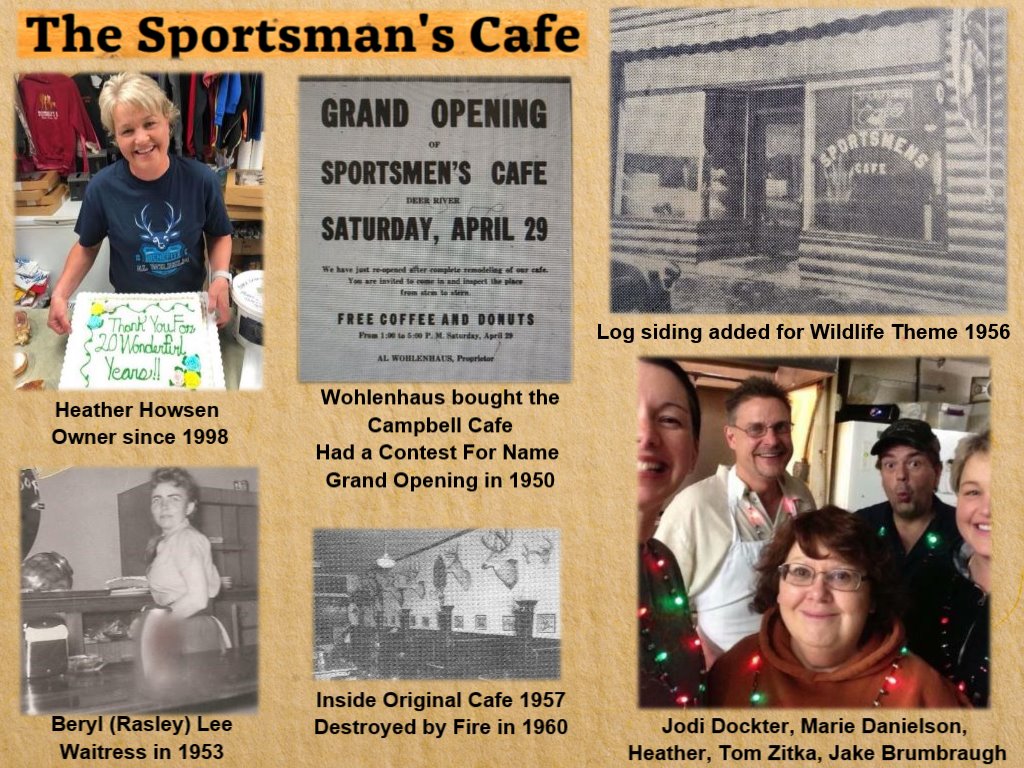
Sportsman’s Cafe ~ 50 cent coffee for 40 years!

12.11.2022 [archived ~ originally published 11.19.2018]

To tell the history of the Sportsman’s Cafe means starting a little further back in history, but first, an explanation as to the spelling of the name. The original spelling, decided in 1949 was Sportsmen’s, but over time and apparently with nothing deliberate on any one individuals’ part, it there has been changes. Newspaper articles through the 1960s spelled it Sportsmen’s and so did the local phone book. During the 1960s the phone book spelling was Sportsman or Sportsmans.  It appears that by the mid-1970s the phone book and newspaper advertising was Sportsman’s Cafe, as it is today.

Three other Deer River restaurants of the past are intertwined, to create what we all know as the only place in town to get a homemade caramel roll and a bottomless cup of coffee for under a $1.50!  They are Harmond’s, Campbells, and Arrowhead cafes.

Deer River Restaurants Through the 1930s

There have been many restaurants in the village of Deer River through the years.  Some of the oldest listed in order of advertisements beginning in 1897 are: Little Harry’s, Willis Block Cafe, Globe Cafe, Itasca Hotel Cafe, Ideal Restaurant, Lou’s Place, Liberty Hotel Cafe, Pete’s Corner, Miller Hotel Restaurant, Finley’s Hot Lunch, Itasca Cafe, Brownie’s Snak Shack and St. Peter Delicatessen Lunch Room.

It doesn’t appear that there were ever more than three or four operating at once and I suspect new owners changed the name at least some of the time.  For instance, I do know that the Itasca Hotel Cafe was bought by Thomas Finley and became Finley’s Hot Lunch.  In 1931 Finley sold to Howard and Ellen Harmond, who renamed the business Harmond Cafe. 

Changes in 1935

Prohibition had ended, and the village of Deer River decided to establish a municipal liquor store.  The location they had in mind required a few businesses to shuffle around.  Campbell Lunch, which was started by Malcolm and Phoebe Campbell in the early 1930s was pivotal to these changes.

In mid-January, a jewelry store moved – “As soon as Mr. Scharfenberg had vacated his former store, M. Campbell began the work of remodeling it for occupancy by his restaurant and beer parlor.  As soon as the building can be made ready, Mr. Campbell will move out of his present quarters which have been leased by the village for the municipal liquor store.” [Itasca News 1-24]

A couple of days later the second move was made “The new Harmond Cafe opens in the former Henry Herreid Clothing store building.” [Itasca News 1-24]

And finally, the following week – “What is probably the last of the shifts to accommodate changes in the business section of the village was made Tuesday night, when the Campbell lunch was moved into the building formerly occupied by the Harmond Cafe but purchase by Mr. Campbell last month. This shift paves the way for opening the municipal liquor here, which will be conducted in the building just vacated by the Campbell Lunch.  The work of preparation was started yesterday, and it is expected the store will be open for business next Monday…” [Itasca News 2-7]

In 1940, Howard Harmond died unexpectedly, and I am not sure how much longer the Harmond Cafe was open, but I assume it became the Arrowhead Cafe because they also occupied the Henry Herreid Clothing building.  The Campbell Cafe changed hands at some point and by the late 1940s was owned by Bill Brewster.

Sportsmen’s Cafe 1949-1998

Albert “Al” Wohlenhaus bought the Campbell Cafe from Brewster in November 1949. The cafe was the 1st or 2nd building to the east of the Neville corner (what is now Cinderella’s Closet). Wohlenhaus wanted to do a complete remodel and name change for the restaurant.  The remodeling began in December and was completed in April, with very little time lost serving meals.

In December, he also advertised a contest for a new name for the cafe and the winner was Mrs. Gerald Swanson. Her suggestion was Sportsmen’s Cafe.  And as the winner, she was presented with a $5 meal ticket equal to over $50 today.  Chances are a cup of coffee was not much over a nickel.

Wohlenhaus had acquired quite a collection of animal mounts and proudly displayed them on the east and west walls of the cafe above the high wooden booths. He had the front of the building redone in log siding in 1953 to enhance the theme, and an advertisement in the 1956 Deer River phone book proclaimed the cafe had “Northwest’s Largest Collection of Wildlife.”

Beryl (Rasley) Lee, 99 years of age, was a waitress at this time. “Those animals,” she said, “we girls had to dust them.  One time this other waitress was with me, and it was a slow time of the day.  She was polishing the eye on the moose.  I was standing behind her and said moo and boy did she ever jump.” Beryl chuckled and with a twinkle in her eye added, “You had to have fun once in a while!”

Sadly, this collection of wildlife mounts was destroyed in a late night fire in January1960 which burned the cafe and the adjacent bakery to the ground. No one was hurt in the fire, and the affected businesses had insurance. Wohlenhaus was undeterred and immediately started over in the vacant building in the same block, which had housed both the Harmond and Arrowhead Cafes. 

He and his wife Jeanette were well known for their friendly and courteous service and excellent food.  They were civic-minded, and he was the mayor of Deer River for a number of years.  The restaurant prospered even without all the animal mounts.  Wohlenhaus died in 1969, and the Sportsmen’s continued under the watchful management of Jeanette, though the price of coffee steadily increased, as it did everywhere.

Charlene (Stangland) Benson began working at the Sportsmen’s after in 1985, and she recalls that a cup of coffee was fifty cents.  In late 1992 when Jeanette was ready to retire (at age 76), Charlene bought the restaurant from her.  She changed a few things, got a new sign for out front, but she didn’t increase the price of the coffee! 

Sportsman’s Cafe 1998-2018

Heather Howsen had been working in local restaurants since she was fourteen years old, so when she heard there was an opportunity to own one, she made it happen. In May 1998, Heather became the owner of the Sportsman’s Cafe.  Her son was only two years old, and there were many long days and short nights, but over the last 30 years, the hours have become not manageable, Heather says “But I can take a vacation.” 

She built up the business and put what she could back into it. Little by little most everything mechanical has been upgraded, and the dining area reconfigured for better seating (remember the old orange booths?) Basically, the only thing that hasn’t changed is the location of the bathroom.  Or so Heather thought.

Part of my research for this article led me to Peg Huotari. She was a waitress at the Arrowhead Cafe in 1956 when it was in the same place that Sportsman’s now occupies.  Peg explained that the counter and stools are the same as they were when she worked there.  Heather has no reason to disagree, “They were here, she said. “But I have painted and recovered them.”

Since it has been determined that a restaurant has occupied the location since Harmond’s moved into the building in 1935, there is a possibility that the stools could be over eighty years old! 

Heather proudly admits that one of the most notable successes of the Sportsman’s is the dedicated staff.  There is about half a dozen that that been working with her for 10-15 years.  That kind of longevity is a goal in any business, but in restaurants, it means not just repeat customers, but those that come in a couple times a week.  Customers who know the names of the staff and who are greeted by name. Customers who know that the item they order from the menu with taste pretty much the same as the last time they had it, no matter who is cooking.

The Sportsman’s has become a community center.  It is where the meals for seniors are served, where you can get a cup of coffee before the lights are turned on or where you can learn the latest news of an ill neighbor.  Heather and the staff help give back the people of Deer River with communitywide and single person fund-raisers. It seems there is always something on the end of the counter encouraging a lending hand. 

Heather is pleased with all she has done with Sportsman’s.  She and her dedicated staff look forward to many more years of being a gathering place in Deer River.  Heather assured me her mother’s caramel roll recipe will not change, and neither will the price of coffee! 

Waitressing In the 1950s During the 1950s and early 1960s, Beryl (Rasley) Lee worked at several of the Deer River restaurants. “We wore uniforms, green at Campbells and white at Sportsmen’s.  I can’t remember what color at Arrowhead, but always an apron or a smock over it.”   Beryl remembers a schoolteacher who came into Sportsman’s for breakfast every day and requested a sandwich that wasn’t on the menu.  “She always had toasted peanut butter, bacon and banana sandwich.”  This sounded familiar to me, so I asked Beryl if the was the sandwich Elvis Presley was famous for. She thought it might have been.   Peg (Cronkhite) Huotari began waitressing at Arrowhead Cafe in May 1956 at the age of fifteen. “I started at 11:00 p.m.,” she said. “The night before the opening of fishing. I wasn’t familiar with Deer River as we lived in Cohasset.  My mom just dropped me off out front, and right behind us was a carload of guys that were stopping at the restaurant.  Katie, the owner, told me to put my apron on and start with the booth where the young men had sat down.  They’ll just order coffee.” It was a busy night, but Peg made it through and was later trained in by Beryl.   Though Peg’s waitressing was only for the summer between her junior and senior year, she really enjoyed it. “The tips were good,” she said, and that’s where I met my husband!”  Peg told me about a prune pie that is a favorite in the family.  “You take the pits out of the prunes and put a walnut in its place. Then cover the crust with the prunes, and then cover with a thickened sauce made from the juice.” Her mother was a neighbor, and good friends with the Arrowhead cook, the recipe was passed on and became favorite at the cafe as well.

Wolf Tails

12.4.2022 [archived ~ originally published 12.7.2017]

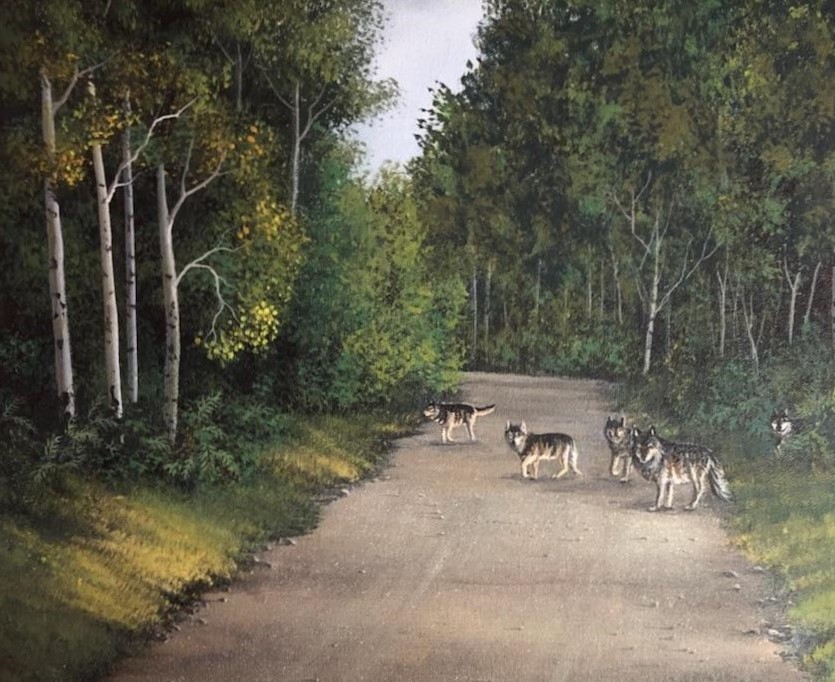
When my grandparents were in their eighties, they still liked to travel the gravel roads between Bigfork, their log cabin, and Marcell.  Always within easy reach, was a camera perched on the dashboard ready to capture a rainbow, sunset or wildlife.  One summer afternoon they rounded a corner just as a pair of wolves crossed the road. 

Gramps slowed to a stop as Gram reached for the camera.  Both watched in amazement as three more wolves filed out. Gram snapped as many pictures as she could before the pack slipped silently through the woods.  In one photo she had five of the wolves, which were considered an endangered species in Minnesota. 

At the turn of the century, the wolves were quite a nuisance in northern Itasca County.  It seems that the logging which changed the landscape brought deer in, and also their prey,  wolves.   The January 3, 1903, Itasca News explains: “It is a truth being proven in this new section of country that as a country develops wolves begin making their appearance.  A few years ago wolves were unheard of between Deer River and Canada, a distance of 100 miles.  Now the hideous yelp of the brutes are common in the Big Fork region, and Henry Denny, a local fur dealer is trapping them on the outskirts of the village.”

The bounty at that time was $7 for a carcass of a full-grown wolf anytime from January through May and $5 in the other months.  A cub was worth $3 at any time of the year. Some settlers and farmers did trap and hunt the wolf, and others had close encounters.

Below are accounts of some of their experiences.

Run for Their Lives ~ Bigfork Settler 12-1-1903

“Bert Hall and Stephen Black, two loaders in the employ of Sam Simpson, a logger operating in the territory came near being killed by wolves last Friday.

They were a mile from camp and on their way in from work when the howl of a wolf half a mile off the road attracted their attention.  The men hastened toward camp, but did not apprehend any real danger.  In a few minutes a wolf was heard at a much closer range.  Then several were heard at various points.

They could think of nobody that the wolves had in view for supper but themselves and they broke into a run.  It was half a mile to camp and as they ran as fast as they could crying out at short intervals to attract the attention of the men at camp if possible.  Hall stopped long enough to pick up a stake from beside the road, to use in case of emergency.  Three wolves were running cautiously behind the men when they were a short distance from camp, and the howls of others indicated that a large pack was gathering.

The men arrived breathless at the camp, the three wolves following them to within 150 feet of the cabin door.  Ten minutes later the howls of the wolves in the vicinity indicated that a great pack had assembled.”

A Fight with Wolves ~ Itasca News 8-29-1903

“Frank Caldwell of the Big Fork was in town Wednesday and had an interesting story to relate of experience with a pack of five wolves near Virginia Lake.  He was on his way home in the afternoon when he suddenly came upon a bunch of the ‘varmits.’  They immediately showed fight and there was nothing left for Frank to do but fought back.  He was armed with a large Colt’s revolver which he used with deadly effect on three, when the other two circled around and made their escape.  As evidence of the exciting encounter, he brought a scalp to town.” Frank Caldwell was born in NY in 1869.  The 1910 United States census documents him living and farming in Popple Township with his wife and eight children.

Wolves ~ Itasca News 3-31-1905

“Bass Lake settler Henry Mattson gets lost while walking home from terminus of Itasca Company railroad, is followed by wolves and saved when he lights candles to hold them off until daylight.  Mattson then shouldered his sack of provisions and trudged on home.”

The topic of wolves was covered in the Up in This Neck of the Woods column of the Grand Rapids Herald-Review, April 8, 1948, and included another hair-raising story.  “George Scott, whose farm is just inside the Cass county border on Mud lake, tells another story of wolves.  He was walking along a trail in deep woods one moonlit night.  The moon was so bright that on wider stretches of the path it was almost as bright as day. 

The howl of wolves reached his ears, and he hastened his steps automatically, although he was certain wolves would not threaten him.  The savage sounds came nearer and nearer, and by this time he admits he was alarmed.  George Scott hastily climbed a tree and watched the path below.

Three large wolves came bounding along the trail just as he settled himself in the branches.  The wolves were on the hunt, all right, but they were after a deer which was racing along a few feet ahead of them.  Mr. Scott descended and continued his journey.”

Although Gram and Gramps looked for the wolves on every outing, they never saw another one.  Gram had wanted to paint what they had seen, but time got away from her.  Gramps secreted one of the photos away, had it painted and framed as a surprise for her.  Married for sixty-six years, they had shared many experiences together, but this was one that left them both momentarily speechless.

Answers to the 1924 Thanksgiving Word Scramble

11.24.2022 Thanksgiving Special Part 2

[1] TRSIFU                                         FRUIT

[2] TSEWE SOOAETTP                    SWEET POTATOES

[3] SNTS                                             NUTS

[4] EEYLCR                                       CELERY

[5] EPKPPMNUII                              PUMPKIN PIE

[6] KCNCIEH UPOS                         CHICKEN SOUP                  

[7] RLEAY CKEA                             LAYER CAKE

[8] EANIRRREBSC                           CRANBERRIES

[9] YUTEKR                                      TURKEY

[11] EOSLVI                                      OLIVES

[10] LPMUDGNDUIP                       PLUM PUDDING

[12] RDABE                                       BREAD

[13] CILSEPK                                    PICKLES

[14] DCISEAN                                   CANDIES

[15] PIPEPLAE                                  APPLE PIE

“Milk Fed Turkeys for Sale” Thanksgiving 1921-1940

11.24.2022 Thanksgiving Special

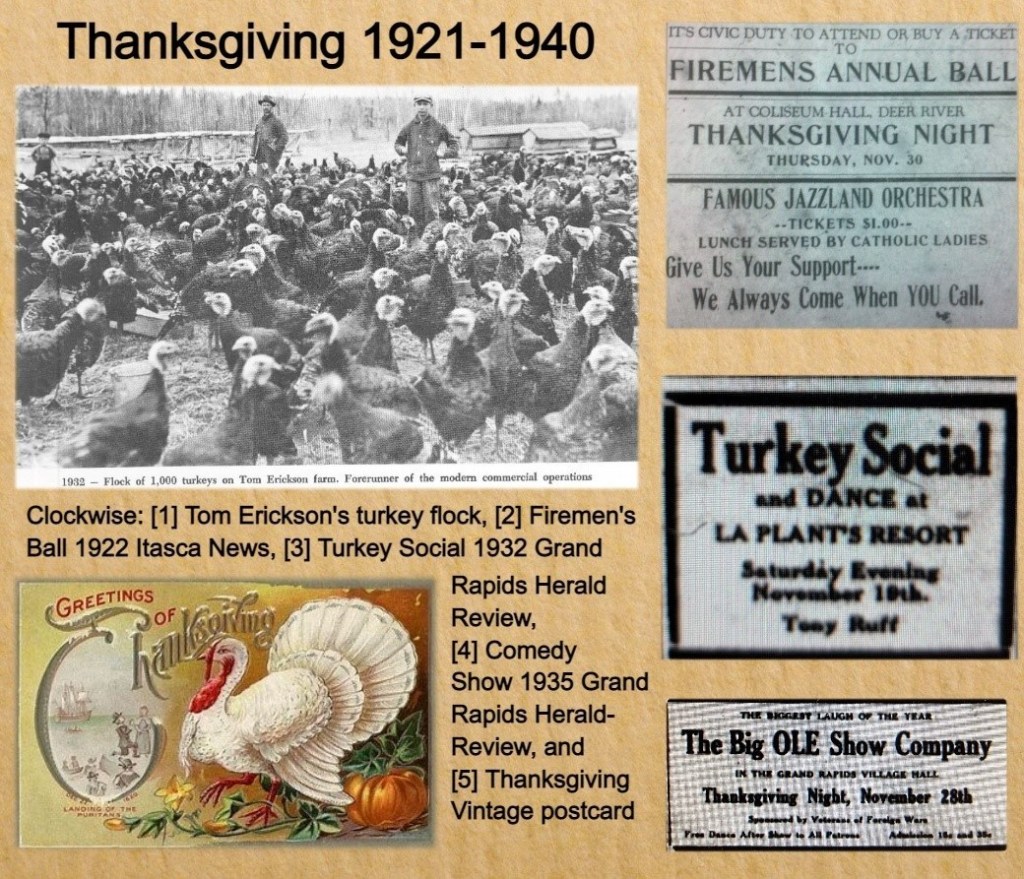
Last November the Reminisce column focused on local events taking place around the Thanksgiving holiday between the years of 1898 to 1920. At that time, domesticated birds were shipped in from southern Minnesota, but by the mid-1920s the domesticated birds were being raised in Itasca County.

For the numerous farm households of the area, Thanksgiving also signified the end of the fall harvest and beginning of the cold and snowy months. Everything that could be canned was, and the root cellar contained any vegetables and fruits which would survive the elements in a banked shelter.

The following snippets are gathered from newspaper articles and advertisements published in local papers from 1921-1940.

Food

The communities of Deer River and Grand Rapids were growing, as were the number of grocery stores. These are two unique ways proprietors enticed shoppers to make purchases. The first is an advertisement that was done jointly by fifteen businesses in Grand Rapids. A prize of two dollars was awarded to the first correct set of answers reaching the Herald Review office. The second prize of one dollar, aimed at readers living outside Grand Rapids, was awarded for the most attractively arranged and correct answers received by a specified date.

Items for Your Thanksgiving Table! What Will They be? ~ Grand Rapids Herald Review 11-19-1924

“Remember ‘way back when as youngsters you used to wonder ‘what all’ was going to be on that Thanksgiving Dinner table? Perhaps even now, you’re anticipating sitting down to a Thanksgiving dinner that will include every item that Mother or Grandmother never forgot!

What do you hope or think those food items will be?  The answers set in ‘shuffled’ type appear at the top of each advertisement on this page [see collage]. Can you figure out what they are by rearranging the letters so that they form the name of some part of the complete Thanksgiving Dinner? Write your answers on a separate sheet of paper, giving the corresponding advertisement with each item named.”

[1] TRSIFU                                        

[2] TSEWE SOOAETTP                   

[3] SNTU                                           

[4] EEYLCR                                      

[5] EPKPPMNUII                             

[6] KCNCIEH UPOS                                                

[7] RLEAY CKEA                            

[8] EANIRRREBSC                          

[9] YUTEKR                                     

[11] EOSLVI                                     

[10] LPMUDGNDUIP                      

[12] RDABE                                      

[13] CILSEPK                                   

[14] DCISEAN                                  

[15] PIPEPLAE

NOTE: The answers will be available on my blog: chrismarcottewrites.com on Thursday November 24th.

FREE Thanksgiving Turkey Passard’s Market – Deer River ~ Itasca News 11-3-1927

“Beginning Friday Nov. 4th, and continuing until we lock up on Saturday evening, Nov. 19th, we will give each customer a coupon for every 25-cent cash purchase or for every similar amount paid on account.

Every coupon gives you a chance to win.  Three prizes will be offered, as follows:

FIRST PRIZE  – 30-Pound Turkey

SECOND PRIZE – 12-Pound Turkey

THIRD PRIZE – 5-Pound Chicken

A coupon will also be given for every 25-cent admission ticket purchased at the Lyceum Theater between the above dates.”

Raising Turkeys

“In 1925 Mr. and Mrs. John Henrikson of Busti purchased three white turkey hens and one gobbler. The birds were evidently frightened by their surroundings as they immediately sought security in the highest trees. It was some days before they were convinced that it was safe nearer the ground. The following fall the Henriksons had a total of seventeen turkeys to market.” [On the Banks of the Bigfork 1956 page 27]

A couple years later, Mammoth Bronze turkeys for breeding were being sold by Mrs. Maude Blythe of Inger, MN. They were priced at $10 for toms and $7 for hens. The advertisement from early November also stated she had “fine, fat turkeys for your Thanksgiving dinner at prices that are right.” [Itasca News 11-3-1927]

During the next few years farmers purchased eggs and hatched them in incubators for their small flocks. This must have been considered a lucrative enterprise at the time, as Tom Erickson of Effie invested in 1,000 young turkey chicks for his flock in 1932.

The Henriksons stayed in the turkey business for at least fifteen years as Mrs. Henrikson had an advertisement for dressed (pluck and cleaned) turkeys. “Orders taken now for Milk Fed Turkeys for delivery anytime from now until November 9th. Young Hens 10-12 lbs. 24 cents/lb. Young Toms 16-20 lbs. 20 cents/lb. Will hold turkeys on which a deposit has been paid for Thanksgiving delivery.” [Progressive Times 10-17-1940]

School Activities

Thanksgiving Program Marks School Closing in Deer River ~ Itasca News 11-25-1926

“A very much enjoyed Thanksgiving program was given by the grade pupils in the school auditorium.  Every grade was represented in the program and the parts were well given.  The program follows:

1st grade Thanksgiving Greeting

2nd grade Finger play

3rd grade song ‘Over the River and Through the Woods’

4th grade dialogue ‘Thank You’

5th grade song ‘Pilgrim Maidens’

6th grade playlet ‘The Newlyweds’ Thanksgiving’ & song ‘Gobble, Gobble’

7th grade play ‘The Courtship of Myles Standish’

Recitations by Myrtle Kinder, Viola Allen, Richard Betsinger, Kathryn Wolfe, Ruby Palmer, Winifred Jones, Frances Wicklund, Margaret Venne, Albert Dezutter, and Beulah Hill.”

A Thanksgiving Dinner ~ Bigfork Times 11-28-1930

“The fourth graders wrote poems last week. The following was written by Lillian Peterson.

A Thanksgiving Dinner

Oh, we won’t be shy

I’ll have some turkey

And some pumpkin pie.

We also are thankful

That we are all here

And not in England

But in our land so dear.”

I believe the Lillian Peterson who wrote this is the daughter of John and Emma.  She was born in 1922, her middle name was Corrine, and she later married Chester Holt.

Guests

In the 1920s most people shared their holiday meal with relatives and friends who lived close. By the 1930s though, trains and busses offered discounted rates to encourage people to travel for the November holiday. Northland Greyhound ran a special in 1932 – “One way ticket price plus just 25 cents for round trip fare,” and the Great Northern Railway offered low round trip fares for two days on either side of the Thanksgiving Day.

Thanksgiving is Festal Day Here ~ Itasca News 11-26-1925

“Deer River people are observing the Thanksgiving feast in the real spirit of the day. Local housewives have been busy attempting to excel each other in the preparation of delicacies that are guaranteed to tempt the most stubborn palate.  Family reunions are being held in large numbers.  Many are entertaining friends in addition.  Others has traveled to other points as guests.  Our ‘curious reporter’ has been ‘listening in’ and picked up the following:

Mr. and Mrs. C.M. Hanson have as their guests the Henry Herreid and William Herreid families, Mrs. George Herreid, Miss Frances Unger, and Miss Georgia Redpath of International Falls.

Mr. and Mrs. Alva A. Baker are entertaining Mr. and Mrs. MJ Baker, Miss Eileen Baker, Harold Baker, and Mr. and Mrs. O.G. Larson and children.

Mr. and Mrs. W.R. Giberson are guests today of Mr. and Mrs. W.F. Becker at Grand Rapids.

Mr. and Mrs. William Scott are eating turkey at the home of the latter’s parents, Mr. and Mrs. Gust Gustafson, near Bigfork.

At the O.H. Sweum home, guests include Mr. and Mrs. Hans Sweum, the Arnold Wright family, and Mr. and Mrs. P.K. Vickjord.

Mr. and Mrs. Andrew Hannula and family drove to Floodwood this morning to share the Thanksgiving feast at the August Wuotila home.”

I hope you have a chance to share memories, laughter, and hugs with those you love over the Thanksgiving Holiday!

“Turkey Shoot and Raffle” Thanksgiving 1898-1920

11.20.2022 [archived ~ originally published 11.28.2021]

Thanksgiving is an American holiday which has traditionally centered on food, family, and friendship. Years ago, it also signified the end of the fall harvest and beginning of the cold and snowy months. This was especially so for those living in northern Minnesota. Everything that could be canned was, and the root cellar contained any vegetables and fruits which would survive the elements in a banked shelter. Fingers were crossed that there was enough in the pantry and cellar until the greens came up in the spring.

Over one-hundred years ago, Thanksgiving was often a time for an extended visit. LeRoy Gustaf “Roy” Olafson, shares a Thanksgiving story from 1918. His recollections were put together in a family booklet titled “Memories of Minnesota and Years Gone By,” in 1972 when he was about 76 years of age. Roy was one of ten children born to Swedish immigrants Johan and Augusta in Morrison County. Several members of the Olafson family homesteaded in northwestern Itasca (Moose Park Township) and northeastern Beltrami (Blackduck) Counties.

When he registered for the draft in 1917, Roy learned that he had a ruptured blood vessel going to his heart, thus he did not pass the physical examination. The following spring, he went to look for work in the wheatfields of North Dakota. He was hired by a man who needed help managing his half section farm and to help run the threshing machine he had. The pay was to be $75 a month and board if he was a good man and could do farm work.

After a prosperous harvest, Roy wanted to go home for a visit. “It was getting late to be in North Dakota so I told my boss I would like to be here at Blackduck for Thanksgiving. Ruth [a sister] had gone to Chicago and Pa was all alone cutting timber. He had bought a cow and a heifer, 25 chickens, and had his horse, Big Frank. We had Thanksgiving dinner at Alma’s and Fred’s [a sister and brother-in-law]. We had a nice venison roast and all the trimmings. It was plain good. Things weren’t so rosy up here.

My boss had figured up my wages and he gave me more than I had coming. The check was for one thousand dollars! I kissed the kids, kissed his wife, and even kissed Archie, my boss! He wasn’t as hard boiled as he tried to act.

After Thanksgiving dinner, me and Pa went home to our place where father and son made up for lost time. We hadn’t been together for five years. We got to work getting things ready for winter. We hauled home tamarack wood and cut it up. We hauled some hay that I had bought from a homesteader. We started to clear some land around the house.

I stayed with dad for about a month. We had everything done for winter. I helped dad set mink and weasel traps on the Moose Creek that ran through our farm. We killed a big buck. My vacation soon came to an end.”

The following snippets are gathered from newspaper articles and advertisements published in local papers from about the turn of the century until 1920 and fit into those three traditional categories referenced above: food, family, and friendship.

Food

The settlers living in and around Deer River and Grand Rapids had the added luxury of enjoying Thanksgiving food they hadn’t grown themselves. This was because both villages were located along the Great Northern Railway line.

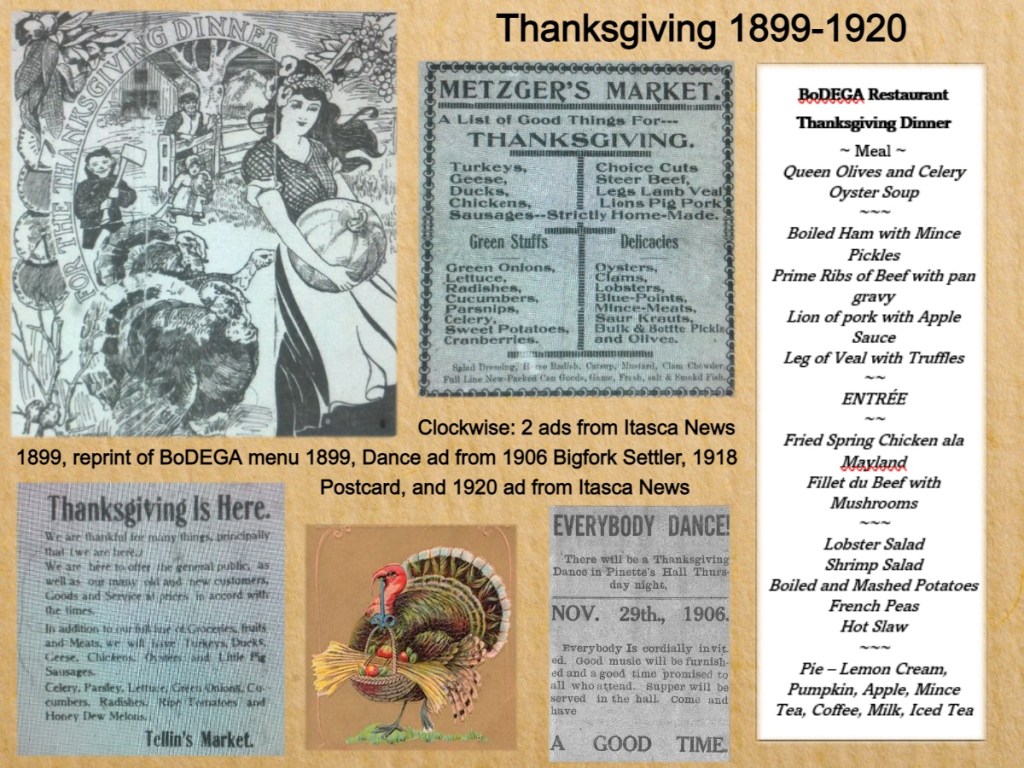
Food not found in the north woods (beef was not even raised here yet) could therefore be procured from Minneapolis or Chicago. In 1898, the Metzer’s Market had quite a selection of poultry and meat [*spelling and wording exactly as they had it] in their advertisement.

Good things for Thanksgiving

~ Turkeys. Geese, Ducks, Chickens; Choice Cuts, Steer Beef, Legs Lamb Veal, Lions Pig Pork; Sausages Strictly Home-Made

~ Green Stuffs – Green onions, Lettuce, Radishes, Cucumbers, Parsnips, Celery, Sweet potatoes, Cranberries

~ Delicacies – Oysters, Clams, Lobsters, Blue-points, Mince-meat, Sour Krauts, Bulk & Bottle Pickles and Olives

~ Salad Dressing, Horseradish, Catsup, Mustard, Clam Chowder, Full Line New-Packed Can Goods, Game, Fresh, salt and Smoked Fish

The following year the BoDega Restaurant in Deer River,owned by C.T. Alexander offered a Thanksgiving Dinner with fourteen items and four different kinds of pie for dessert!

It wasn’t long before enterprising businessmen thought of ways they could be a part of the festivities. Throughout the years, several communities held turkey raffles.

G.T. Robinson combined a game of chance with a discounted price on poultry in 1901. “A turkey raffle will be given next Wednesday evening, Nov. 27 at G.T. Robinson’s saloon. Turkeys, ducks and chickens will go cheap to the best card players or lucky dice throwers. ‘Old George’ thinks he can play seven-up himself, but he is a snap for anybody in a four-hand game.” [Itasca News 11-23-1901]

Thanksgiving Raffle ~ Grand Rapids Herald-Review 11-21-1903

“A. M. Johnson, of the Boston Grand sample room and restaurant, has the reputation of holding the most successful and satisfactory raffles in Grand Rapids. Every year he is first in the field with a choice lot of fowls, including turkeys, geese, ducks, and chickens. He buys only the very best in the market, and if he hears of a choice lot he makes it a point to get them regardless of cost. His raffles are always conducted in a manner to avoid any complaint and those who participate are always satisfied. This year he has secured an unusually fine lot that was offered alive and dressed. He will hold his raffle on the evening of the 24th, so that all who wish to participate may secure their Thanksgiving dinner for a few cents. Mr. Johnson wishes to announce that no schoolboys will be permitted to take part in the raffle, and they will not be allowed in the room.”

Pete Peterson, owner of a hotel and saloon in Bigfork offered a similar event a few years later, but his was earlier, so the birds could be eaten on Thanksgiving. “Turkey Shoot and Raffle – at Bigfork Wednesday afternoon Nov 24th. On this date, I will have 50 fine turkeys shipped in and am furnishing you this opportunity of getting turkeys for Thanksgiving dinner. Remember the date and come and get a turkey. Pete Peterson” [Bigfork Settler 11-11-1909]

Family ~ School Programs

The village and surrounding community of Bigfork held their first Thanksgiving program on November 25, 1903. Miss Katherine Costello, the teacher of the newly built school in the village had organized a program that included all of her students. In all there were twelve recitations from the older children. (Recitations are poems and short stories which are memorized.) The most challenging were, “Tommy’s Thanksgiving” by Cleve Larson, and Linnea Nordlin’s selection from “Hiawatha.” Between the recitations were songs by the entire school of about twenty. Thirteen-year-old Aminta Nordlin soloed with “Mother Goose”, and she along with several others sang “Five Little Gooses.”

The students were: Alma Larson, Cleve Larson, Harry Larson, Theresa McDonald, Aminta, Linnea, and Victor Nordlin, Robert Pedersen, Julia, Walter, and Alma Petersen, Bertha Rossing, and Jenny Shultis. They were all born in Minnesota, though about half their parents had emigrated from Sweden, Norway, Denmark, and Germany.

In 1915, Kathleen Keenan, a nine-year-old from Deer River, had a story she wrote published in the Itasca News. Titled “Bessie’s Thanksgiving,” it was about a girl named Bessie who lived in a large city with her parents. Bessie befriended Mary, a child her own age who had to work to take care of her sick mother. Bessie wanted to bring them a hot meal at Thanksgiving and figured out a way to do just that.

Kathleen was the daughter of George and Celia Keenan and always had a desire to help others. The 1930 U.S. Census indicates she is a nurse in Rochester, Minnesota.

Friendship ~ Entertainment

If someone is available to play the harmonica or fiddle, folks will dance. Thanksgiving Day was no exception. In Bigfork, one of the places dances were held was at the Pinette Hall. Although the musicians weren’t named, there was probably a full house on Thanksgiving Day, November 29, 1906. The advertisement in the Bigfork Settler stated, Everybody is cordially invited. Good music will be furnished, and a good time promised to all who attend. Supper will be served in the hall.”

As the communities in the area grew, so did the variety of activities that were offered for entertainment on Thanksgiving Day. Examples I found include a wartime meal in 1917, and a boxing match in 1920.

Thanksgiving Festival ~ Itasca News 11-24-1917

A community Thanksgiving festival has been planned. It is to be held at the M.E. [Methodist Episcopal] Church, Wednesday, Nov. 28, at 5 p.m.

The festival is to consist of a program and a wartime supper. The supper is to be donated by the community and served in the basement of the church, free of charge. The supper committee consists of Mrs. Keenan, Mrs. H. Seaman, Mrs. Mawhinney, Mrs. Bartholomew, W.B. Taylor and Mr. Shaad. Please help them to make it meatless and wheatless by donating your poultry, fish, venison, and best war breads. **

The program committee is Mrs. Wallace, Miss Moen and Miss Tabor, and they would be thankful if you would volunteer to assist them. A collection is to be taken for the starving Armenians and Syrians who are less fortunate than we. So, plan to make this a real Thanksgiving festival for in doing so you prove that you, too are thankful for your many blessings.

Fight Card on Thanksgiving ~ Grand Rapids Herald-Review 11-24-1920

“A boxing bout that promises to attract a large number of fans from all over Itasca County and from points even farther away will be staged in Bovey on the evening of Thanksgiving Day. The Bovey post of the American Legion is sponsoring the boxing exhibition and will have it in the Legion Hall in Bovey.

The curtain raiser will be a four-round exhibition between the Pelky brothers of Bovey. These boys, while light, are fast, and always get a good hand. Following them will be a six-round go between Bartholomew of St Paul and Swede Johnson of Grand Rapids. Johnson is rapidly securing a reputation as a fast and clever boxer and has a number of friends in Grand Rapids who will go to watch him in Bovey.

The principal match of the evening will be between Ed Franti of Bovey and Harry Boyle of Duluth. This bout is scheduled to go for ten rounds and will be a fast one. Both men are full of confidence and will enter the ring expecting to secure a decision. Bovey men are backing Franti to win and expect to see some exciting situations during this mill.”

In recent years, the time spent following the Thanksgiving meal seems to have focused on the shopping bargains the day after Thanksgiving. “The term ‘Black Friday’ (in the retail sense) was coined in the 1960s to mark the kickoff to the Christmas shopping season. ‘Black’ refers to stores moving from the ‘red’ to the ‘black,’ back when accounting records were kept by hand, and red ink indicated a loss, and black a profit.” [blackfriday.com/news/black-friday-history]

The Poppy Lady ~ Another Significant Piece of Military History

11.13.2022 [archived ~ 5.21.2015]

Commemorative stamp issued by the United States Post office in 1948, four years after the death of Moina Bell Michael, the founder of the Memorial Poppy

“Girls selling poppies on the streets Monday for a benefit fund for disabled soldiers of the late war found their biggest job was to keep up their supply.  The red flowers sold rapidly and before the day was over the man who did not wear one was a rarity.” [Itasca News 6-3-1922]

Although 1922 was the first year that the red poppies were sold as a national effort to raise money to aid our disabled soldiers, the endeavor actually started two days before Armistice Day in 1918, by Miss Moina Bell Michael.  She purchased and distributed several dozen silk poppies to men during the annual Conference of the Overseas Y.M.C.A. War Secretaries in New York, New York.

Miss Michael had been inspired by the poem written by Colonel John McCrae about the soldiers in the Great War, in May 1915.

In Flanders Fields

In Flanders fields the poppies blow
Between the crosses, row on row,
That mark our place; and in the sky
The larks, still bravely singing, fly
Scarce heard amid the guns below.

We are the Dead. Short days ago
We lived, felt dawn, saw sunset glow,
Loved and were loved, and now we lie
In Flanders fields.

Take up our quarrel with the foe:
To you from failing hands we throw
The torch; be yours to hold it high.
If ye break faith with us who die
We shall not sleep, though poppies grow
In Flanders fields.

Miss Michael was born shortly after the Civil war.  She began a lengthy teaching career which started in a rural school when she was only fifteen!  At the time the United States entered the war in Europe in 1917 she was a professor at the University of Georgia.  Determined to do more than just knit and roll bandages, she applied to join the only line of service that she could at the age of forty-seven, War Work with the Y.M.C.A. and when accepted at the training headquarters in New York, she took a leave of absence from the university. 

In her autobiography, The Miracle Flower Michael explained that on Saturday, November 9, 1918, a soldier brought her the latest issue of the “Ladie’s Home Journal” and showed her the page on which Colonel John McCrae’s poem, ‘We Shall Not Sleep’ (later named ‘In Flanders Fields’) was written. She had read it before, but the accompanying illustration made the words of the verse more real, especially the last line.

Miss Michael wrote, “…I pledged to KEEP THE FAITH and always to wear a red poppy of Flanders Fields as a sign of remembrance and the emblem of ‘keeping the faith with all who died.” On a used envelope “…I hastily scribbled my pledge” Her pledge was actually a poem written in reply to Colonel McCrae’s and was entitled, We Shall Keep the Faith’. 


We Shall Keep the Faith

Oh! you who sleep in Flanders Fields,
Sleep sweet – to rise anew!
We caught the torch you threw
And holding high, we keep the Faith
With All who died.

We cherish, too, the poppy red
That grows on fields where valor led;
It seems to signal to the skies
That blood of heroes never dies,
But lends a luster to the red
Of the flower that blooms above the dead
In Flanders Fields.

And now the Torch and Poppy Red
We wear in honor of our dead.
Fear not that ye have died for naught;
We’ll teach the lesson that ye wrought
In Flanders Fields.

That same day, with ten dollars Miss Michael received from those attending the 25th Conference of the Overseas Y.M.C.A. War Secretaries, she purchased several dozen silk poppies and pinned them to the lapels of all the men present. “…I have always considered that I, then and there, consummated the first sale of the Flanders Fields Memorial Poppy.”

When the war was over Miss Michael returned to the university and taught a class of disabled servicemen. Realizing the need to provide financial and occupational support for these men, she pursued the idea of selling silk poppies as a means of raising funds to assist disabled veterans. In 1921, her efforts resulted in the poppy being adopted as a symbol of remembrance for war veterans by the American Legion Auxiliary.

The Veterans of Foreign Wars (VFW) conducted its initial poppy campaign in May 1922, becoming the first veterans’ organization to facilitate a nationwide distribution. The poppy soon was adopted as the official memorial flower of the VFW of the United States and by 1924 the Buddy Poppy was a registered name and trademark with the United States Patent Office.

The Deer River community has proudly supported the poppy sales since that very first year. In 1924, Mayor Frank Sanger (also druggist in Deer River) designated Thursday, May 29th as Poppy Day at the request of the Ladies Auxiliary. 

The American Legion makes but an annual appeal to the public for financial contribution.  It is not a selfish request.  This year it is a campaign on behalf of those who cannot ask for aid and would not if they could – the orphans of war.  These unhappy but uncomplaining victims are inarticulate.  The public engaged in its own busy affairs is inclined to forget its debt to them.  The American Legion has pledged itself to make the nation remember that these fatherless children represent the cost of war; a debt of every individual American that can never be paid in full.

“It is appropriate that this campaign should take place during the week proceeding Memorial Day.  The poppy should be as much a memorable reminder of the public obligation to these orphans as the red kettles of the Salvation Army at Christmas time.” [Itasca News 5-15-1924]

Known as the “Poppy Lady” for her humanitarian efforts, Miss Michael received numerous awards during her lifetime. In 1948, four years after her death, the U.S. Postal Service issued a commemorative stamp honoring her life’s achievement. In 1969, the Georgia General Assembly named a section of U.S. Highway 78 the Moina Michael Highway.

Deer Tails ~ Shoot up Ladies High Chairs

11.6.2022 [archived ~ originally published 11.5.2015]

Terry Pinette, grandson of Abygail Pinette found this photograph of the deer head and the high back chair used to construct the mystical deer.  It is unknown who the men are, and if the photograph was taken before or after it was camouflaged in the bushes.

I found a couple unusual tales that occurred during the 1930 hunting season and the best way to share them is in their entirety.  The first is about illegal gains (or an attempt anyway) so the editor choose not to name names, but that doesn’t mean a sheriff didn’t extract a name and at least give the “young man” a stern talking to. 

The second article is about Abygail Pinette, wife of John Pinette, from Bigfork and how she entertained herself that hunting season.  One of the mighty hunters of that story was a sheriff deputy from Todd County.  I would love to know if anyone in Todd County heard of his hunting story!  Members of the Pinette family say that this story resurfaces in at least one deer camp every year provoking lots of laughs and good cheer.

Here’s Prize Story of Hunting Season ~ Deer River News 11-20-1930

The strangest story of the big game hunting season is being told on a young man of Itasca County, on reliable authority.

A day or so before the big game seasons opened, it is said this young man was traveling near Weller’s Spur, when he saw a fine buck beside the road ahead of him.  One shot brought the animal down, but before the shooter could bleed the deer, a car appeared in the distance.  Fearing detection, the hunter hastily threw the deer into the back seat of the car and pursued his journey.

He had driven but a short distance when the deer revived and began kicking his way out of prison.  One hoof struck the driver in the back of the head, stunning him and causing him to lose control of the car, which crashed into the ditch and turned over.  Mr. Buck kicked his way through the top of the car and disappeared into the swamp.  When the hunter revived, his prize had disappeared, leaving no notice of his destination.

Carry deer on the running board!  They object to cushions!

Hunters, Victim of Practical Joke, Shoot up Ladies High Chairs, Ancient Deer Head ~ Bigfork Times 11-28-1930

Every big game season for many years, Mr. and Mrs. J.B. Pinette have as their guests the Adams of Long Prairie.  This year the party was made up of the following: F.H. Adams, Kenneth Adams, August Stephen, Rolland Knapp and Selie Adams, all of Long Prairie, Jim Adams of St. Cloud, Will Adams of Cass Lake and W. LaRoux of Minneapolis.  Our story concerns only two members of the party, Jimmy and Kenneth Adams.

The first few days of the season the weather was miserable and hunting as not so good.  The deer didn’t seem to be moving in the rainy weather.  No one could get a shot.  Mrs. Pinette, with an eye for business, realized that something must be done, or the Adams would hunt no more at Bigfork.  And too, the guns were getting rusty from the damp weather and lack of exercise.  Some shooting had to be provided somehow.

Then a brilliant thought struck her.  In the garage was a deer head, a thirteen-point buck, salvaged from the pool hall fire two years ago.  To be sure, the hair was singed, and one eye was missing, but it would do.  While the party was out for their morning exercise (that’s all that their wanderings in the brush had netted them so far) Mrs. Pinette and Mary Hollander, who was visiting at the Pinette home, took the scarred and weather-beaten deer head and a high chair and arranged them very artistically in the bushes on the road towards town.  The deer head could not be in too plain sight, or the deception would be instantly noticed so the services of Oscar were solicited to act as guide. 

Mr. Pearson was sent to town on an errand and invited Kenneth Adams to accompany him.  When about a block from the house Oscar, like a true setter froze in his tracks.  (Setters who are set from cars don’t actually freeze in their tracks – they just step on the brakes.)  Kenneth’s eyes followed the direction of the guide’s pointing finger, and he began to shake like a man with the ague.  Here, almost in the yard, was a monster buck and seven of them had scoured the woods for miles and never sighted a flag.

Kenneth shook himself out of the car and started on a dead run for the house.  Dashing breathlessly into the house he gasped, “Buck, buck,” and grabbed the nearest gun and dashed back.  But before he got back James Adams, who is rangier and consequently faster, had overtaken him and both of them arrived on the scene with Jim nose in the lead.  Oscar’s nod and warning gesture assured them that their quarry was still there.  Then the bombardment began.

Bang! Bang! and many more Bangs.  Singed hair was flying! Sawdust, the very lifeblood of mounted deer, was streaming to the ground from innumerable holes!  Splinters were flying from the highchair!  What a slaughter!

But here Oscar broke down and cried.  This was too cruel.  And here Kenneth and Jimmy first realized the deception – but they didn’t cry.  They threw their red caps on the ground and danced on them and swore by all that was good and holy that a special election would have to be called to fill the vacancy caused by the untimely demise of the commissioner of the 2nd district.

So that’s that.  In justice to Kenneth and Jimmy Adams it must be said that their marksmanship was good, and the ruse would have deceived anyone.  And this target practice apparently was just what they needed for both came in the next evening with a buck apiece.  True, they weren’t 13-point bucks, but they had two good eyes apiece and unsinged hair.”

The Last Laugh ~ A 1930s Northwoods Halloween Story

10.30.2022

Like any other holiday on the calendar in the 1930s, Halloween was celebrated in our one room country school. Our teachers focused on the more positive aspects of the holiday with storytelling and an opportunity to become the characters in the picture books on our library shelf.

The community around Kinghurst was always looking for an excuse to gather, and Halloween was usually the first event in the school since the fall term had begun. Besides the families, the bachelors from miles around would attend as it gave them a chance to meet the ‘new teacher’ who could become someone’s ‘new Missus’. 

The days leading up to the celebration the younger kids would be decorating the school with carefully scissored and pasted jack-o-lanterns, ghosts, black cats, and witches. Us older kids were memorizing poems and songs.

Our mothers helped us turn old clothes and bed sheets into costumes to resemble Humpty-Dumpty, Old King Cole, Cinderella, Mother Hubbard, and Santa Claus. They baked oatmeal cookies and fried doughnuts to go with the gallons of coffee and lemonade that we’d consume.

I remember one year when my brother was much too ‘mature’ for interest in schoolhouse activities, and instead prowled around with a few of his pals. I had heard them talking near the barn a couple days before Halloween. I crept up but stayed hidden behind the chicken coop. Tom was drawing in the dirt with a stick. “I say we go to Lofgren’s first,” Tom said marking the dirt with an X.

His buddy Eddie chimed in, “Then we can run across the field, over the creek and get to Jones place. We know he’ll be at the program for sure – everyone knows he’s got his eye on Gloria Hanson.” 

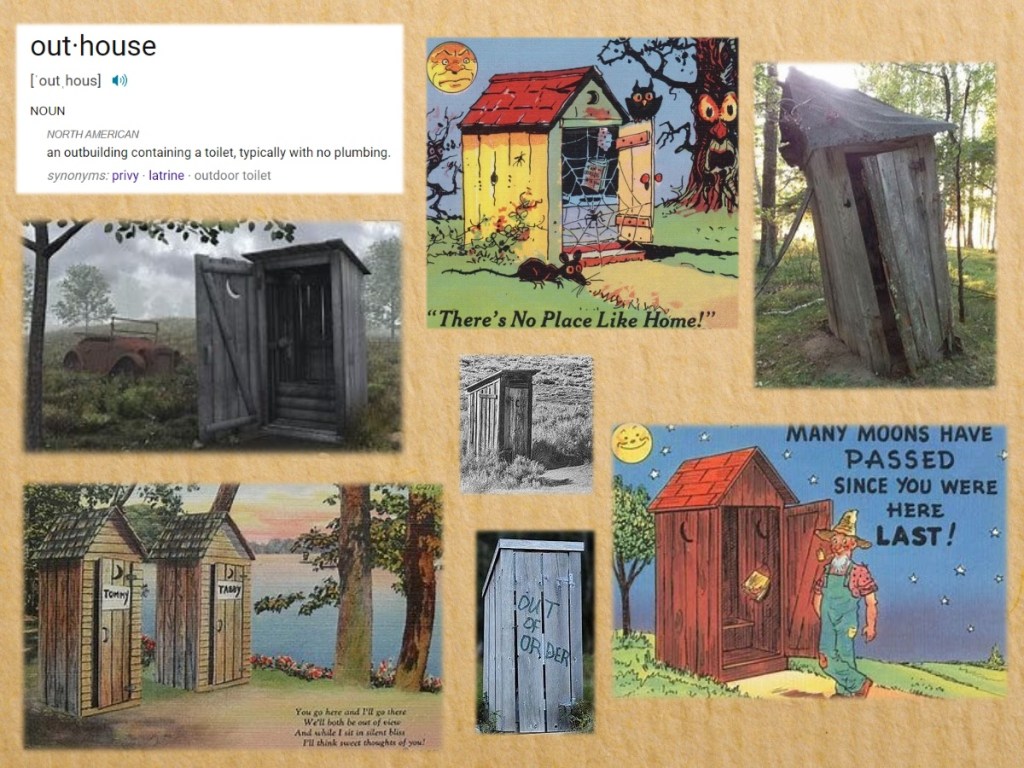
“OK,” Tom said, using the stick to mark the route they would take. “We got time for one more, what other outhouse should we tip over?” 

I didn’t hear what else they said because our dog started barking and I thought it best to scurry back to the house. I slumped on the porch, catching my breath and wondering what to do with this information. Of course. I knew the boys in the neighborhood tipped over an outhouse or two every Halloween. Dad sure wasn’t happy when ours was the victim. He made Tom and my other brothers help him get it bolted down.

I liked Oliver Jones. He was polite and always had a joke or a story to tell. Even though he was going with Gloria who was the oldest girl in school, he’d talk to me like I was a person, not a little kid, which by the way, at eleven-years-old I certainly wasn’t!  I decided I would tell Gloria and she could get word to Oliver.

That year, 1935, Halloween was on a Thursday, and so was the school program. Miss Nelson helped us make the final preparations and we got to take turns in the front of the room, saying or doing our part of the Halloween entertainment. At recess Gloria told me that Oliver had a plan, but he wouldn’t tell her anything more. After school we quickly got our chores done and ate supper early so we could be at school by 6:30. Mom made a washbasin full of doughnuts and dad used the hay wagon to bring us and our neighbors to the school.

Mom helped me dress like an old lady because I was reciting all eight verses of There was an Old Woman who Swallowed a Fly. I sat on a bench next to the other 5th and 6th graders. I think we all started getting nervous. My best friend Sally had a much shorter poem, but said she had butterflies so bad she couldn’t even eat supper. I turned towards the door just as Oliver came in. He was tall and stood scanning the room. When he saw me, he nodded his head slightly and winked. I turned to the front as I felt the color creep up on my cheeks. If only I were a little older, I thought, then reminded myself he was Gloria’s beau.

Most of the evening was a blur, but I know I was very proud of myself. I made only one mistake that no one seemed to notice.  After our part was done, and the little kids were back near their parents, the lights were dimmed, and a couple of the old timers told stories on the scary side. A few candles made distorted shadows on the walls adding to the creepy way the flickering light shone on their faces.

We were almost to our house when the wind picked up and with the whirling leaves came the awful stench of a neglected outhouse. “Pee-yew,” we all said, covering our noses and gagging. Even our horses veered away from the smell.

“Pa,” Tom called out from the ditch. “It’s me, Eddie, and Fred. Can we have a ride?” 

“Are you boys what stinks?”

“Yeah, I guess. We fell in an outhouse hole.”

Dad laughed. “Heck, no. You boys get yourselves cleaned up in the pond before you even think of coming near the house.” 

“It’s gonna be freezing in the water,” Tom said.

“Yep,” Dad said. “My guess is your privy tipping has come to an end though.”

Of course, we were in bed when Tom finally came in, chilled to be sure as I heard him pull a chair up close to the cookstove. Dad asked him who had moved their privy prior to the anticipated shenanigans.

 “Ollie Jones,” he said just above a whisper.

I laughed into my pillow, understanding now exactly why Oliver had winked at me. And as far as I know that was the last year that any outhouses were tipped over in our neighborhood!

“His Axe in His Hand”

10.23.2022 [archive 11.1.2018]

Last Halloween I shared stories about deaths resulting in unusual circumstances.  I have gathered a few more for this year, including errors in judgment, acts of nature, and equipment malfunctions. The title of this week’s column comes from the story about being killed by a falling tree.

Judgment Errors

It’s Not Whiskey ~ William Walker, and Hugh McDonald were on their way up to Walker’s claim in the Bigfork Valley.  They stopped for a rest at a deserted camp.  McDonald took a walk into the woods, and upon returning Walker called out to him that he’d drunk from a bottle he’d found in the abandoned cabin, thinking it was whiskey but knew now that it could not have been.  McDonald pulled the stopper and realized at once it was carbolic acid.  Before he could even think of what to do, Walker said in a whisper, “I’m gone, I’m gone,” sank to the ground and breathed his last breath.

“The coroner was telegraphed for, and the remains taken to Grand Rapids. Deceased was a painter by trade and until a year ago has lived with his brother, Orlando Walker, on the latter’s homestead near Little Bowstring Lake and the past year he has been working here.  He was about forty years of age, a good workman, and aside from his desire for drink was a good citizen.”  [Itasca News 7-30-1904]

Jumps from Train; Stunned and Drowned ~ Itasca News 10-17-1908

“While returning on the train from North Dakota Wednesday morning, Con Kelly was going to leave the train at Ball Club thinking that was Deer River station.  He was stopped by the brakeman who told him the next stop was Deer River.  Two miles farther at the bridge of Ball Club Lake, the train slowed down for the bridge, and here Kelly managed to get the vestibule open and out before he could be caught.

It was about fifteen feet down to the water and Kelly hit his head on the side of the pier and fell onto some longs into the water.  He was picked up late in the day by undertaker Herreid under instructions from County Coroner Russell.  It is supposed the blow on Kelly’s head by falling against the pier stunned him and that when he fell onto the floating logs his head lay in the water and he then drowned.  When picked up his head lay in the water and his body on the logs.

Kelly has worked here the past three years for the Itasca Lumber Company, but the company knows nothing of his former home.  He was a fine built man and about thirty-five years old.  County Coroner Russell took the remains to Grand Rapids Thursday for burial.”

Mother Nature

Treetop ~ Paul Waleske was instantly killed by a flying treetop hitting him while cutting timber for wood last Saturday.  He was working near his home seven miles north of town, and when he did didn’t come in for dinner, his wife went to look for him.  She went to a neighbor, and he accompanied her back through the timber, where they found Paul’s body.

“It appeared from indications that the unfortunate man fell a tree into a smaller half head ash tree, which sprung back, breaking its top part off, this striking Waleske and with such force as to kill him instantly, as the snow about him showed no signs of a struggle and the tree stub lay upon his body in three places.  His axe was gripped tightly in his hand.

Paul lived her about ten years and was an esteemed citizen and kind neighbor.  He was about thirty-four years of age and was married four years ago.  Besides the young wife, he leaves a child three years old, and one of a few months.  The parents reside at Sturgeon Lake, Minn., to which place the remains were taken on Wednesday.” [Itasca News 12-13-1919]

Lightning Kills Lars Hope ~ Itasca News 8-31-1907

“People here were shocked Wednesday to learn through the newspapers of the horrible death meted Lars Hope by lightning near Crookston.  Hope, in the company of another man, was driving on the road each in separate wagons and when in the storm near Dugdale lightning struck Hope’s wagon which was ahead.  The man in the wagon behind was slightly dazed, and after recovering noticed a blaze of fire ahead of his team and going to make investigation found Hope in the wagon stark naked and fire was burning around his head.

His body was not marred, and only his hair was slightly singed.  Fragments of his clothing were found strewn hundreds of feet away; his pocketbook containing $300 was found one hundred and fifty feet from the spot, and his watch was thrown a hundred feet.  He was stone dead when his friend reached him.

Lars Hope was a single man and an old settler of Wirt, forty miles north of here.  He has a good claim at Wirt, upon which he has made final proof.  Crookston authorities have notified relatives of the man in Iowa.”    

Equipment Malfunction

Parachute did not Open ~ According to a telegram delivered last Sunday, George Vanselow, the son of Albert and Anna, was killed in an accident on June 27, 1925.  George was a stunt flyer and was performing when the accident occurred.  He leaped from a plane during a picnic in Kenyon, Minnesota and his parachute failed to open.  He died while being taken to a hospital at Faribault. Albert and Anna had moved to Deer River from Waseca after the marriage of George, and his young bride, Bessie. George is buried in Waseca.

Young Man Killed by Dynamite Blast ~ 5-8-1930 Deer River News

“Howard C. Beckel, 21-year-old son of Mr. and Mrs. Geo. F. Beckel who lived about 14 miles northwest of Deer River on the old Inger Road, was one of the four men instantly killed shortly after 1 p.m. yesterday, by the premature explosion of a charge of dynamite in the Holman mine near Taconite.

The explosion came without warning as men were loading a drill hole with 12 boxes of dynamite.  The blast was felt for miles.

Beckel was born in Albert Lea, Minn., in 1909.  He came here with his parents about twelve years ago.  In recent years he has been engaged as a truck driver hauling timber.  He was a young man of good habits and industry, and his host of friends are extremely shocked by his untimely death.”